
SynCode: Marrying Formal Grammars with LLMs for Error-Free Code Generation
2403.01632v4
SynCode is a novel framework designed to enforce syntactical constraints on Large Language Model (LLM) generation using Context-Free Grammars (CFG). By integrating a sound and complete decoding algorithm with an offline-constructed DFA mask store, it achieves state-of-the-art performance in generating JSON, SQL, Python, and Go, eliminating 100% of syntax errors in JSON and reducing them by over 96% in programming languages.
TL;DR
SynCode is a high-performance framework that forces LLMs to follow Context-Free Grammars (CFGs). By utilizing an offline-constructed DFA Mask Store and incremental parsing, it eliminates syntax errors in JSON and reduces errors in Python/Go by over 96%. It solves the "token misalignment" problem while remaining fast enough for real-time inference.
The Problem: Hallucinating Syntax
LLMs are increasingly used as "engines" in compound AI systems, where they must output JSON for APIs or Python for code execution. However, LLMs don't "know" grammar; they predict tokens based on probability. This leads to:
- Hallucinations: Generating nonexistent keywords or invalid structures.
- Token Misalignment: LLM tokens (like
ret+urn) don't correspond 1-to-1 with grammar terminals (the keywordreturn), making it hard for traditional parsers to guide the model mid-generation. - Inference Bottlenecks: Current tools often check the entire vocabulary (~32k-128k tokens) every step on the CPU, killing performance.
Methodology: The SynCode Innovation
SynCode's core insight is to treat the LLM vocabulary as a set of strings that must satisfy a Deterministic Finite Automaton (DFA).
1. Incremental Parsing & Accept Sequences
As the LLM generates text, SynCode keeps a running parser state. It separates the output into a parsed prefix and a remainder (the part of a token that isn't a full terminal yet). It then looks ahead to see which "terminals" (e.g., an INT, a STRING, or a + sign) are allowed next.
2. The DFA Mask Store (The Secret Sauce)
Instead of calculating validity from scratch at every step, SynCode precomputes a lookup table. For every possible state in the language's terminals and every token in the LLM's vocabulary, it asks: "If I start in this state and append this token, is the result still valid?" This result is stored as a bitmask. During inference, SynCode simply:
- Identifies the current DFA state.
- Fetches the precomputed mask.
- Performs a fast Bitwise AND on the GPU to filter the LLM's logits.
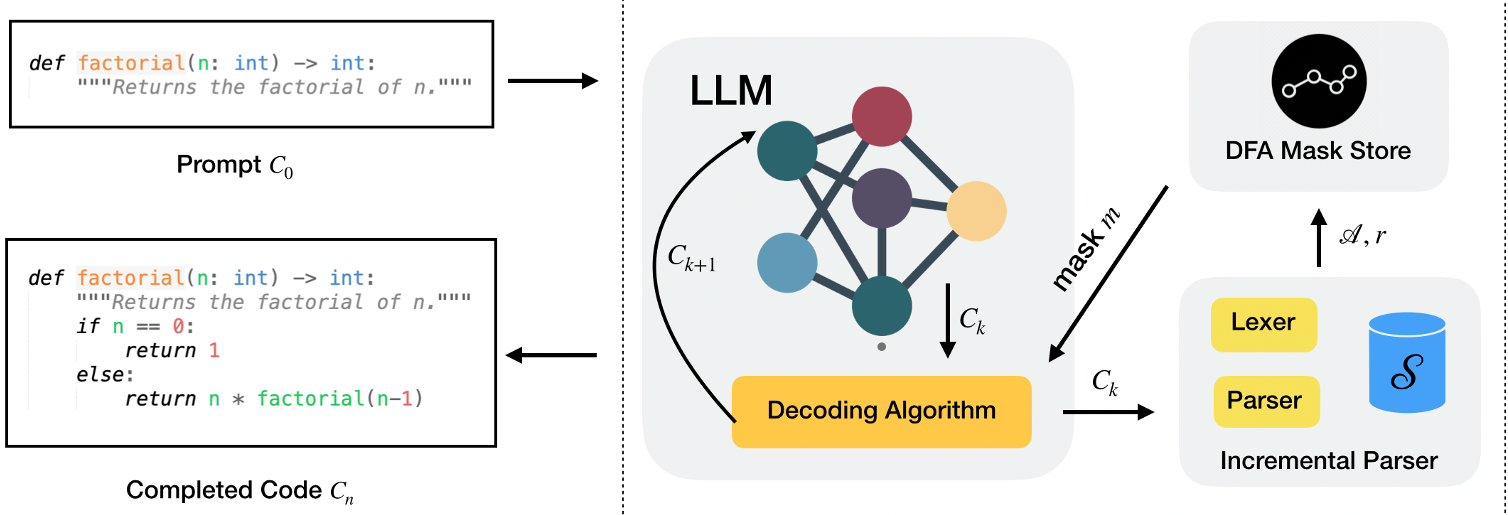 Figure 1: The SynCode loop: Parsing partial output to generate masks via the DFA store.
Experiments: Real-World Precision
The authors tested SynCode against heavyweights like llama.cpp and Outlines.
JSON Generation
On the JSON-Mode-Eval dataset, SynCode achieved zero syntax errors. In contrast, standard Llama-2-7B failed 98% of the time on original prompts without guidance.
Programming Languages (Python & Go)
In code completion tasks (HumanEval), SynCode reduced errors by 96.07%. Interestingly, the few remaining "errors" weren't syntax violations—they were cases where the model hit the max_token limit before finishing a valid block.
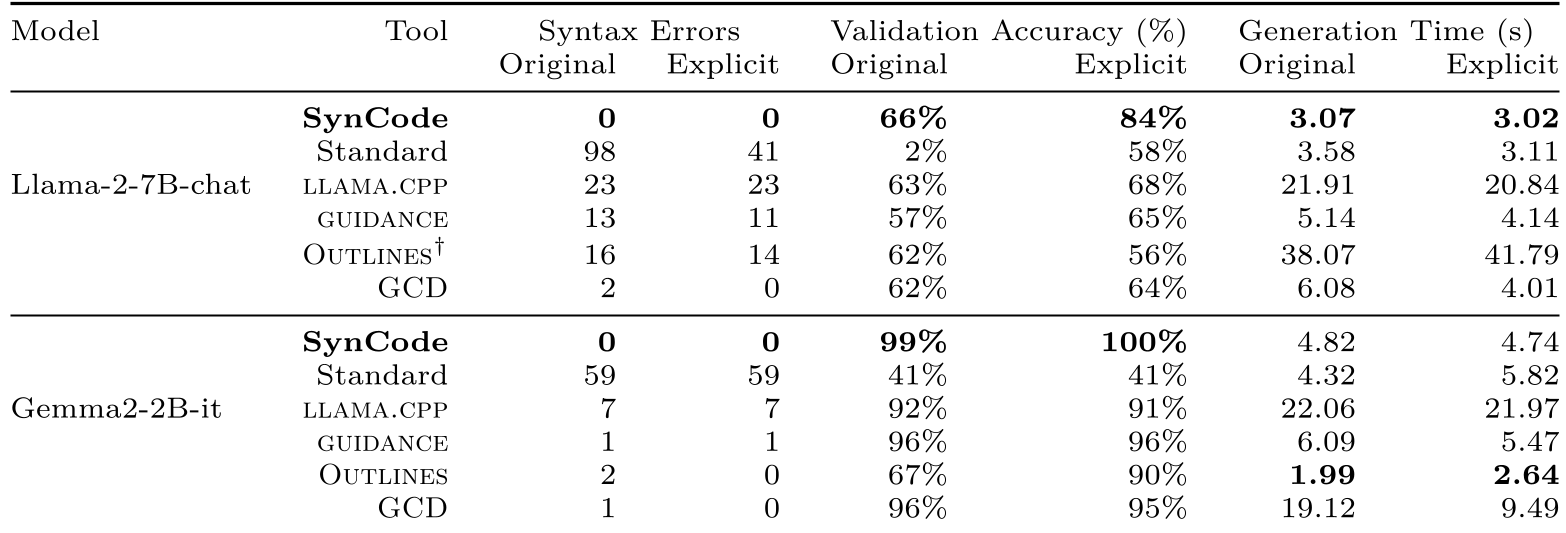 Table 1: SynCode consistently hits 100% syntactical accuracy compared to fluctuating baselines.
Why It Matters: Precision + Speed
The most impressive feat of SynCode is its efficiency. By using an incremental parser, it avoids the cost of re-parsing the whole string at every step. For a 300-token generation, SynCode is 9x faster than non-incremental approaches.
Critical Analysis & Conclusion
Soundness vs. Completeness: The paper proves SynCode is sound (it never discards a valid token) and complete under specific lookahead conditions. This is a significant step over "heuristic" masking used in earlier tools.
Limitations: Currently, SynCode focuses on Syntax (CFG), not Semantics. It will ensure your Python code has the right colons and indentations, but it won't stop the LLM from using an undefined variable.
Future Outlook: SynCode paves the way for "Reliable LLMs." By offloading the "rules" of language to formal parsers and leaving the "logic" to the LLM, we can build robust systems that won't break just because the model forgot a closing brace.
Summary Takeaway: If you are deploying LLMs for code or structured data, SynCode's DFA-masking strategy is the current gold standard for balancing rigorous guarantees with GPU-accelerated performance.