
Focus: Slime Mold-Inspired Context Management for LLM Agents
Active Context Compression: Autonomous Memory Management in LLM Agents
The paper introduces Focus, an agent-centric architecture for autonomous context management in LLM agents. By allowing agents to actively prune their interaction history and consolidate key insights into a "Knowledge" block using its start_focus and complete_focus tools, it achieves a 22.7% token reduction on SWE-bench Lite while maintaining 60% task accuracy.
TL;DR
The "Context Window" is no longer just a capacity limit; it is a cost and noise bottleneck. Focus is a new agent architecture that gives LLMs the "delete" button. By mimicking the biological retraction of slime molds, the Focus Agent autonomously summarizes its exploration and prunes its own history, reducing token usage by over 22% on SWE-bench without sacrificing a single point of accuracy.
The "Context Bloat" Crisis in Agentic AI
Modern LLM agents are typically "Append-Only" entities. In software engineering tasks, every ls command, every 500-line file read, and every failed test case is permanently etched into the model's short-term memory.
This leads to three critical failures:
- Quadratic Cost: You pay for the same stagnant history at every new step.
- Latency: The model becomes sluggish as the prompt size grows.
- Context Poisoning: The "Lost in the Middle" effect means the model forgets the original goal because it’s distracted by 50 steps of trial-and-error logs.
Focus moves us from Passive Retention (keeping everything) to Active Compression (keeping only what matters).
Methodology: The Slime Mold Intuition
The author draws a fascinating parallel to Physarum polycephalum (slime mold). When a slime mold explores, it expands; when it finds a dead end, it physically retracts its biomass but leaves a chemical trail to remember where it has been.
Focus translates this into a "Sawtooth" context pattern through two primitive tools:
start_focus: Sets a checkpoint before starting a sub-task (e.g., "Exploring the directory structure").complete_focus: The agent synthesizes its findings into a "Knowledge Block" at the top of the prompt and deletes everything between the checkpoint and the current state.
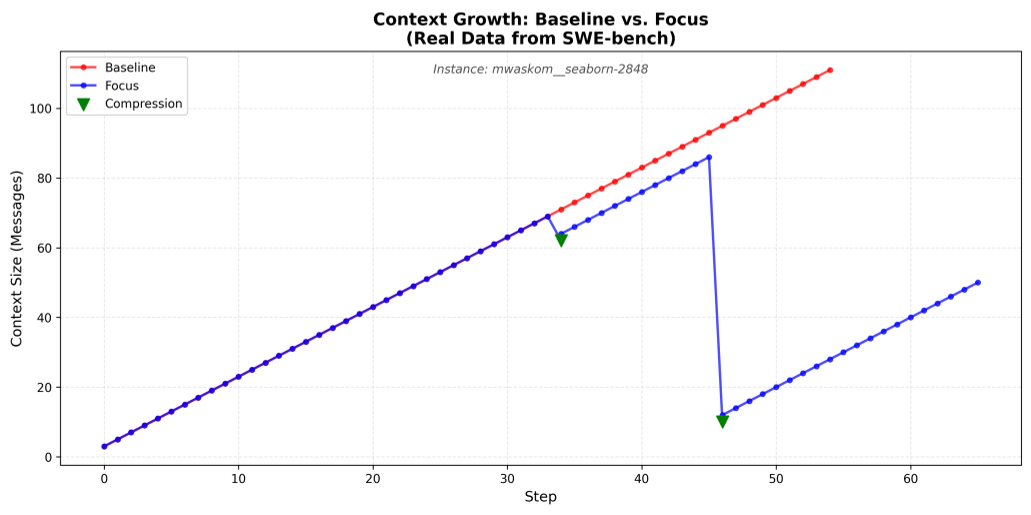 Fig 1: The Sawtooth Pattern - Context grows during exploration and collapses during consolidation.
Experiments: Maintaining Accuracy via Aggression
The study discovered a crucial nuance: Passive agents are lazy. When merely "offered" the compression tools, the models used them sparingly (6% savings).
To achieve real efficiency, the researchers implemented Aggressive Compression Prompting. By forcing a compression every 10-15 tool calls, the agent maintained a clean workspace. On the matplotlib-26020 instance, this reached a staggering 57% token reduction.
SOTA Comparison (Haiku 4.5 on SWE-bench Lite)
| Metric | Baseline | Focus (Ours) | Delta |
|---|---|---|---|
| Task Success | 60% | 60% | 0.0% |
| Total Tokens | 14.92M | 11.52M | -22.7% |
| Avg Messages Dropped | 0 | 70.2 | +70.2 |
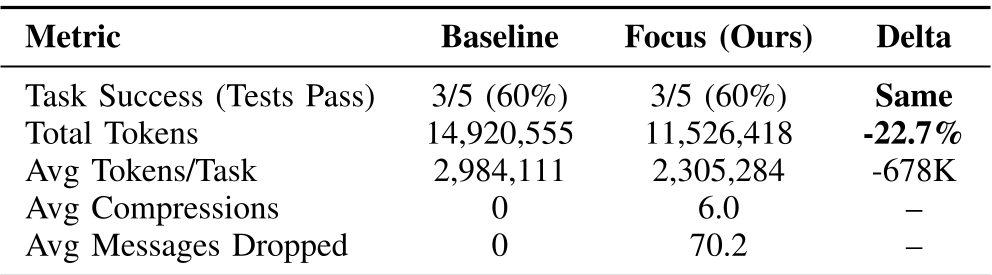 Table 1: Performance metrics showing efficiency gains without performance degradation.
Analysis: When Does It Fail?
Focus isn't a silver bullet. The "Cognitive Tax" of generating summaries is a real overhead. In the pylint-7080 case, token usage actually increased by 110%. This happened because the task required deep, iterative trial-and-error where the "intermediate" logs were actually vital for context. Pruning them forced the agent to "re-explore" what it had already seen.
Conclusion and Future Outlook
Focus proves that LLMs like Claude 4.5 are capable of autonomous memory management. The key takeaways for developers are:
- Architecture over Capacity: Large 200k windows are for reading, but active working context should be kept lean.
- Prompting is the Filter: Until models are fine-tuned for efficiency, we must build scaffolds that treat context management as a first-class citizen.
The future of cost-aware AI agents lies in "forgetting" the noise and remembering the map.
Disclaimer: This blog post is based on the paper "Active Context Compression: Autonomous Memory Management in LLM Agents" by Nikhil Verma (2026).