
Agentic World Modeling: From Passive Frames to Active Evolution
Agentic World Modeling: Foundations, Capabilities, Laws, and Beyond
The paper introduces "Agentic World Modeling," a comprehensive taxonomy and roadmap that unifies fragmented AI communities around the core challenge of modeling environment dynamics. It proposes a "levels × laws" framework (L1-L3 capabilities across physical, digital, social, and scientific regimes), synthesizing over 400 works into a coherent strategy for building agents that simulate and transform their environments.
In the quest for Artificial General Intelligence (AGI), the spotlight is shifting. We are moving from models that merely generate text or images to agents that act within complex environments. At the heart of this transition lies the World Model—an internal representation of reality that allows an agent to imagine "What happens if I do X?"
Despite its importance, the term "World Model" has become a linguistic chameleon, meaning different things to a roboticist, a video researcher, and an LLM developer. A landmark new survey, "Agentic World Modeling: Foundations, Capabilities, Laws, and Beyond," finally brings discipline to this chaos.
The Taxonomy: Levels and Laws
The paper’s most significant contribution is a two-axis coordinate system for World Models.
1. The Three Capability Levels (L1-L3)
Instead of categorizing by model size, the authors categorize by what the model can do:
- L1 - Predictor: High-fidelity, one-step "next frame" or "next token" prediction. (The Humean observer).
- L2 - Simulator: Long-horizon, action-conditioned "dreaming." Crucially, it must be decision-usable, meaning it respects the laws of the world enough for a planner to use its rollouts.
- L3 - Evolver: The frontier. A model that realizes it is wrong, designs an experiment to learn why, and updates its own code or parameters. (The Scientist).
2. The Four Governing-Law Regimes
A world model isn't just a generic neural network; it is a system constrained by specific "Laws":
- Physical: Gravity, collisions, and geometry.
- Digital: API calls, code logic, and GUI state machines.
- Social: Beliefs, negotiation, and "Theory of Mind."
- Scientific: Hidden causal mechanisms (e.g., protein folding).
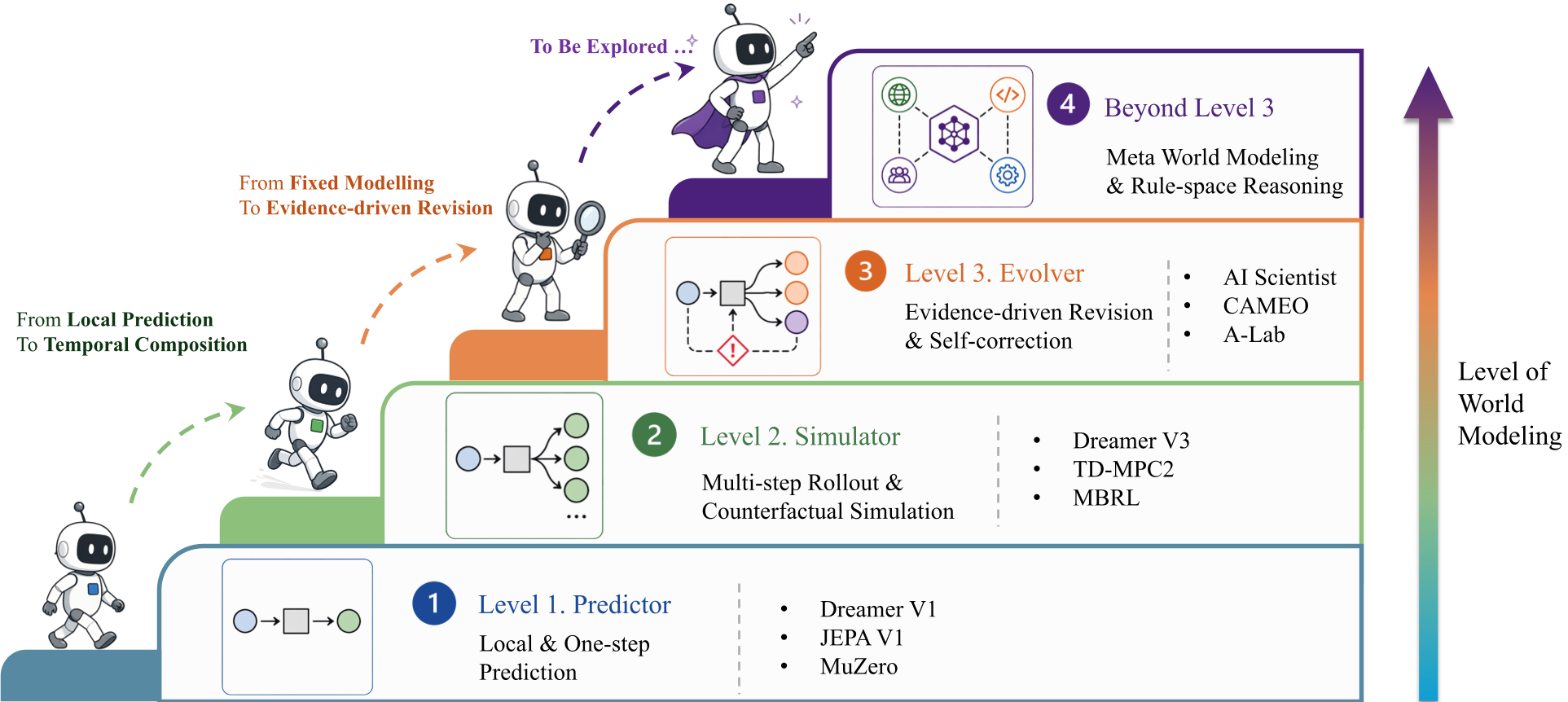 Figure: The progression from pattern recognition (L1) to temporal rollout (L2) to adaptive evolution (L3).
The Motivation: Why Visual Plausibility Isn't Enough
We’ve all seen the photorealistic videos from Sora or Lumiere. In the "L1" sense, they are masterpieces. But the authors argue that for an agent, a world model that looks real but allows a cup to pass through a solid table is a failure.
They identify a "Visual vs. Decision" gap. Current models might achieve high FVD (Fréchet Video Distance) scores while possessing zero "Intervention Sensitivity." If a model produces the same outcome regardless of whether the agent turns left or right, it is useless for planning.
The L2 Boundary Conditions
To graduate from L1 to L2, a model must pass three tests:
- Long-horizon Coherence: Can you "dream" 100 steps ahead without the world dissolving into soup?
- Intervention Sensitivity: Does the future change logically when the agent takes a different action?
- Constraint Consistency: Does the wood burn? Does the car stay on the road?
Methodology: The Unified POMDP Framework
The paper grounds all these concepts in the mathematics of Partially Observable Markov Decision Processes (POMDP). By viewing world modeling through this lens, the authors decompose the L1 world model into four distinct operators:
- State Inference: Compressing pixels into a latent "belief" ().
- Forward Dynamics: Predicting from and action .
- Observation Decoding: Turning back into pixels/text.
- Inverse Dynamics: Deducing what action was taken based on two states.
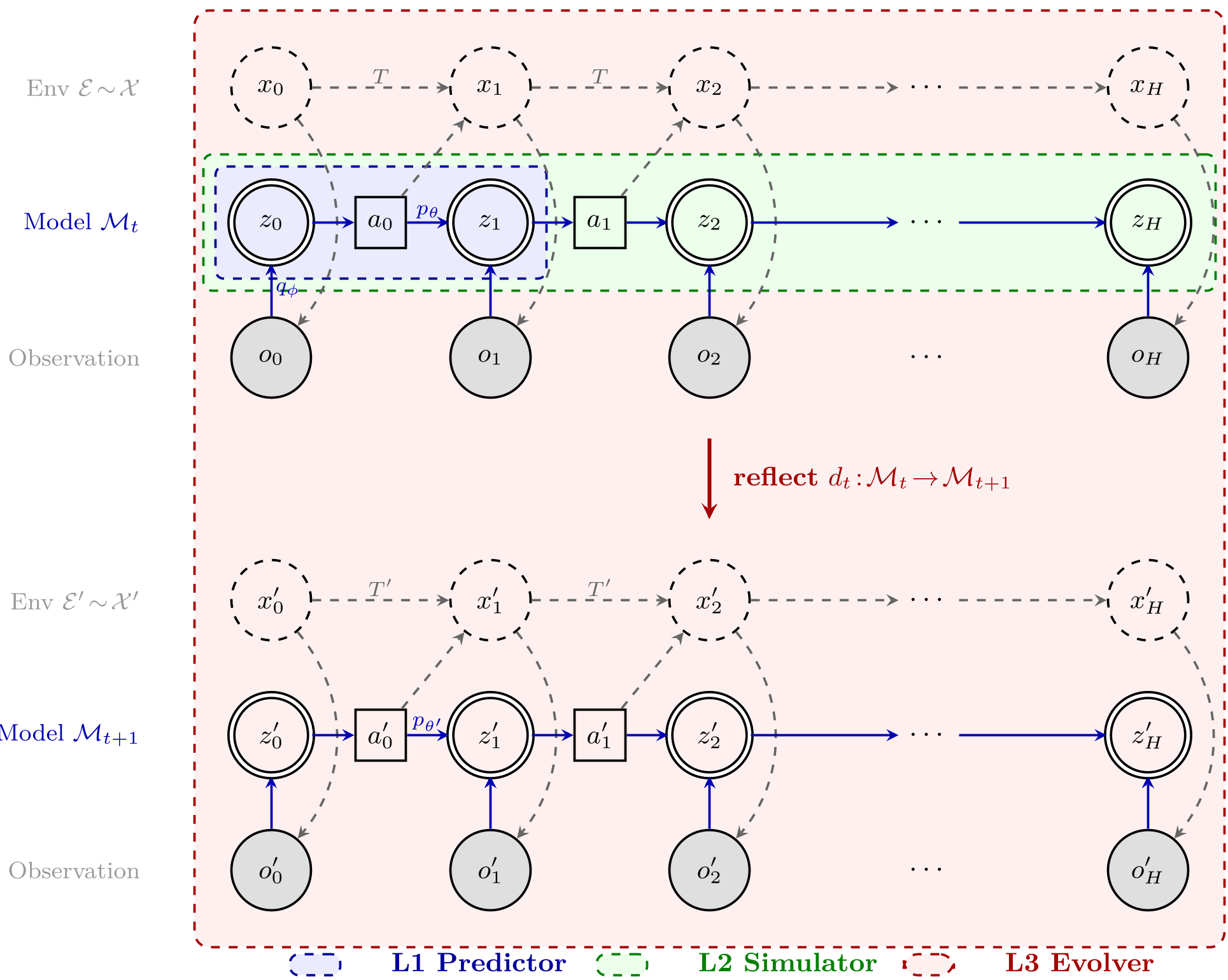 Figure: A unified POMDP graphical model. The red "Reflect" arrow represents the jump to L3 capability—revising the model itself based on evidence.
L3: The Final Frontier (The Evolver)
The most exciting part of this work is the formalization of Level 3: The Evolver. Most current world models are "frozen" after training. An L3 system is alive; it uses a Design-Execute-Observe-Reflect loop.
The survey highlights "Robot Scientist Adam" and "A-Lab" in scientific discovery as the most mature examples of L3. These systems don't just predict; they notice when their predictions fail to match a laboratory measurement and autonomously revise their metabolic or chemical models.
SOTA Comparison & Open Problems
The paper includes a brutal assessment of current SOTA:
- Physical World: Models look stunning but fail 70%+ of "physical law" probes (e.g., gravity, conservation of mass).
- Social World: LLM agents suffer from "Role Drift" and "Goal Forgetting" over multi-turn interactions.
- Digital World: Agents are easily broken by UI race conditions and non-deterministic API lags.
Strategic Roadmap
The authors outline a research agenda focused on "hard" constraint enforcement. Instead of just adding more data, they suggest Programmable Visual Representations (representing the world as code/SVG instead of just raw latents) and Harness Engineering (designing better execution environments for agents).
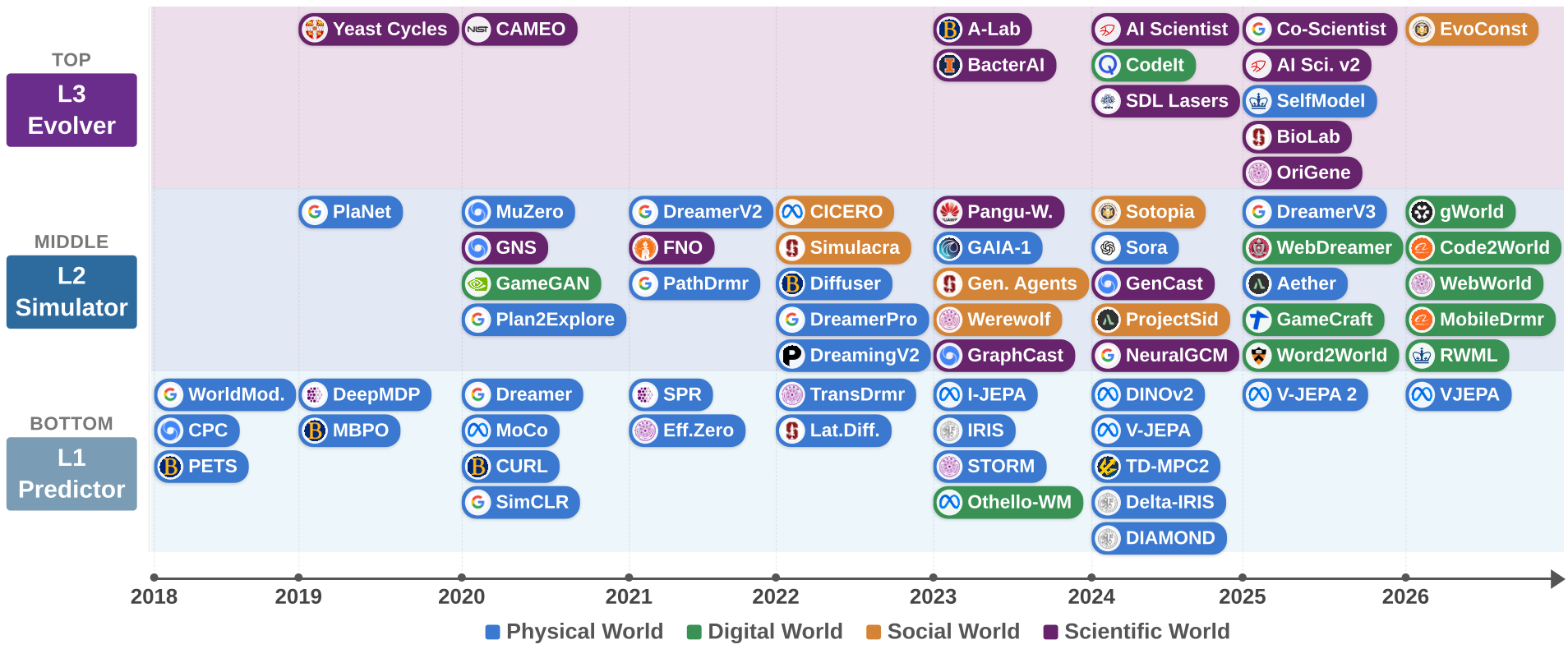 Figure: The timeline of world model evolution, showing the recent "Generative Revolution" pushing toward L3.
Conclusion: The Path Forward
The "Agentic World Modeling" paper is a manifesto for the next decade of AI. It argues that we must stop evaluating models as "media generators" and start evaluating them as "physics engines of the mind."
Key Takeaway: The winner of the AGI race won't just have the biggest transformer; they will have the most efficient "Evolver"—a world model that learns from its own failures in real-time, just like we do.
For the full taxonomy, list of representative systems, and the "MREP" evaluation package, visit the project website at: agentic-world-modeling.xyz