
AGILE: How RL and Human Advice Turn 13B Models into GPT-4 Killers
AGILE: A Novel Reinforcement Learning Framework of LLM Agents
This paper introduces AGILE (AGent that Interacts and Learns from Environments), a novel reinforcement learning framework for LLM agents. AGILE unifies memory, tool usage, reflection, and a proactive "seeking advice" mechanism within a token-level MDP, achieving SOTA performance in complex QA tasks like ProductQA, MedMCQA, and HotPotQA, often surpassing GPT-4.
TL;DR
Researchers from ByteDance and top universities have released AGILE, a framework that treats LLM agent actions—including memory access, tool usage, and human consultation—as a unified Reinforcement Learning (RL) problem. By fine-tuning Vicuna-13B using PPO, the agent learns not just how to answer, but when to ask for help. The results? A 13B model that beats GPT-4 on complex benchmarks like ProductQA and MedMCQA.
Background: The "Stochastic Parrot" and the Long-Tail Problem
Even the strongest LLMs suffer from two fatal flaws: they don't know what they don't know (hallucinations), and they struggle with "long-tail" domain-specific knowledge (e.g., specific Amazon product specs). While previous strategies like RAG or ReAct provide tools, they are often hard-coded or prompted, rather than optimized end-to-end.
AGILE's core insight is that seeking advice is a skill that should be part of the model's policy. If the cost of human intervention is lower than the penalty for a wrong answer, the model should learn to "hit the panic button" and consult an expert.
Methodology: The RL-Driven Agent Loop
AGILE transforms the LLM into a policy model within a Markov Decision Process (MDP). The system consists of four pillars: the LLM (Predictor), Memory (Knowledge Store), Tools (SQL/Search), and the Executor (The Controller).
The "SeekAdvice" & Reflection Cycle
When AGILE encounters a query it cannot resolve via its metadata or SQL tools, it triggers [SeekAdvice].
- Expert Consultation: A human provides the ground-truth answer.
- Reflection: The LLM analyzes the expert's answer to extract generalizable knowledge.
- Memory Update: This knowledge is stored, reducing the need for human help when similar questions appear.
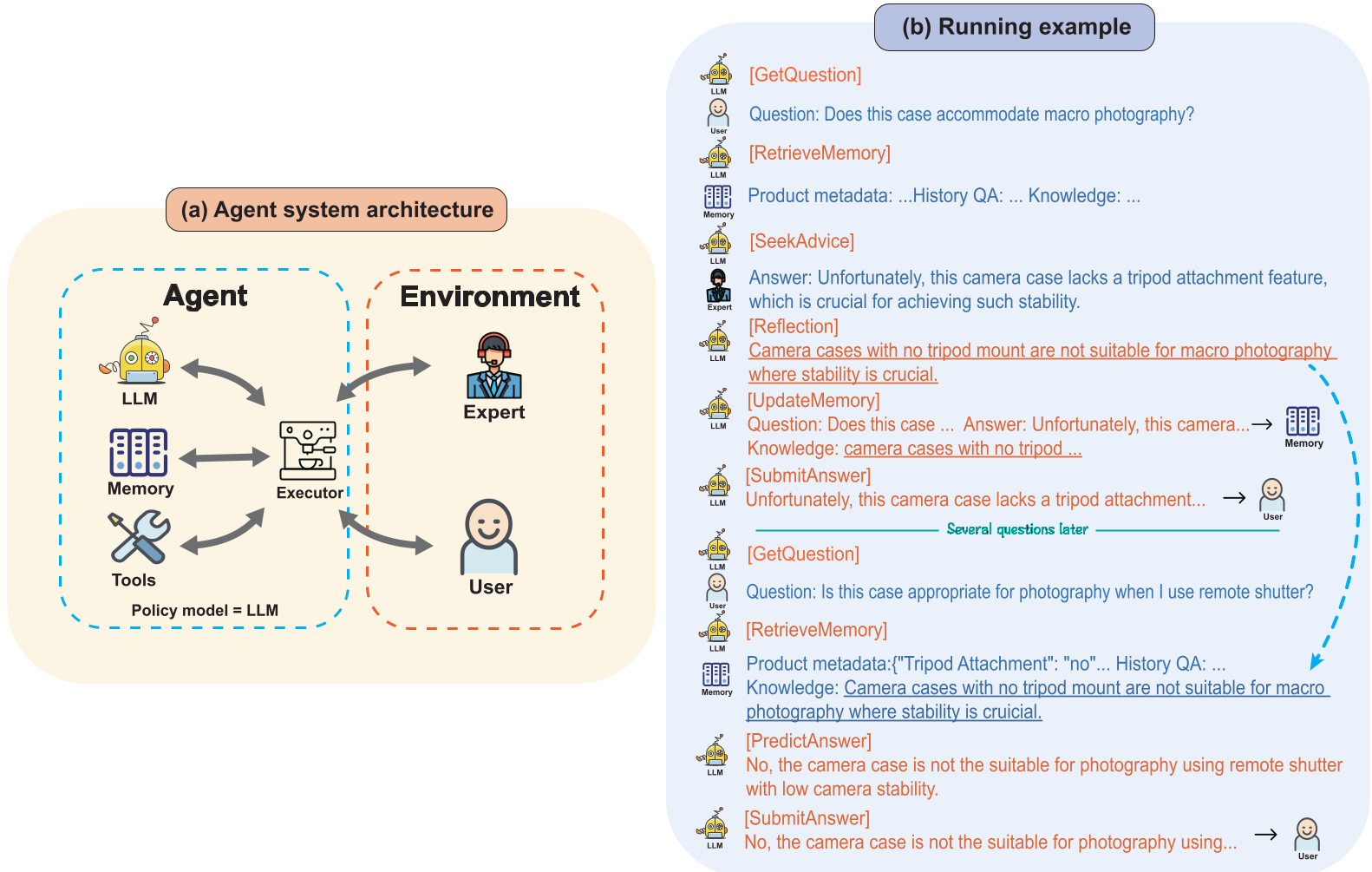 Figure 1: (a) Integrated architecture of AGILE. (b) A trace showing the model transitioning between Tool Usage, Predicted Reasoning, and Memory Retrieval.
The PPO Advantage
Unlike standard Supervised Fine-Tuning (SFT), AGILE uses Proximal Policy Optimization (PPO). This allows the model to optimize for a "Total Score" that balances accuracy against the "cost" of human advice. Throughout a trajectory, the model becomes more independent as its memory fills with "reflected" knowledge.
Experiments: Dominating the Benchmarks
The authors introduced ProductQA, a massive dataset of ~88k pairs involving real-world E-commerce logic.
| Method | Accuracy (Short) | Total Score |
|---|---|---|
| GPT-4 Prompt | 46.4% | - |
| Agile-GPT-4 | 78.0% | 0.718 |
| Agile-Vicuna-13B-PPO | 85.4% | 0.784 |
As shown in the table above, the RL-trained AGILE agent significantly outperformed the prompting-based GPT-4 agent.
Key Visual: The Learning Curve
A critical finding was the Trend of Advice Rate. As the agent interacts more with the environment, the frequency of [SeekAdvice] calls drops while accuracy remains high. This proves the agent "learns" from the human expert and populates its internal memory successfully.
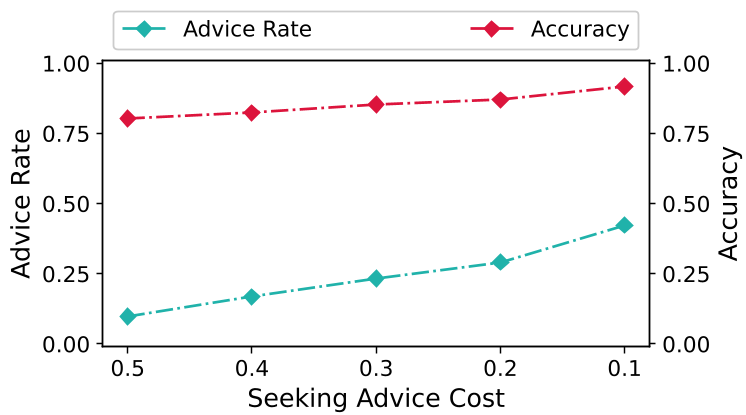 Figure 2: The model progressively relies less on human advice (orange line) as it accumulates experience, while maintaining superior accuracy.
Critical Insights: Why It Works
The ablation study (Table 5 in the paper) reveals that every part of the engine is fuel-injected:
- Without Memory: Advice rates skyrocket because the model can't remember past lessons.
- Without Tool-Use: The model becomes "blind," forced to ask humans for basic facts.
- Without RL: The model is "overconfident"—it doesn't select the
[SeekAdvice]option at the right time, leading to lower total scores.
Conclusion & Future Outlook
AGILE proves that LLM intelligence is not just about parameter count, but about the system architecture. By integrating a "System 2" thinking process (Tools, Memory, Reflection) and optimizing it with Reinforcement Learning, smaller models can function as highly reliable, autonomous experts.
However, the framework currently relies on a human expert in the loop for the "Advice" phase. The next frontier will likely involve using a larger "Teacher Model" (like GPT-4o) as the expert to train smaller "Student Agents" (7B models) in a fully automated iterative loop.