
Perspective: AI for Scientific Discovery is a Social Problem, Not Just an Algorithmic One
AI for Scientific Discovery is a Social Problem
PerspectiveAI for scientific discovery is a social problem argues that the primary obstacles to AI-driven science are social and institutional rather than purely technical. It highlights that while AI tools like AlphaFold have achieved SOTA results, true progress requires democratizing access via community coordination, shared benchmarks, and standardized data practices.
TL;DR
While the tech world obsesses over the next "AI Scientist" that can supposedly replace human researchers, a critical new paper from Hugging Face and Oxford researchers argues that we are looking at the wrong problem. The bottleneck for AI in science isn't just model architecture—it’s community dysfunction, data fragmentation, and infrastructure inequity. To truly revolutionize discovery, we must treat AI as a collective social project rather than a race for autonomous agents.
The Mirage of the "Autonomous AI Scientist"
Current industry narratives from giants like OpenAI and DeepMind promise "legitimate AI researchers" by 2028. However, the authors point out a dangerous fallacy: these systems excel at literature synthesis (summarizing what we already know) but fail at mechanistic investigation (discovering why things happen).
The "Lone Genius" myth is being reborn in silicon. By praising the algorithm, we erase the essential human labor—the data curation, the experimental validation, and the domain expertise—that makes the AI work in the first place.
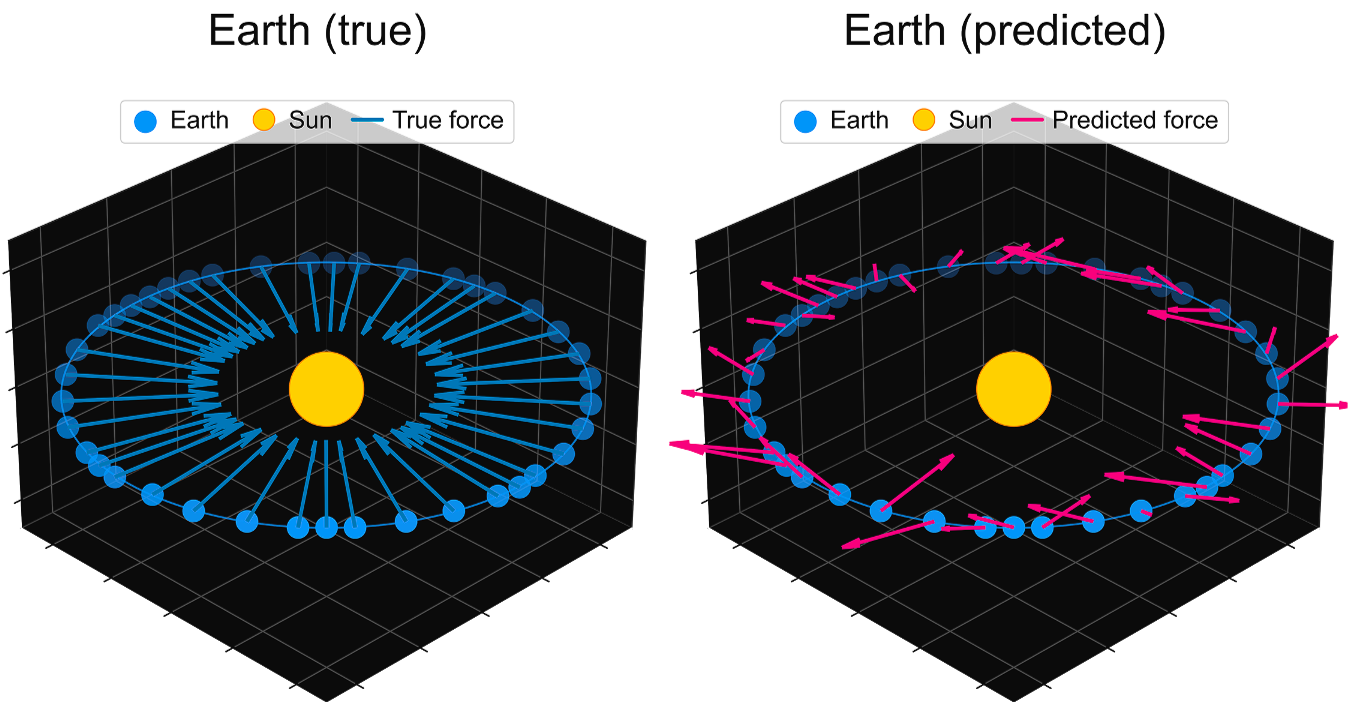 Figure 1: A Transformer can predict planetary orbits with high accuracy (right) without ever "learning" the actual laws of Newtonian physics (left). High accuracy does not equal scientific understanding.
The Four Barriers to Democratized Discovery
The paper identifies four systemic "walls" preventing the global scientific community from reaping AI's rewards:
- Community Dysfunction: A massive "terminology gap" exists. ML researchers chase SOTA accuracy on benchmarks, while domain scientists need causal explanations they can use to design real-world experiments.
- Misaligned Research Priorities: Funding favors flashy, narrow applications (like a specific drug) rather than the "upstream" computational bottlenecks (like faster PDE solvers) that would help everyone.
- Data Fragmentation: We are drowning in data but starving for standardized data. Data scientists spend 45% of their time cleaning "dirty" scientific data that lacks interoperability.
- Infrastructure Inequity: There is a staggering "compute divide." While a researcher in a G7 country can iterate in 30 minutes, a researcher in Africa might wait 6 days for the same result.
Methodology: Reframing the Solution
The authors argue that we cannot "code" our way out of these social problems. Instead, they propose a structural overhaul:
1. Structuring "Upstream" Challenges
Instead of fragmented efforts, the community should rally around "Grand Challenges." They cite CASP (Critical Assessment of Protein Structure Prediction) as the gold standard. CASP spent 20+ years defining the problem of protein folding; without that social infrastructure, AlphaFold would have had nothing to solve.
| Challenge | Impacted Domains | Current Limitation |
|---|---|---|
| PDE Neural Operators | Weather, Climate, Aerodynamics | Fails to generalize to turbulent flows |
| Rare Event Sampling | Protein Folding, Extreme Weather | Standard models miss the "tails" |
| Quantum Many-Body | Superconductors, Catalysts | Exponential scaling (Fermion sign problem) |
2. Bridging the Tokenization Gap
Scientific data doesn't look like text. Current Transformer architectures struggle with the complex spatial and multimodal relationships in multi-omics or climate data. We need architectures with better Inductive Biases—like Graph Neural Networks (GNNs) or State-Space Models (Mamba)—that actually "respect" the structure of the physical world.
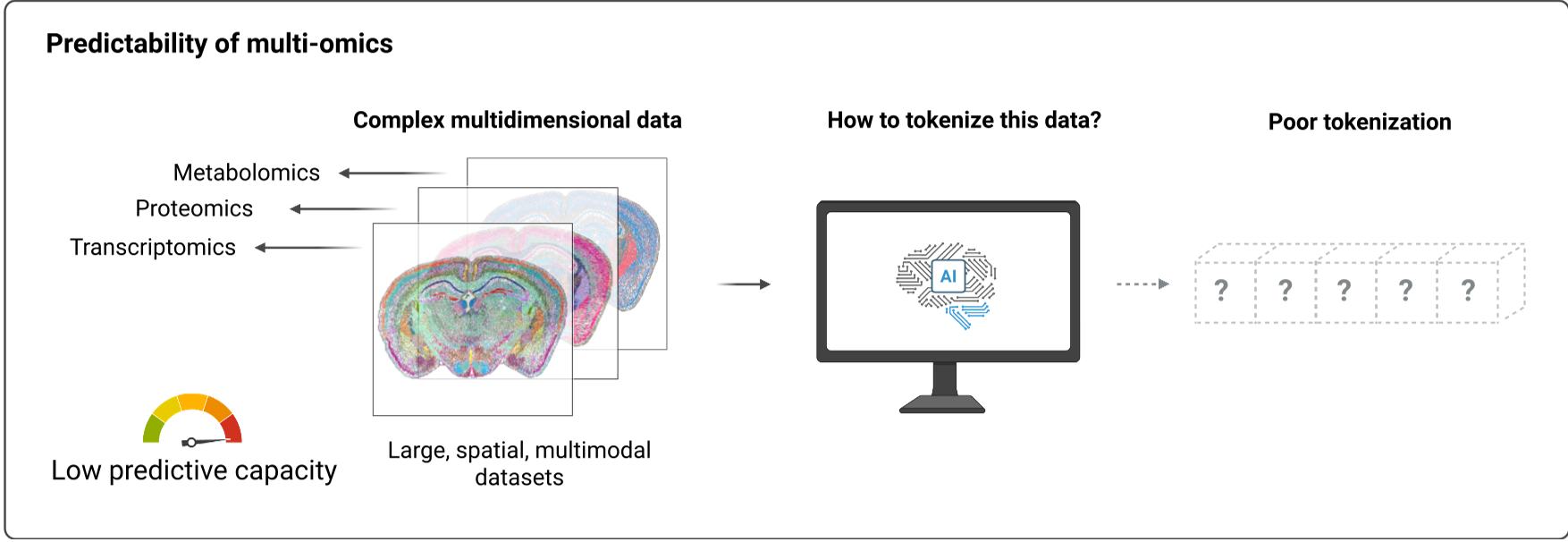 Figure 2: The difficulty of translating complex multi-omics data into the "tokens" that current AI models understand.
Deep Insight: The Value of Data Stewardship
The authors make a provocative point: The half-life of a model is months; the half-life of a high-quality dataset is decades.
Yet, academic incentives (hiring, tenure, citations) reward the person who builds the 101st slightly better model, not the person who spends six months curating a foundational dataset. We must pivot toward rewarding the "bridge-builders"—the researchers who create the tools and data that enable everyone else’s breakthroughs.
Conclusion: A Call for Community Ownership
The transformation of science via AI depends less on the next billion-parameter model and more on our collective ability to build inclusive, sustainable systems. We need:
- Open-source pipelines (not just code dumps).
- Federated infrastructure like the Open Science Grid.
- Interdisciplinary training that teaches ML to scientists and physical constraints to ML engineers.
Without these social changes, AI risks making science less transparent and more unequal. Success isn't just a prediction; it's a shared understanding.