
SCRN: Defending AI-Generated Text Detection Against Adversarial Attacks
Are AI-Generated Text Detectors Robust to Adversarial Perturbations?
The paper introduces the Siamese Calibrated Reconstruction Network (SCRN), a novel AI-generated text (AIGT) detector designed to resist adversarial perturbations. By combining a denoising reconstruction network with a unique siamese calibration training strategy, SCRN achieves SOTA performance across multiple benchmarks.
TL;DR
As Large Language Models (LLMs) proliferate, distinguishing AI-generated text (AIGT) from human content has become a security imperative. However, current detectors are remarkably fragile—easily fooled by tiny tweaks like abbreviations or typos. This paper introduces the Siamese Calibrated Reconstruction Network (SCRN), which uses a denoising architecture and a "consistency-enforcing" loss to achieve a massive 18.25% boost in robustness over existing SOTA methods.
The Fragility of Current Detectors
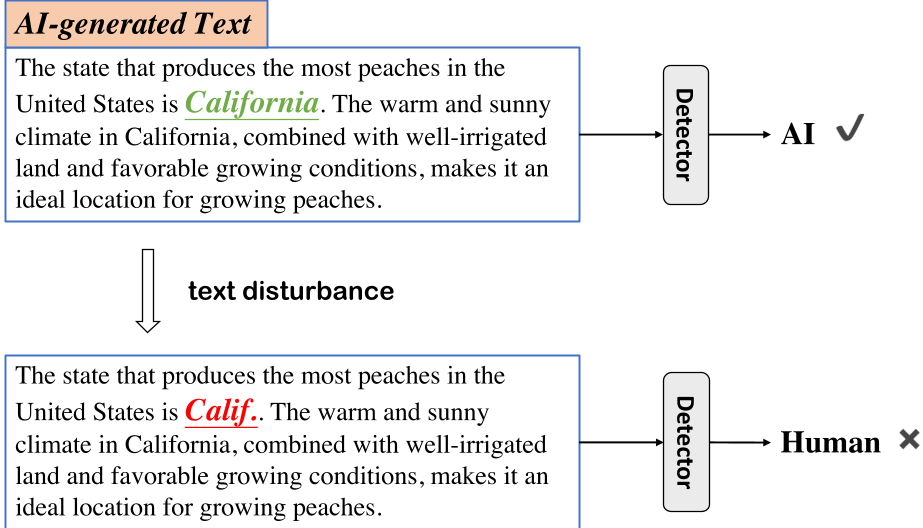
Most AI detectors look for statistical "watermarks" or specific token patterns inherent in LLM outputs. The problem? These patterns are easily obscured. An attacker can swap a few characters or replace a word with a synonym (adversarial perturbations), causing a RoBERTa-based detector to flip its prediction from "AI" to "Human."
As shown in the paper's opening example, shortening "California" to "Calif." is enough to evade detection. This proves that current systems lack semantic depth—they are obsessed with tokens rather than meaning.
Methodology: The SCRN Framework
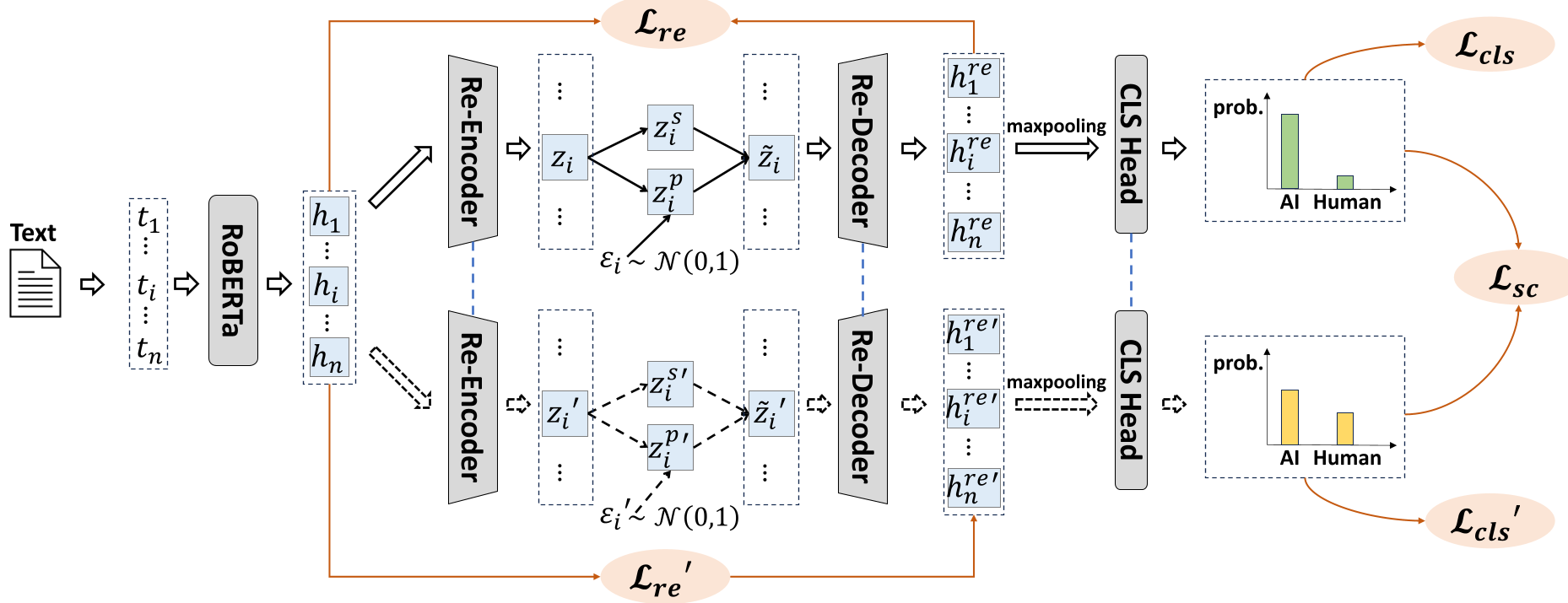
The researchers proposed a two-pronged defense strategy: Representation Reconstruction and Siamese Calibration.
1. The Reconstruction Network
The SCRN doesn't just process the raw output of an encoder (like RoBERTa). Instead:
- It maps encoded tokens into a latent space.
- It splits these into a semantic term and a perturbation term.
- It injects random Gaussian noise and then tasks a "Re-Decoder" to reconstruct the original clean representation.
This process acts as a denoising auto-encoder, training the model to "see through" the noise to the core semantic signal.
2. Siamese Calibration: The Secret Sauce
The authors discovered that just adding noise wasn't enough; the model needed to be forced into consistency. During training, the Siamese Calibration strategy processes the same input through two independent branches with different random noises.
By minimizing the symmetric Kullback–Leibler (KL) divergence between these two branches, the model is penalized if it gives a high-confidence "AI" prediction for one set of noise but a low-confidence or different prediction for another. This rigorous constraint ensures the model relies on stable, high-level contextual features.
Experimental Battleground: SOTA Results
The SCRN was tested across four challenging scenarios:
- In-domain: HC3 dataset.
- Cross-domain: Training on HC3, testing on TruthfulQA.
- Cross-genre: Training on QA, testing on news/essays (Ghostbuster).
- Mixed-source: Texts from GPT-2, LLaMA, GPT-J, etc.
Key Findings:
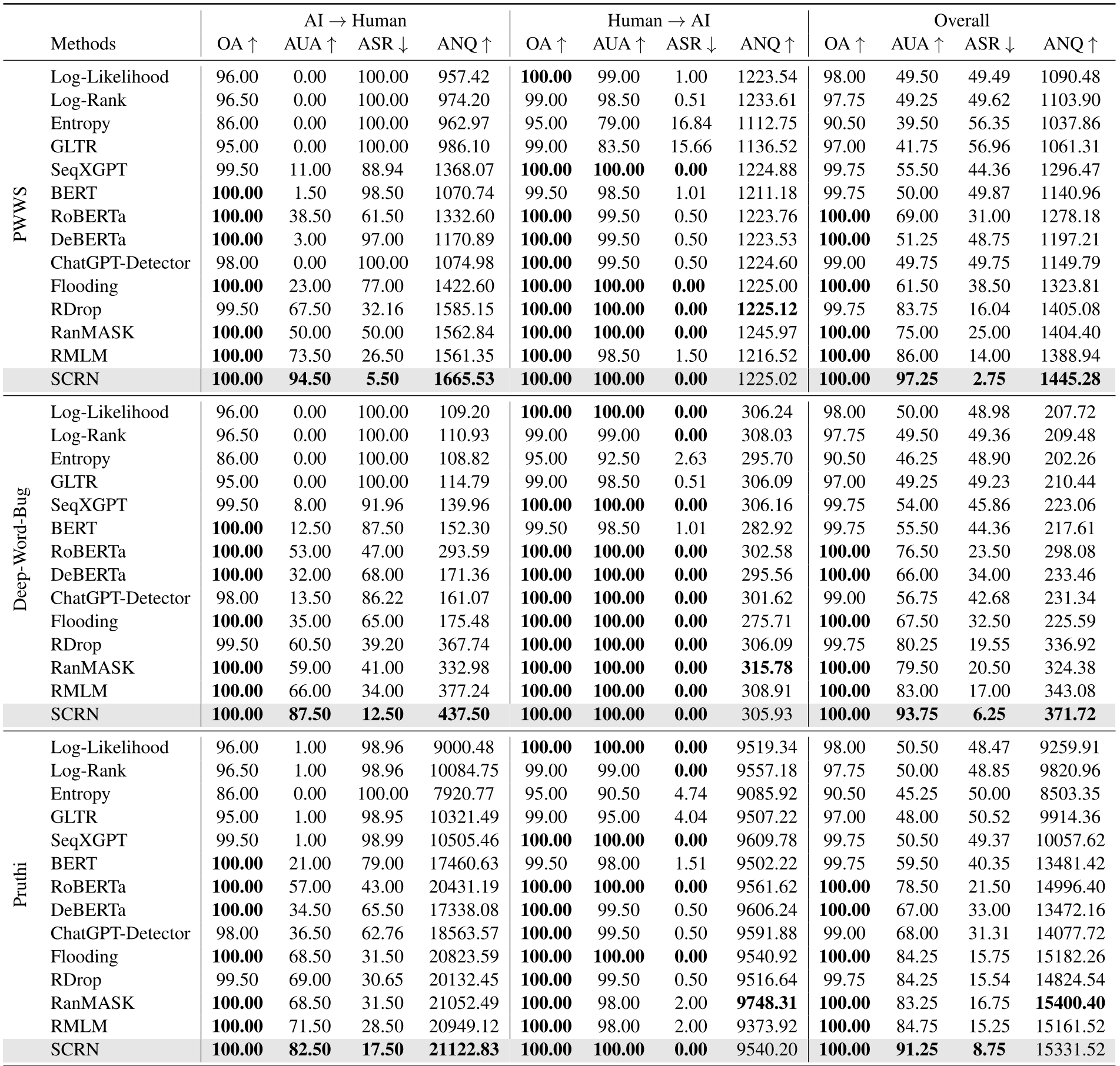
- Massive Robustness Gains: In cross-domain tasks, SCRN improved Accuracy Under Attack (AUA) by 18.25% compared to the strongest baseline.
- Evasion Defense: In cross-genre settings, SCRN achieved 71% AUA against evasion attacks (AI Human), where traditional models plummeted to near zero.
- Efficiency: Despite the complex training, the inference speed is 28.5x faster than RanMASK and remains at 92.7% the speed of a standard RoBERTa model.
Ablation Insights: Why it Works
The ablation study (Table 10) confirmed that Siamese Calibration (-SC) is the most critical module. Removing it caused Accuracy Under Attack to drop by nearly 50% in some scenarios. Interestingly, while "Adversarial Training" (RMLM) works well for in-domain data, it fails in cross-domain settings because it overfits to specific attack patterns. SCRN’s denoising approach generalizes far better.
Future Outlook and Limitations
While SCRN is a landmark in robust detection, the authors acknowledge limitations:
- Paraphrasing: It does not yet account for full-text paraphrasing, which the authors view as a different class of transformation.
- Multilingual Support: The current training focused on English.
In a world where LLMs are increasingly used to generate misinformation, SCRN provides a vital defensive layer, shifting the "cat-and-mouse" game of AIGT detection toward a more semantically aware and resilient future.