
Attention Is All You Need: The Architect of Modern AI
Attention Is All You Need
This seminal paper introduces the Transformer, a novel sequence transduction architecture that abandons recurrence and convolution in favor of a pure Self-Attention mechanism. It achieves SOTA performance on WMT 2014 English-to-German (28.4 BLEU) and English-to-French (41.0 BLEU) tasks.
TL;DR
The Transformer architecture revolutionized NLP by replacing recurrent neural networks (RNNs) with a mechanism called Self-Attention. It solves the bottleneck of sequential computation, allows for extreme parallelization during training, and sets new benchmarks in translation quality with significantly lower computational costs.
Background: The End of the Recurrent Era
For years, the sequence modeling landscape was dominated by LSTMs and GRUs. While effective, these models possess an inherent flaw: Sequentiality. To compute the state of the 100th word, you must first compute the previous 99. This makes training on large datasets painfully slow.
Furthermore, RNNs struggle with "long-term dependencies"—remembering a word from the beginning of a long paragraph to understand a word at the end. The Transformer's motivation was simple yet bold: Can we achieve superior sequence modeling using only attention, without any recurrent loops?
Methodology: The Core Engine
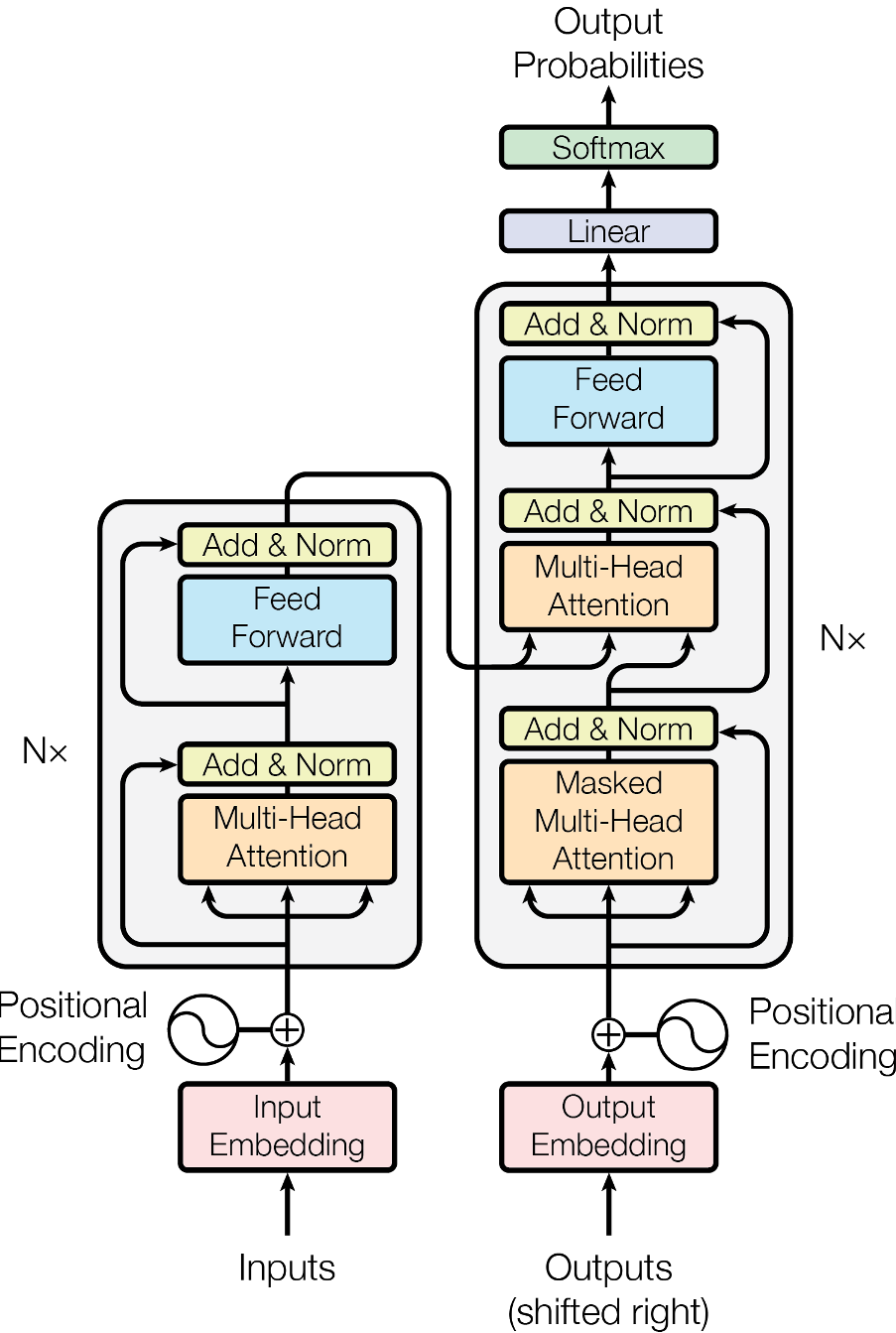
The Transformer utilizes an Encoder-Decoder structure, but its "secret sauce" lies in three specific components:
1. Scaled Dot-Product Attention
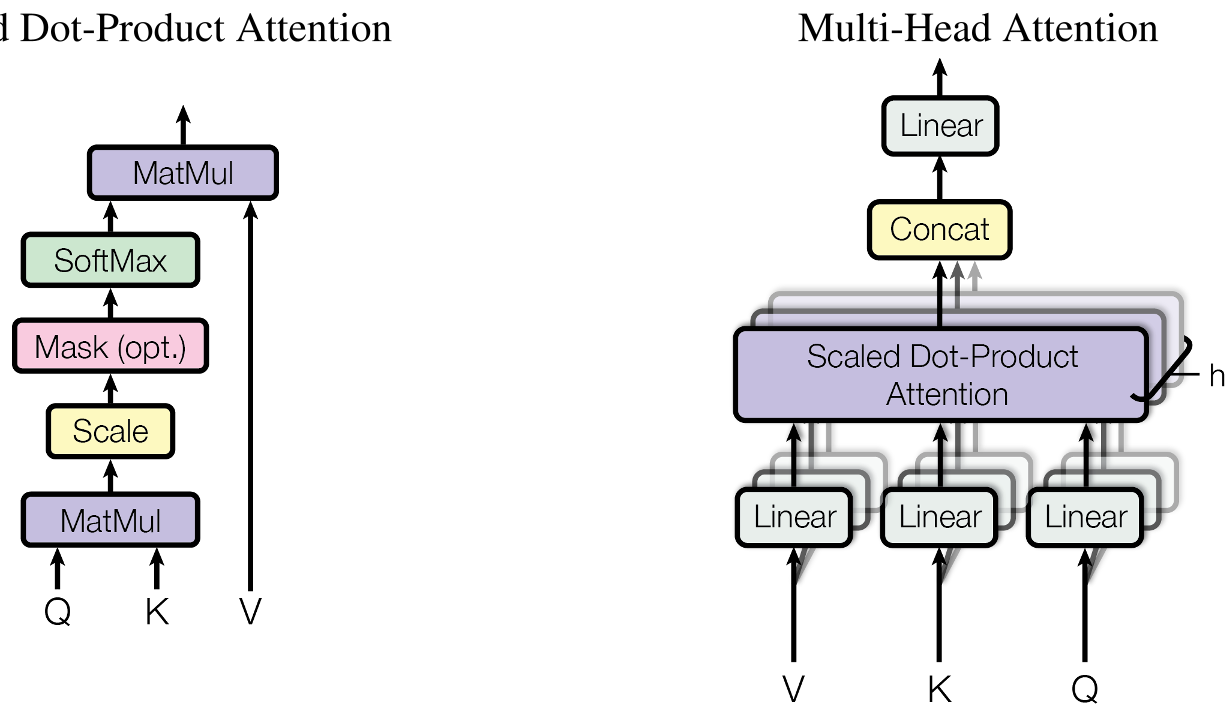
Instead of iterating through words, the model calculates the relationship between all words in a sequence simultaneously using Query (), Key (), and Value () vectors. The scaling factor is critical; it prevents the dot product from growing too large, which would otherwise push the softmax into regions with extremely small gradients.
2. Multi-Head Attention
Rather than performing one single attention function, the authors project into multiple smaller "heads." This allows the model to attend to information from different representation subspaces concurrently—for example, one head might focus on syntax while another focuses on semantic meaning.
3. Positional Encoding
Since the model has no recurrence, it doesn't "know" the order of words. The authors solve this by adding sinusoidal Positional Encodings to the input embeddings. This injects information about the relative or absolute position of tokens without requiring sequential processing.
Experimental Results: Efficiency Meets Power
The results were indisputable. The Transformer didn't just beat existing models; it crushed them in terms of efficiency.
| Model | EN-DE (BLEU) | Training Cost (FLOPs) |
|---|---|---|
| GNMT + RL | 24.6 | |
| ConvS2S | 25.16 | |
| Transformer (big) | 28.4 |
The Transformer (big) achieved a BLEU score of 28.4 on the WMT 14 En-De task, a gain of over 2.0 BLEU points over previous SOTA ensembles, while being significantly faster to train than convolutional or recurrent alternatives.
Critical Insight: Why Does It Work?
The genius of the Transformer is the reduction of the Maximum Path Length to . In an RNN, signals travel through steps to connect two distant words. In a Transformer, every word "sees" every other word in a single operation. This dramatically simplifies the learning of long-range dependencies.
Conclusion & Future Impact
"Attention Is All You Need" is more than a paper about translation; it is the blueprint for the current AI explosion. By proving that attention alone is sufficient for high-quality sequence transduction, the authors paved the way for BERT, GPT, and the entire ecosystem of Large Language Models.
Takeaway: If you want to handle long-range dependencies and maximize hardware utilization, move away from sequential inductive biases and embrace global, parallel attention.
Main Limitation: The complexity relative to sequence length means that while it is parallelizable, it becomes computationally expensive for extremely long documents (e.g., entire books).*