
[SCET 2026] Resumming the C-Parameter Shoulder: Beyond the "Mercedes" Symmetry
Resummation of the C-Parameter Sudakov Shoulder Using Effective Field Theory
This paper presents the first Soft-Collinear Effective Theory (SCET) based resummation of the C-parameter distribution near its kinematic "Sudakov shoulder" at C = 3/4. The authors derive a novel factorization theorem and achieve NLL+NLO accuracy, eliminating unphysical fixed-order singularities.
TL;DR
In a landmark study for precision QCD, researchers have finally applied Soft-Collinear Effective Theory (SCET) to the C-parameter Sudakov shoulder. By computing new, measurement-specific jet and soft functions, they’ve replaced the unphysical "spikes" of fixed-order theory with a smooth, resummed distribution at NLL+NLO accuracy. Crucially, the work reveals why the C-parameter is technically "friendlier" than thrust or heavy jet mass—it lacks the dreaded Sudakov-Landau pole.
The Problem: When 3 Partons Aren't Enough
In annihilation, the C-parameter is an "event shape" that describes the geometry of particle flow. At leading order (LO), it has a hard limit at C = 3/4. This point corresponds to a perfectly symmetric "Mercedes-Benz" logo configuration of three partons.
If you want to go beyond C = 3/4, you need a fourth parton. This transition creates a Sudakov shoulder: a kinematic boundary where the probability distribution suddenly sees a step-discontinuity at tree level and logarithmic divergences () at Next-to-Leading Order (NLO). These "spikes" are artifacts of perturbation theory—nature is smooth, and this paper provides the mathematical "sanding" to make the theory match reality.
Methodology: The Quadratic Insight
The core challenge of the C-parameter is its mathematical definition. Unlike Thrust, which is linear in phase-space deviations, the C-parameter is quadratic.
1. The Factorization Theorem
The authors matched QCD onto SCET to produce a factorization formula:
Where:
- (Hard Function): The initial trijet production.
- (Jet Functions): Collinear radiation within the three jets.
- (Soft Function): Soft gluons bouncing between the jets.
2. New Measurement Operators
This paper introduces a new C-shoulder soft function. Unlike standard soft functions that look at linear projections, the C-parameter soft operator measures: This quadratic dependence on transverse momentum is what explains the "step" to "spike" transition.
 Fig 1: The canonical scale hierarchy: . Resummation is achieved by evolving these functions from their natural scales to a common renormalization scale.
Experiments & Results: Smoothing the Spike
The authors validated their SCET predictions against EVENT2 Monte Carlo simulations.
- Agreement: The singular coefficients derived ( for the total cusp factor) perfectly matched the numerical extractions.
- Matching: By using profile scales, they blended the resummed prediction (which works near the shoulder) with fixed-order NLO (which works in the "tail").
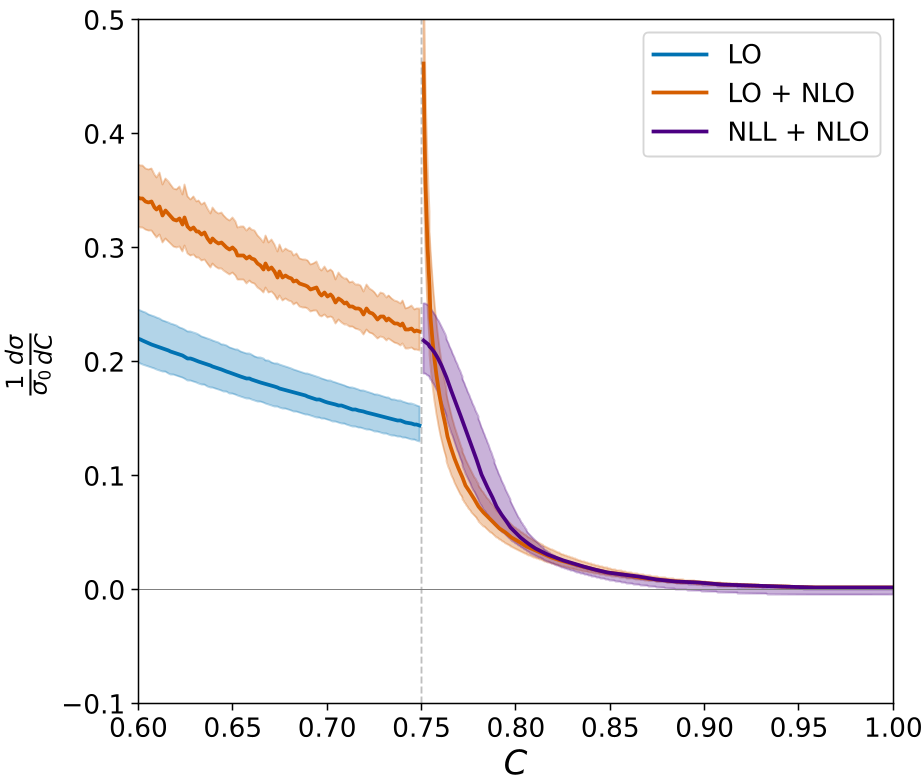 Fig 2: Comparison of LO (blue), NLO (orange), and the matched NLL+NLO (purple). Notice how the orange "spike" at C=3/4 is replaced by a smooth purple curve that continuously joins the LO value.
Critical Insight: Why the C-Parameter is Special
The authors highlight a significant theoretical advantage: Additivity. Because the C-parameter shift is simply the sum of contributions from each jet and the soft sector, it avoids the "Sudakov-Landau pole" that plagues the Heavy Jet Mass. In Heavy Jet Mass, the observable involves a max/min selection that creates non-linearities in the denominator during resummation. The C-parameter's global, additive nature makes it a "cleaner" observable for future high-precision studies.
Conclusion & Future Outlook
This work completes the NLL resummation program for the C-parameter shoulder. While LEP data in this region is sparse, the paper looks toward the FCC-ee (Future Circular Collider) and CEPC. With the massive luminosity boost of these next-gen machines, the shoulder region will become a prime territory for testing the "running" of the strong coupling constant with unprecedented accuracy.
Key Takeaways:
- Successfully derived measurement-specific SCET functions for C-parameter.
- Confirmed the cancellation of "geometry logs" () between jet and soft sectors.
- Paved the way for NNLL accuracy by providing all one-loop matching constants.