
Combination of Research Questions and Methods: A New Measurement of Scientific Novelty
Combination of research questions and methods: A new measurement of scientific novelty
The paper proposes a novel framework to measure scientific novelty by focusing on the combinations of Research Questions (Q) and Research Methods (M). It introduces two distinct metrics—Life-index novelty and Semantic novelty (using BERT embeddings)—to evaluate over 200,000 publications from the ACM Digital Library, achieving a comprehensive quantification of "newness" in scientific content.
TL;DR
Quantifying "innovation" has long been the "Holy Grail" of scientometrics. This paper moves beyond simple citation counting by introducing a dual-metric approach—Life-index and BERT-based Semantic Novelty—to analyze how researchers combine specific questions and methods. By analyzing decades of ACM data, the authors demonstrate that the most impactful research is often a "recombination" of elements, and semantic analysis is the key to distinguishing true breakthroughs from incremental updates.
Problem & Motivation: Beyond the Citation Myth
Why do we need a new way to measure novelty? For decades, the community used citations as a proxy for quality. However, high citations often reflect "popularity" or "controversiality" rather than genuine novelty. Previous content-based attempts focused on keyword co-occurrence but suffered from two major flaws:
- Temporal Blindness: They didn't account for how long a term has existed in the field.
- Semantic Surface-Leveling: They couldn't tell that "Neural Networks" and "Deep Learning" might be evolutionarily related, treating them as entirely distinct or identical without nuance.
The authors' intuition is that scientific novelty essentially boils down to the relationship between the What (Research Question) and the How (Methodology).
Methodology: The Core of the Measurement
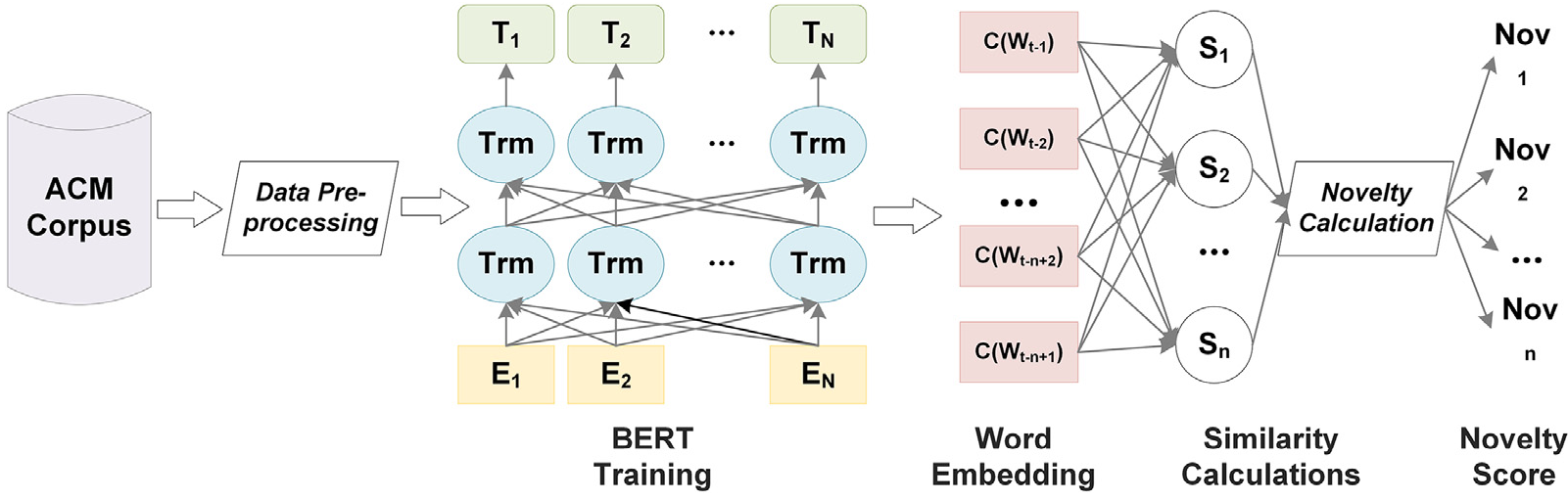
The researchers developed a pipeline that first identifies the "functional role" of terms in a paper (Question vs. Method) and then applies two mathematical lenses to evaluate them.
1. Life-index Novelty (The Temporal Lens)
This calculates a score based on the Potential Development Year (PDY). If a term is brand new this year, its novelty is 1. If it has appeared frequently over many years, its novelty approaches 0.
2. Semantic Novelty (The AI Lens)
Using BERT (Bidirectional Encoder Representations from Transformers), the system maps terms into a high-dimensional vector space.
- Logic: If a paper uses a method that has never been applied to a specific question before, the system calculates the cosine similarity between this method and all methods previously used for that question. A low similarity score indicates a "leap" in thinking—hence, high novelty.
Experiments & Results: Mapping Computer Science
The authors tested their framework on 204,224 papers from the ACM database.
Key Findings:
- Innovation Hierarchy: The study categorized papers into four types. "New Question + New Method" leads the pack in Computer Science (42.39%), highlighting the field's rapid self-renewal.
- Semantic Precision: The "Trend Chart" (Fig 6) demonstrates that while Life-index tends to polarize (either 0 or 1), the Semantic Novelty score (SN_QM) provides a "softer," more continuous distribution, proving it is better at capturing the subtle gradations of innovation.
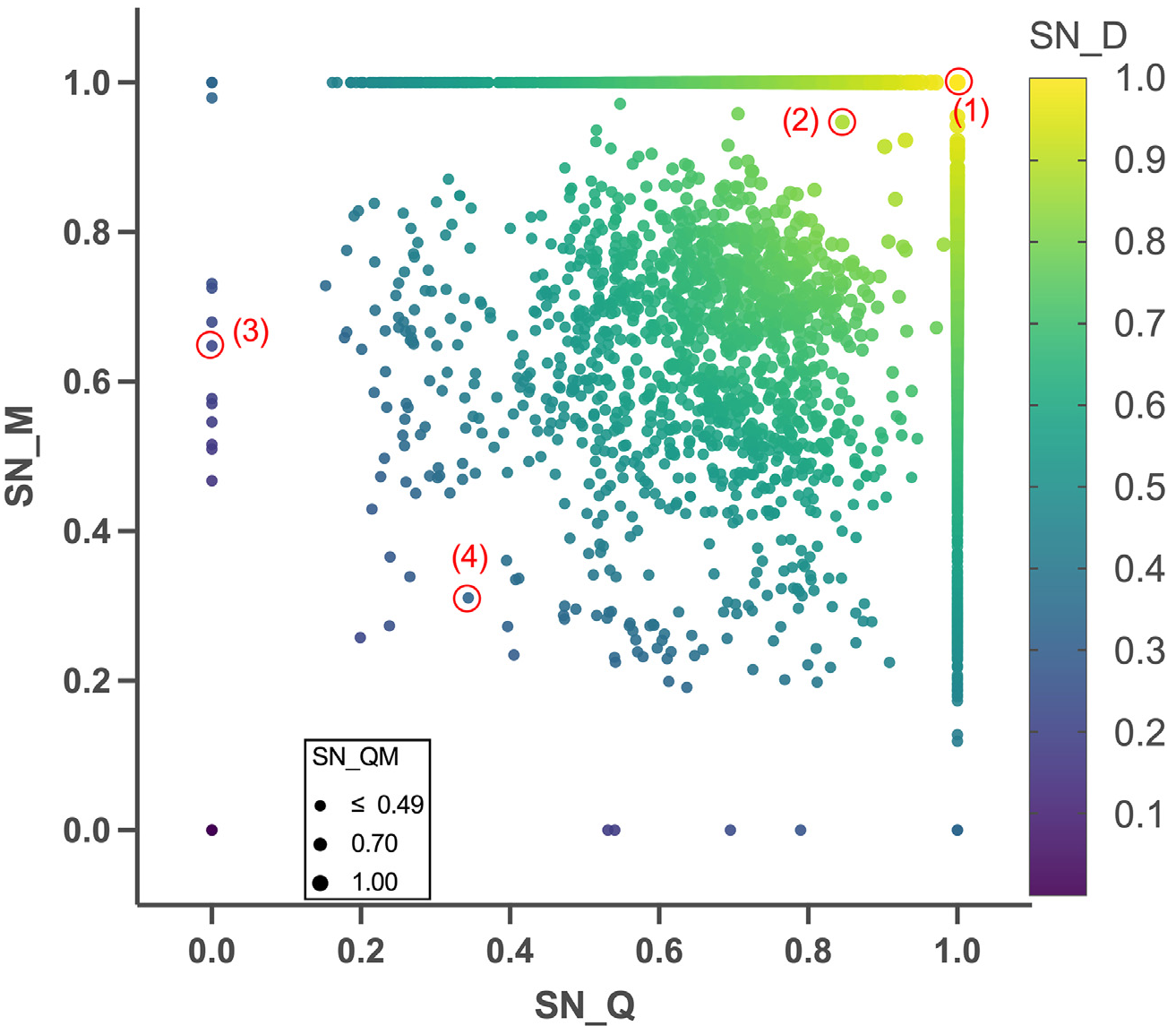 Fig: Scatter plot of semantic novelty. Note how the points converge toward the high-novelty upper-right corner.
Case Study Analysis:
The paper cites fascinating examples, such as using "Structural Social Networks" (Method) to solve "Fake News Detection" (Old Question). This cross-pollination of techniques is what drives the highest curiosity and, ultimately, impact in the community.
Critical Analysis & Conclusion
This work provides a robust, reproducible roadmap for "Innovation Mapping." By treating scientific papers as a structured combination of Problems and Tools, it reflects the true nature of scientific progress: recombinatorial evolution.
Limitations:
- Disciplinary Bias: While perfect for CS or Engineering, it might struggle with Sociology or Philosophy where "Methods" aren't always explicitly labeled.
- Granularity: Currently, it identifies one "core" question and method; future iterations should handle multi-faceted papers.
The Takeaway? If you want to write a high-impact paper in 2026, don't just apply a standard tool to a standard problem. Look for the "Atypical Combination"—find a method from a distant sub-field and apply it to a classic pain point. The math proves that this is where the novelty thrives.