
Integrating Context Compression and Structural Representation: A New Frontier for Financial LLMs
Integrating context compression and structural representation in large language models for financial text generation
The paper introduces a specialized LLM framework for financial text summarization and generation that integrates context window compression with structure-aware graph modeling. By employing an attention-guided information selection mechanism and graph attention networks, it achieves SOTA performance on the FinSum dataset, significantly outperforming baselines like FinGPT and GraphRAG.
TL;DR
Processing massive financial reports requires more than just a larger context window; it requires structural intelligence. This paper proposes a dual-mechanism framework that compresses redundant financial data while explicitly modeling logical hierarchies using Graph Attention. The result is a system that outperforms current champions like FinGPT in both accuracy (ROUGE scores) and logical coherence.
Background: The "Long-Context" Trap in Finance
In the financial sector, a single earnings report or regulatory disclosure can easily exceed the token limits of standard LLMs. While the industry trend is to "blindly expand" the context window (e.g., 128k+ tokens), this approach is often computationally prohibitive and prone to the "lost in the middle" phenomenon. Financial texts aren't just long; they are structured lattices of facts, figures, and causal links.
The authors argue that simply feeding more tokens into a Transformer doesn't help if the model cannot distinguish between a critical risk disclosure and a redundant boilerplate paragraph.
Methodology: Compression Meets Graph Theory
The core innovation lies in the synergy between two modules:
1. Context Compression Module
Instead of simple truncation, the model uses a trainable attention-guided scoring function: This formula identifies high-information clauses, ensuring the most semantically dense parts of a document survive the "compression" into the model's fixed window.
2. Structure-Aware Graph Modeling
The authors treat the document as a graph , where nodes are sentences or paragraphs and edges represent logical dependencies. They use a Graph Attention update rule:
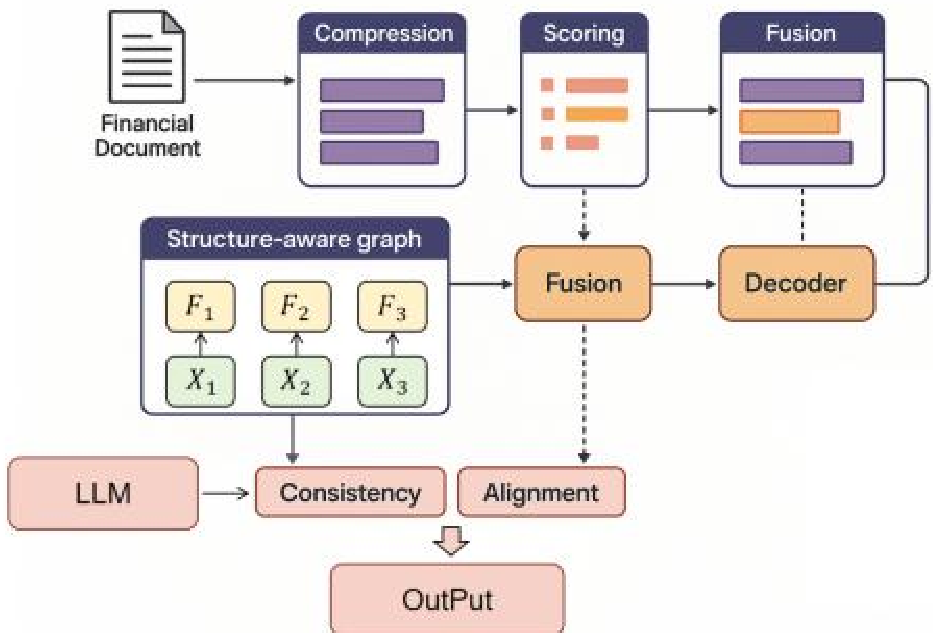 Figure 1: The model architecture integrates the compressed context and the structural graph into the Transformer decoder.
This allows the model to "remember" that a figure on page 2 is logically tied to a conclusion on page 50, providing a global semantic anchor that standard self-attention might miss.
Experiments: Surpassing the State-of-the-Art
The researchers tested their approach on the FinSum dataset against heavyweights like FinGPT and GraphRAG.
| Model | ROUGE-1 | ROUGE-2 | ROUGE-L |
|---|---|---|---|
| FinGPT | 49.14 | 25.76 | 45.12 |
| Ours | 51.03 | 27.41 | 47.38 |
The metrics show a significant leap in ROUGE-L, which measures the longest common subsequence. This suggests that the generated summaries are not just picking up keywords (ROUGE-1) but are maintaining the structural layout and flow of the original professional summaries.
The Impact of Redundancy
A fascinating part of the study was the "Redundancy Perturbation" test. Financial data is often noisy.
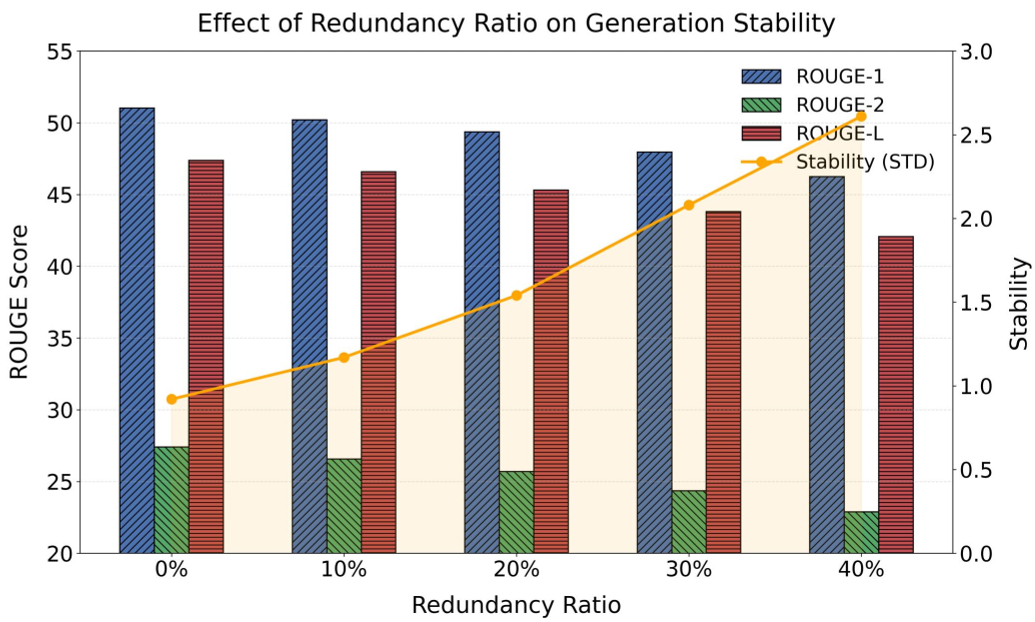 Figure 2: Performance stability against increasing redundancy.
As seen in the chart, while all models degrade when the text becomes "noisier," the proposed method maintains a much higher baseline than competitors, proving that its information selection mechanism is working as intended.
Critical Insight & Conclusion
The true value of this work is the realization that domain-specific Inductive Bias matters. By forcing the model to acknowledge the "graph-like" structure of a financial report, the authors have created a framework that is more stable and faster to converge.
Limitations & Future Work
- Domain Variation: The model performs slightly better on earnings reports than on fragmented news or announcements, suggesting that the "structure-aware" module is most effective when the input follows a rigid template.
- Future Path: Integrating external knowledge graphs and time-series data (numerical trends) could transform this from a summarization tool into a predictive reasoning engine.
Final Takeaway: For AI engineers in fintech, the lesson is clear—don't just throw more hardware at the context window. Invest in better structural representations of your data.