
CUDRT: Decoding the DNA of LLM-Generated Text Across Languages and Operations
Towards Reliable Detection of LLM-Generated Texts: A Comprehensive Evaluation Framework with CUDRT
The paper introduces CUDRT, a comprehensive bilingual (Chinese-English) evaluation framework and benchmark for LLM-generated text detection. It categorizes LLM activities into five operations—Create, Update, Delete, Rewrite, and Translate—and evaluates state-of-the-art detectors (MPU, RoBERTa, XLNet) across diverse datasets.
TL;DR
As Large Language Models (LLMs) achieve human-level fluency, the "arms race" between generation and detection intensifies. This paper presents CUDRT, a massive bilingual benchmark that proves detection isn't just about what is written, but how it was produced. By breaking down LLM tasks into five operations—Create, Update, Delete, Rewrite, and Translate—the researchers provide a blueprint for building detectors that don't crumble when they see a new model or language.
The "Static Benchmark" Problem
Most current LLM detectors are trained on simple Question-Answering (QA) pairs or static datasets like HC3. However, real-world LLM usage is far more nuanced. Users use AI to polish resumes (Update), summarize long reports (Delete), or bridge language gaps (Translate).
The authors argue that existing benchmarks suffer from "scenario-blindness" and a heavy English bias. Because detectors often overfit to specific prompt styles, they fail spectacularly when tasked with recognizing a subtle "polished" text or a "summarized" news snippet.
Methodology: The Five Operations of CUDRT
The cornerstone of this research is the CUDRT Framework (Create, Update, Delete, Rewrite, Translate). The authors meticulously collected human-authored texts from 2016 (pre-LLM era) to ensure data purity.
- Create: Includes text completion and QA.
- Update: Covers "Polishing" (fluency) and "Expansion" (adding detail).
- Delete: Includes "Summarization" and "Refinement" (removing redundancy).
- Rewrite: Stylistic reorganization without changing core meaning.
- Translate: Bilingual transformation between Chinese and English.
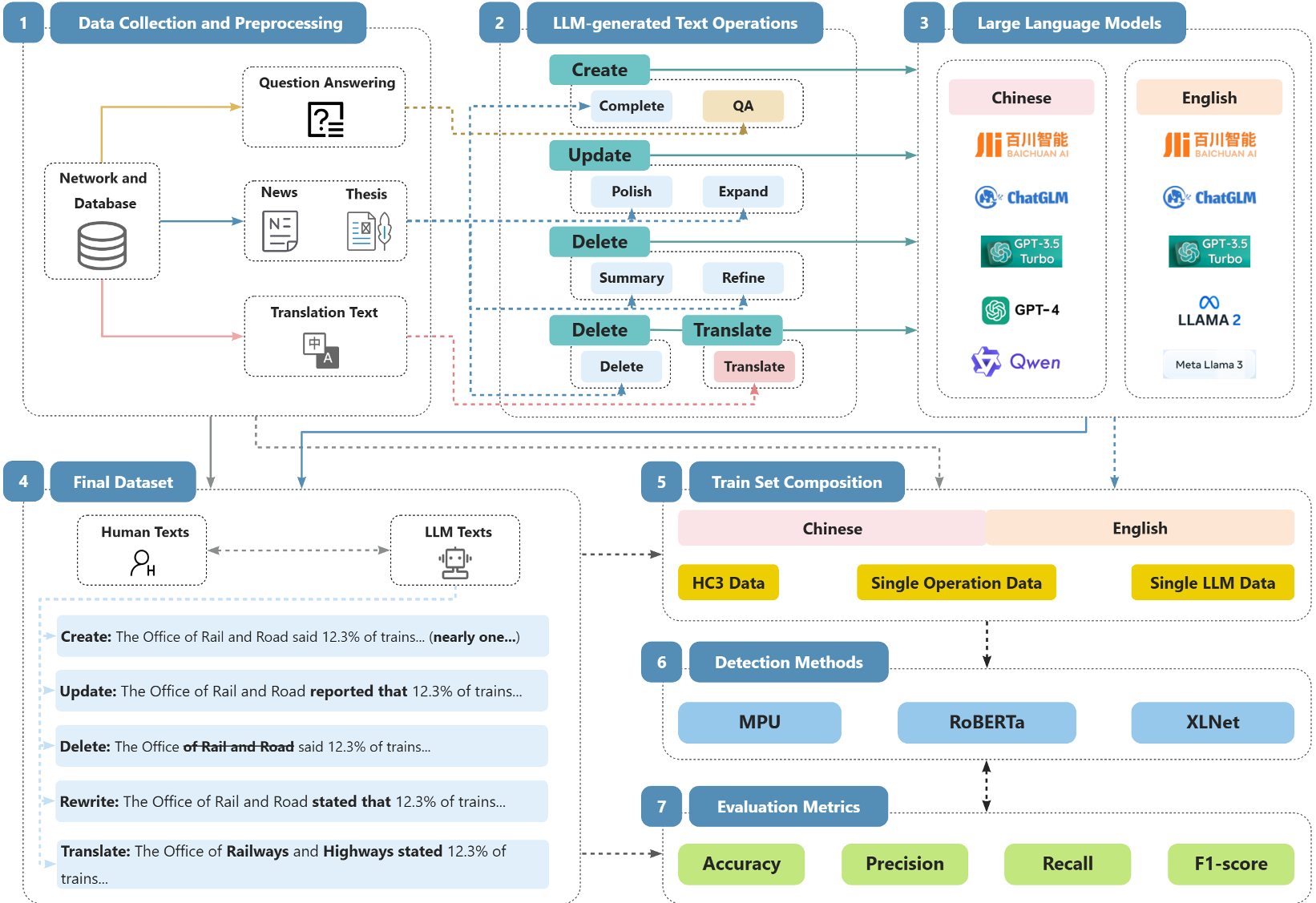 Fig 1. The CUDRT framework uses a "Train-then-Test" approach to evaluate robustness across datasets and LLMs.
Key Insights: Why "Delete" is the Secret Sauce
One of the most profound findings of the paper is the effectiveness of the "Delete" operation as a training signal.
The researchers discovered that when models like RoBERTa and XLNet are trained on "Delete" tasks (summaries and refinements), they generalize far better to other operations like "Rewrite" or "Update."
- The Intuition: When an LLM summarizes or refines text, it makes more "characteristic" structural decisions. These subtle fingerprints—how it identifies redundancy and rephrases core ideas—are a dead giveaway for its underlying architecture, making "Delete" data a goldmine for training robust detectors.
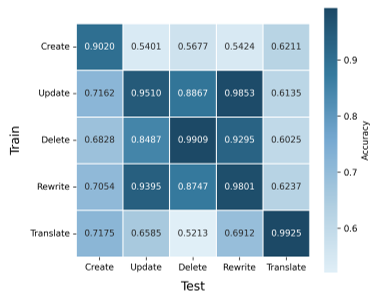 Fig 2. Heatmaps showing that models trained on "Delete" and "Update" operations achieve the most consistent F1-scores across different test sets.
Experimental Battleground: Model-Based vs. Metric-Based
The study compared two philosophies of detection:
- Metric-Based (MPU): Uses statistical rules like word rank and entropy. It’s transparent and fast but often rigid.
- Model-Based (RoBERTa, XLNet): Deep learning classifiers. These are powerful but "black boxes" that need diverse training data.
In Cross-LLM evaluations, models trained on GPT-4 and Qwen1.5 were the "champions," effectively catching text from weaker or less common models like Baichuan2. This suggests that the highest-tier models exhibit the most "universal" AI signatures.
Conclusion: A Roadmap for the Future
The findings are clear: training on diverse operations is more important than training on more data from a single operation.
Takeaways for Practitioners:
- Diversify Operations: Don't just feed your detector QA pairs. Include summarized and polished texts.
- Embrace Multilingualism: Detection patterns in Chinese and English are distinct; a universal detector must account for these linguistic boundaries.
- Focus on Structure: Advanced LLMs like GPT-4 are harder to catch with simple stats, requiring model-based approaches that understand context and structural "AI-isms."
CUDRT isn't just a dataset; it's a call to action for the AI safety community to start looking at LLM activity as a multi-dimensional spectrum rather than a binary "human or bot" switch.