
ASTERIS: Redefining the Depths of the Universe Through Spatiotemporal Denoising
Deeper detection limits in astronomical imaging using self-supervised spatiotemporal denoising
The paper introduces ASTERIS, a self-supervised transformer-based denoising algorithm designed for astronomical imaging. It leverages spatiotemporal correlations across multiple dithered exposures to suppress non-i.i.d. noise, achieving a SOTA detection limit improvement of ~1.0 magnitude at 90% completeness and purity compared to standard co-addition.
Executive Summary
TL;DR: Researchers have developed ASTERIS, a self-supervised deep learning algorithm that pushes the detection limits of telescopes like the James Webb (JWST) by a full magnitude. By treating multiple dithered exposures as a 3D spatiotemporal cube rather than just stacking them, the model filters out complex, structured noise that traditional math misses. This resulted in a 300% increase in the number of early-galaxy candidates discovered in existing deep-field data.
Academic Positioning: This work bridges the gap between digital signal processing and observational cosmology. It is a high-impact application of Self-Supervised Learning (SSL) that proves "software-defined depth" is as crucial as "hardware-defined aperture" in the next era of astronomy.
Problem & Motivation
The "Standard Model" of image stacking—averaging exposures to gain in S/N—is reaching a point of diminishing returns. To improve a detection limit from 31 to 32 magnitudes, a telescope like JWST would need to stare at the same spot for a month instead of four days.
The root of the problem is that astronomical noise is not i.i.d. (independent and identically distributed). Fluctuations from zodiacal light, instrument electronics, and the telescope's own Point Spread Function (PSF) create "structured" noise that simple averaging cannot remove. Prior deep learning attempts often used synthetic data (bridging the gap to real data is hard) or single-image denoising (which can create artifacts or destroy the PSF).
Methodology: The Core of ASTERIS
The breakthrough in ASTERIS (Astronomical Self-supervised TransformER-based denoisIng Strategy) lies in its exploitation of spatiotemporal correlations.
1. Spatiotemporal 3D U-Net
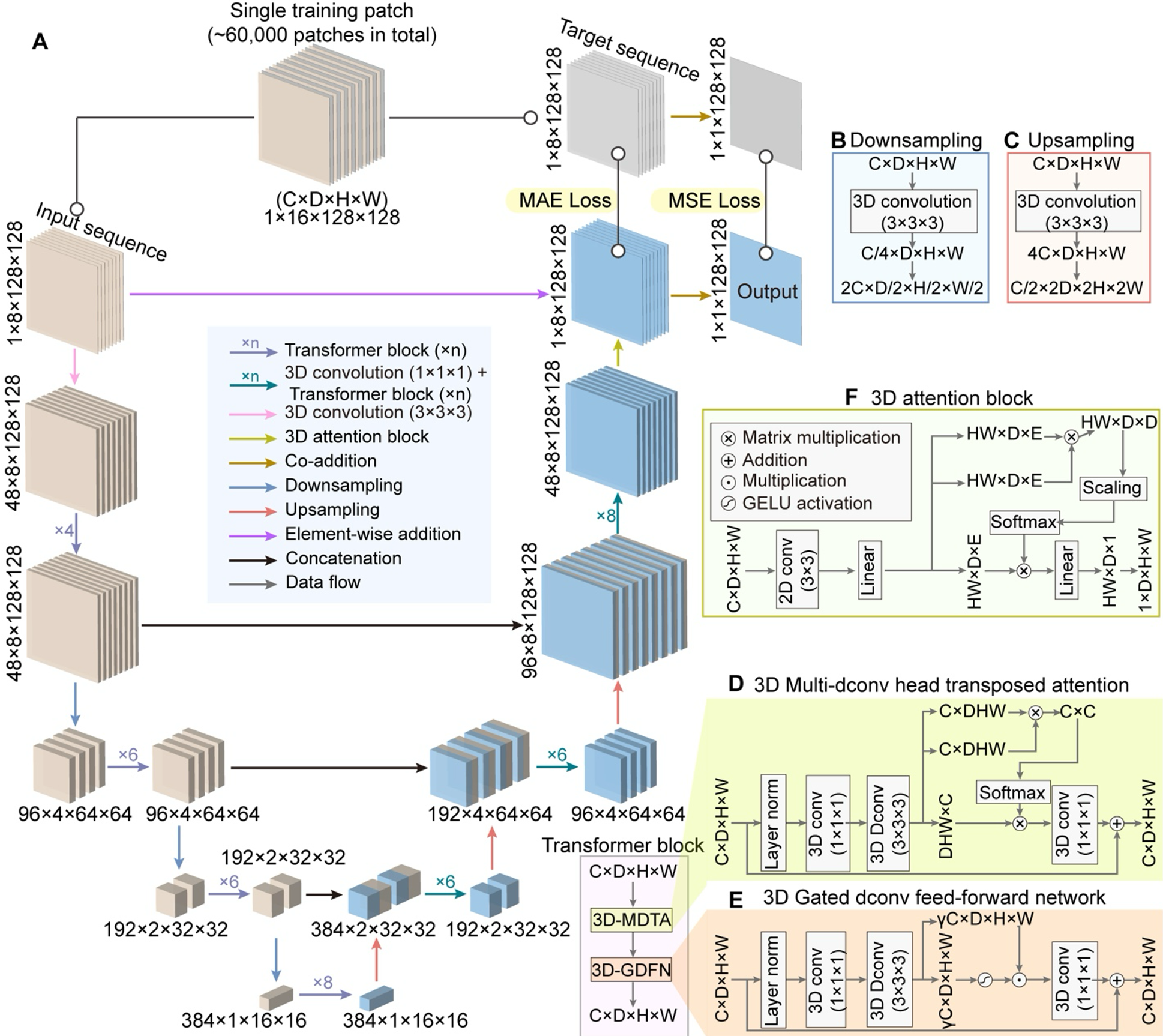
Instead of denoising a single flat image, ASTERIS takes a "voxel" approach. It aligns 8 to 16 independent exposures and processes them as a 3D volume. The architecture uses:
- 3D-MDTA (Multi-Deconvolved-Head-Transposed-Attention): This allows the model to capture long-range dependencies across both spatial pixels and temporal exposures, bypassing the local receptive field limits of standard CNNs.
- 3D-GDFN (Gated Feed-Forward Network): This helps the network focus on the most informative features in a background-limited regime.
2. Self-Supervised Learning Strategy
Training ASTERIS requires no "clean" ground truth. It uses a variation of the Noise2Noise principle. By splitting exposures into two sets ( and ), the network learns to predict the signal expectation of using as a proxy.
- Composite Loss: It balances MSE (for signal accuracy) and MAE (for robustness against outliers like cosmic rays).
- 3σ Selective Denoising: To maintain the vast dynamic range of space images, ASTERIS only processes pixels below a 3σ threshold. Brighter "sure thing" stars/galaxies are preserved traditionally, preventing the network from introducing bias in high-flux regions.
Experiments & Results
The authors validated ASTERIS using both mock injection tests and real-world observations from JWST (space-based) and Subaru (ground-based).
Key Breakthroughs:
- Detection Limit: ASTERIS achieved a 1.0 magnitude improvement at 90% completeness. In astronomical terms, this is a massive leap; it makes an 8-exposure stack perform like a much deeper survey.
- PSF Preservation: Unlike standard smoothing or many CNN denoisers, ASTERIS showed a Kolmogorov–Smirnov test p-value of 0.9 compared to original data, meaning the delicate shape of stars (crucial for lensing studies) was perfectly preserved.
- High-Redshift Discovery: Applied to the JADES Origins Field, ASTERIS found 162 galaxy candidates at z ≳ 9. This is three times the count of previous state-of-the-art catalogs using the same data.
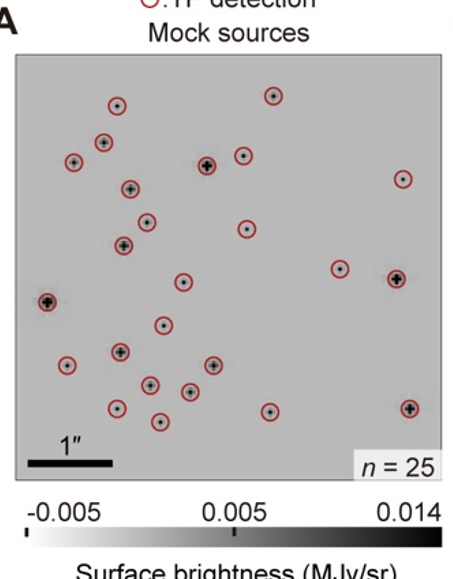 (The charts above demonstrate the significant narrowing of image histograms and the surge in true-positive detections.)
Application: The Faintest Galaxies Ever Seen
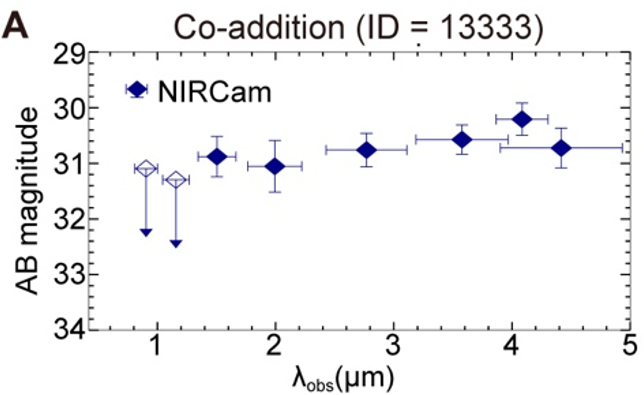
The most striking result is the detection of galaxies at to . By suppressing noise in "dropout" bands, ASTERIS resolved ambiguities in photometric redshift. It proved that many sources previously dismissed as "marginal noise" actually fit the spectral energy distribution (SED) of high-redshift galaxies.
Deep Insight & Conclusion
Takeaway
ASTERIS proves that our current telescopes are "seeing" more than we are capturing. By moving from a 2D spatial mindset to a 3D spatiotemporal voxel mindset, we can filter out the structured noise of the universe. This effectively increases the "software aperture" of the telescope.
Limitations & Future Work
- Exposure Count: Currently, ASTERIS requires an even number of exposures (ideally 8 or 16). Handling odd-numbered or extremely sparse dither patterns remains an engineering challenge.
- Instrument Specificity: While ASTERIS generalizes across filters, it requires re-training for vastly different hardware (e.g., ground-based Subaru vs. space-based JWST) to account for atmospheric turbulence.
- Future: Integrating this directly into the calibration pipelines (like the JWST Science Calibration Pipeline) could fundamentally change how public catalogs are produced.
Final Thought: If software can add 1.0 magnitude of depth to a $10B telescope, ASTERIS might be the most cost-effective "aperture upgrade" in the history of astronomy.