
DeepSeek-V3.2: Redefining the Frontier of Open Reasoning and Agentic Intelligence
DeepSeek-V3.2: Pushing the Frontier of Open Large Language Models
DeepSeek-V3.2 is a state-of-the-art open large language model that introduces DeepSeek Sparse Attention (DSA) to achieve extreme computational efficiency and long-context performance. It matches GPT-5 in reasoning and achieves gold-medal performance in IMO/IOI 2025 via a high-compute variant, DeepSeek-V3.2-Speciale.
TL;DR
DeepSeek-V3.2 represents a landmark shift in the open-source AI landscape, proving that open models can not only compete with but surpass top-tier proprietary models like GPT-5 and Gemini-3.0-Pro in specialized reasoning. By introducing DeepSeek Sparse Attention (DSA) and a massive 10% post-training compute allocation, DeepSeek-AI has delivered a model capable of gold-medal performance in international olympiads (IMO/IOI) while maintaining industry-leading inference efficiency.
Motivation: The Efficiency-Intelligence Paradox
Until now, a "performance gap" existed between open and closed models. The authors identify three culprits:
- Architectural Stagnation: Reliance on vanilla attention makes long-context processing (e.g., complex coding or multi-step agents) prohibitively expensive.
- Compute Under-investment: Post-training (RL) often receives too little budget compared to pre-training.
- Agentic Fragility: Open models often fail to generalize when navigating complex, interactive tool-use environments.
Methodology: The Core Innovations
1. DeepSeek Sparse Attention (DSA)
The most significant architectural upgrade is the transition to DSA. Unlike dense attention, DSA uses a Lightning Indexer—a lightweight FP8-based module—to select only a subset ( tokens) of the most relevant history for any given query. This shifts the complexity bottleneck from to .
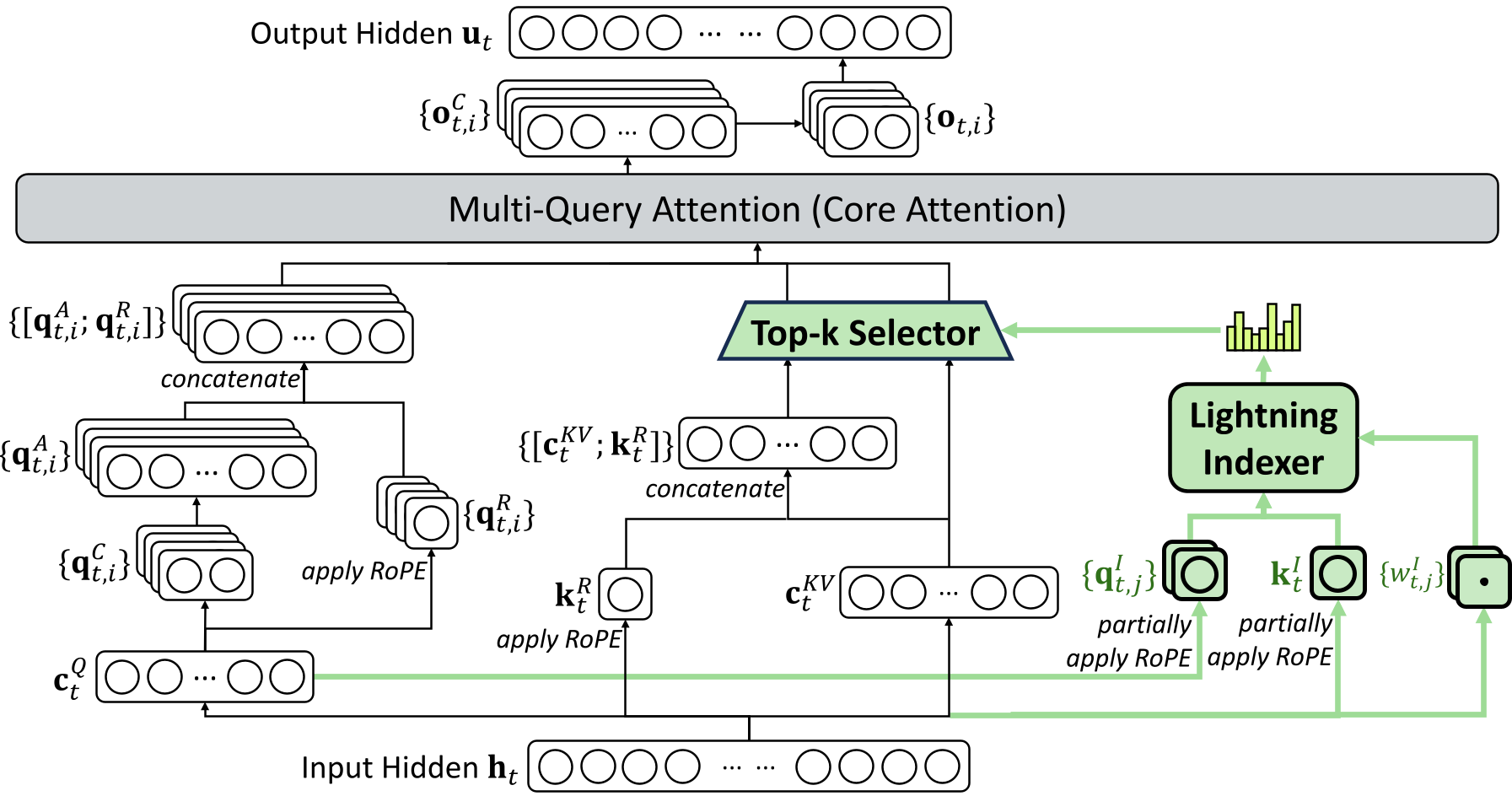 Figure: The DSA architecture integrated under Multi-Head Latent Attention (MLA), showcasing the top-k selection mechanism.
2. Scaling GRPO & Stable RL
To push reasoning to the limit, the team utilized Group Relative Policy Optimization (GRPO). They solved traditional RL instability through:
- Unbiased KL Estimates: Preventing gradient noise when the policy diverges.
- Off-Policy Sequence Masking: Filtering out detrimental "mistakes" that are too far from the current policy's distribution.
- Keep Routing: Ensuring expert selection in Mixture-of-Experts (MoE) remains consistent between inference and training.
3. Agentic Task Synthesis
Recognizing that real-world agent data is scarce, DeepSeek-AI built a pipeline to synthesize 1,827 unique environments and over 85,000 prompts. This includes "Trip Planning" and "Code Engineering" tasks that are hard to solve but easy to verify via automated scripts.
Results: Breaking the Olympiad Ceiling
The results are nothing short of historic for the open-source community. DeepSeek-V3.2-Speciale (the high-compute reasoning variant) achieved:
- IMO 2025 Gold Medal: 35/42 points.
- IOI 2025 Gold Medal: 492/600 points.
- SOTA Agent Performance: Substantially narrowing the gap with Gemini-3.0-Pro in tool-calling benchmarks.
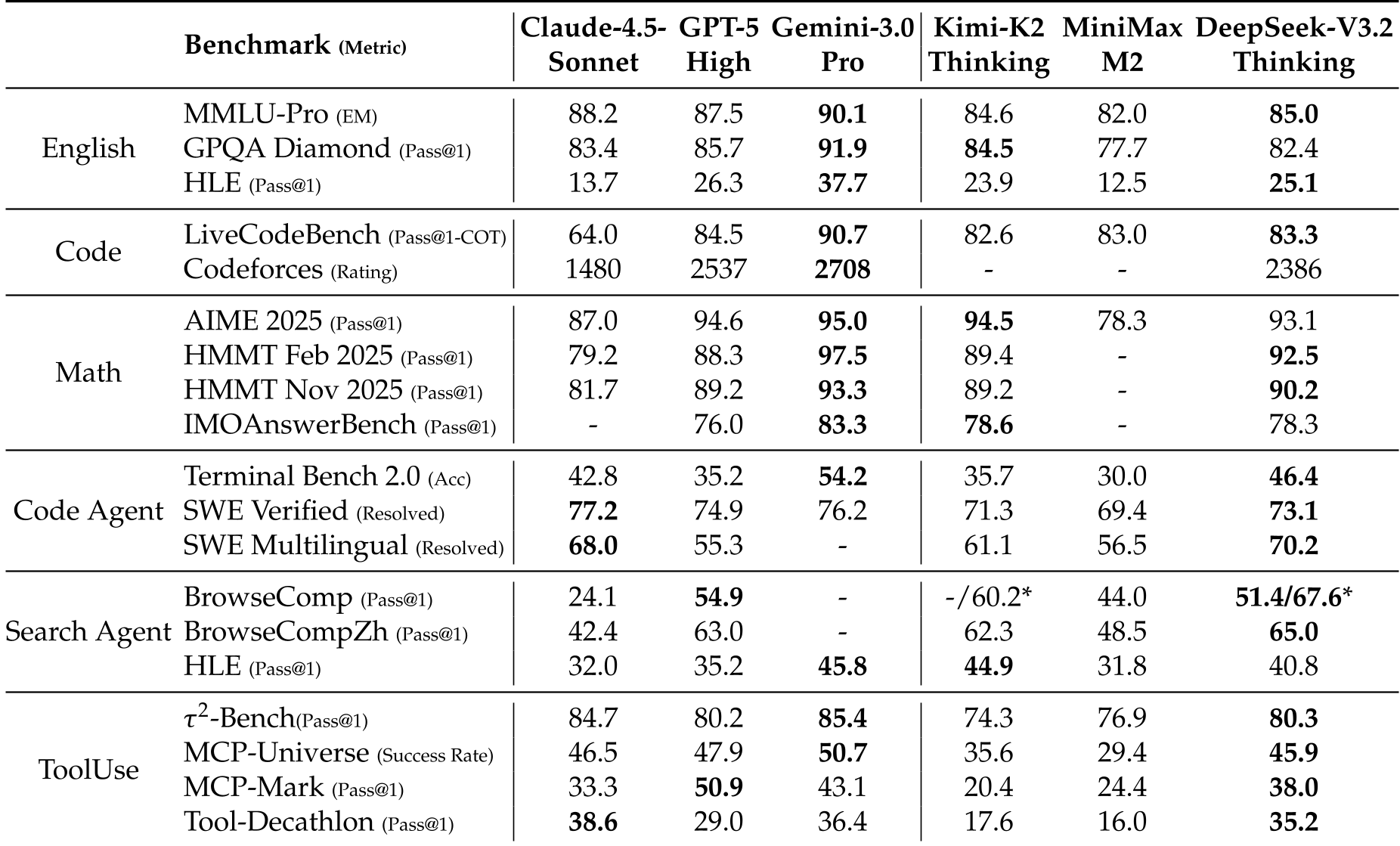 Table: Benchmark comparison showing DeepSeek-V3.2's competitive edge against GPT-5 and Gemini-3.0-Pro.
Inference Efficiency: Scaling Test-Time Compute
Efficiency is not just about the architecture but how the model manages context. The paper introduces Context Management strategies like "Summary" and "Discard-all" for search agents. These allow the model to extend its reasoning steps by roughly 2.6x, leading to significant accuracy gains in long-horizon tasks.
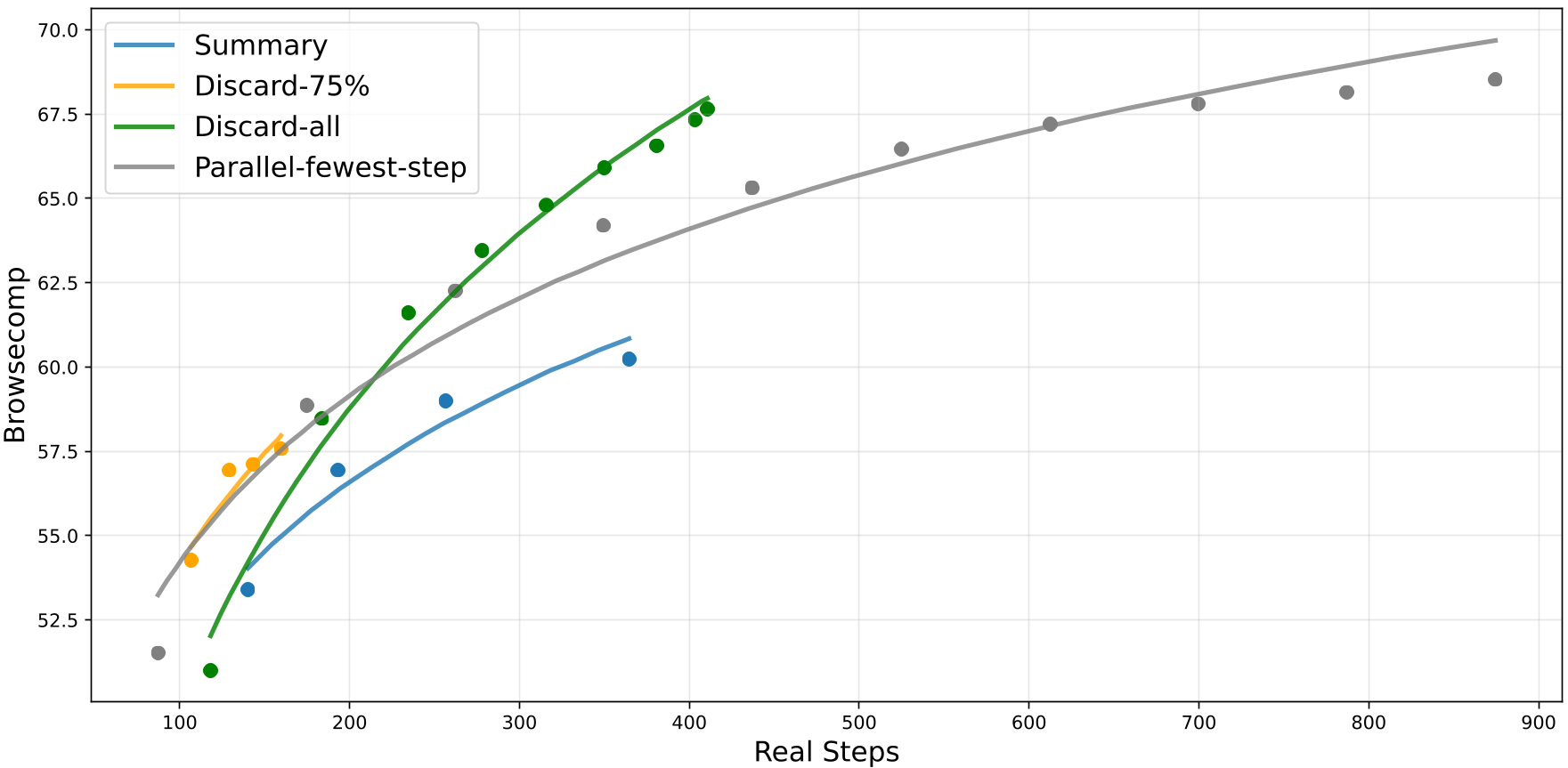 Figure: Accuracy gains on BrowseComp via serial/parallel test-time compute scaling.
Critical Insight & Conclusion
DeepSeek-V3.2 proves that the "secret sauce" of frontier models like OpenAI's o1 or Gemini Pro is not just model size, but Post-Training Compute (RL) and Synthetic Data Quality.
Limitations: Despite the reasoning prowess, the model's general world knowledge still slightly trails proprietary models due to lower total training FLOPs compared to the multi-trillion token giants. Furthermore, it often requires more "thinking tokens" to achieve parity, suggesting that "intelligence density" is the next frontier for optimization.
Takeaway: The era of proprietary dominance in reasoning is ending. DeepSeek-V3.2 provides the blueprint for high-efficiency, high-reasoning open AI.