
DAMAGE: Unmasking the "Humanizers" in the AI Arms Race
Detecting Adversarially Modified AI Generated Text
The paper introduces DAMAGE, a deep-learning-based AI text detector specifically engineered to identify text modified by "AI humanizers." By utilizing a data-centric augmentation approach and the Mistral NeMo architecture, the model achieves a 98.26% True Positive Rate (TPR) on humanized AI text, significantly outperforming existing commercial and open-source baselines.
TL;DR
As AI-generated content floods the internet, a new predatory industry of "AI Humanizers" has emerged, promising to make ChatGPT text invisible to detectors. The paper DAMAGE (Detecting Adversarially Modified AI Generated Text) reveals that while popular detectors like GPTZero and Binoculars are easily fooled by these tools, a robust deep-learning approach can maintain near-perfect accuracy. By treating humanization as a data augmentation task, the authors built a detector that resiliently identifies AI authorship even under direct adversarial attacks.
The Motivation: The "Humanizer" Loophole
The rise of Large Language Models (LLMs) led to a corresponding rise in detection tools used by educators and search engines. However, the market quickly responded with "Humanizers"—tools like BypassGPT or StealthWriter that rewrite AI text to evade detection.
The core motivation of the authors was twofold:
- Fragility of Current SOTA: Tools relying on perplexity (statistical "randomness") are brittle. If a humanizer replaces just a few key words, the statistical signature collapses.
- Watermarking Failure: Even advanced watermarking schemes like Google’s SynthID are rendered useless. The authors demonstrated that a quick pass through a paraphraser (DIPPER) dropped SynthID detection from 87.6% to a staggering 5.4%.
Methodology: Learning Invariance
The authors didn't just build a better classifier; they conducted a comprehensive audit of 19 tools. They discovered that humanizers range from "L1" (high-quality, meaning-preserving) to "L3" (garbage-in, garbage-out tools that add nonsensical citations or symbols).
The Architecture
The team utilized the Mistral NeMo (12B) architecture with LoRA adapters. Crucially, they constrained the context window to 512 tokens to force the model to focus on short-range linguistic features rather than long-term semantic structure, which humanizers are better at disguising.
Data-Centric Augmentation
The secret sauce lies in the training data. Instead of just adding a "humanized" category, the authors:
- Used Mirror Prompts: Generating AI essays that exactly match the topic and length of human essays.
- Humanizing the "Human": They passed human-written text through humanizers but kept the label as "Human." This taught the model to ignore the style of the humanizer and focus on the underlying signal of authorship.
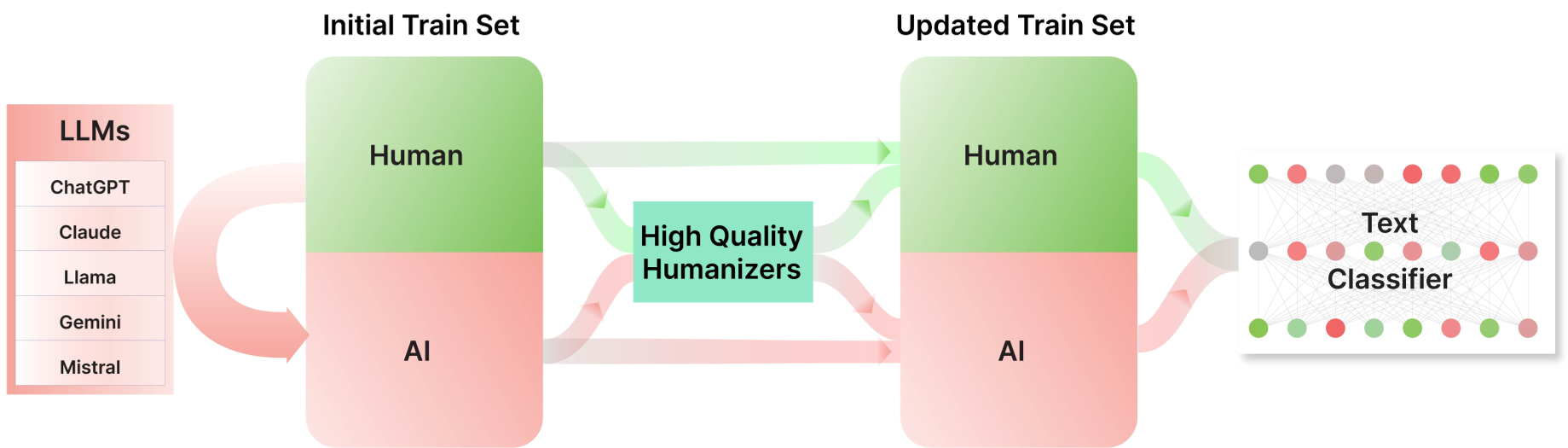 Figure 1: Augmenting the training set with high-quality humanizer data improves robustness.
Experimental Results: A One-Sided Battle
The results are sobering for those relying on current commercial tools. When humanizers are applied, standard detectors see their performance fall off a cliff.
| Model | Raw AI Text TPR | Humanized AI Text TPR (at 5% FPR) |
|---|---|---|
| GPTZero | 99.73% | 60.04% |
| Binoculars | 94.15% | 28.23% |
| DAMAGE (Ours) | 100.00% | 98.26% |
The authors even went a step further: they attacked their own detector by training a custom humanizer fine-tuned specifically to beat the DAMAGE model. Even this "dedicated hunter" only managed to slip a small fraction of text past the detector, which maintained a 93.2% success rate.
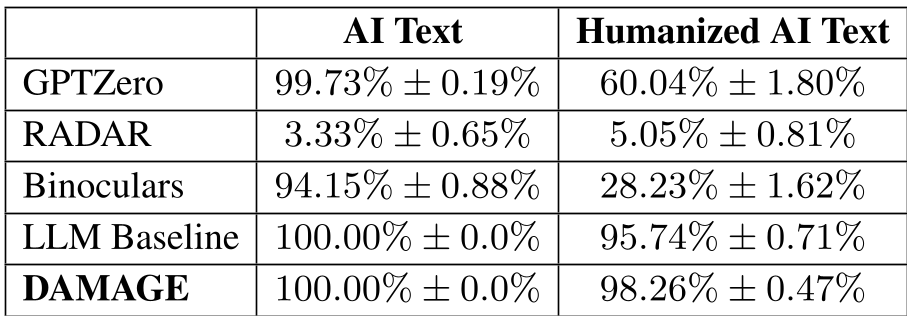 Table 1: DAMAGE maintains high True Positive Rates where others fail.
Critical Insights & Takeaways
This research highlights a fundamental shift in AI safety and integrity:
- The Death of Simple Metrics: "Perplexity" is no longer a valid metric for detection in an adversarial world.
- The Persistence of AI "Fingerprints": High-parameter LLMs (like the 12B Mistral NeMo) can pick up on subtle structural patterns that even high-quality humanizers like DIPPER cannot fully erase.
- Future Outlook: While the DAMAGE detector is powerful, the authors admit that as humanizers become more sophisticated (leveraging L1 patterns), the "gray area" of detection will grow. The focus must shift toward cross-humanizer generalization—the ability to detect patterns from tools the model has never seen before.
Ultimately, this work suggests that the "cat-and-mouse" game is far from over, but deep learning models that view humanization as a "noise" to be ignored (invariance) have the upper hand.