
DeTeCtive: Rethinking AI Detection as a Stylistic Genealogy Problem
DeTeCtive: Detecting AI-generated Text via Multi-Level Contrastive Learning
DeTeCtive is a novel AI-generated text detection framework that utilizes multi-level contrastive learning and multi-task auxiliary objectives. It achieves state-of-the-art performance across major benchmarks (Deepfake, M4, TuringBench), redefining detection as a writing-style differentiation task rather than simple binary classification.
TL;DR
The rapid evolution of Large Language Models (LLMs) has turned AI-generated text detection into a "cat-and-mouse" game where traditional binary classifiers quickly become obsolete. DeTeCtive breaks this cycle by treating AI detection not as a classification task, but as a writing-style differentiation problem. By using a multi-level contrastive learning framework and a retrieval-based inference pipeline, it creates a "familial map" of writing styles that significantly improves generalization to unseen models and domains.
The Core Insight: LLMs Have "Ancestry"
Most detectors fail on new models (like GPT-4 or Llama-3) because they try to find a universal "AI-ness" that doesn't exist. The authors of DeTeCtive argue that LLMs, much like human authors, have unique stylistic biases rooted in their architecture and training data.
They propose a Kinship Hierarchy:
- Individual Model: Text from the exact same LLM.
- Family/Company: Models sharing same lineages (e.g., the GPT family or Llama family).
- General AI: Any machine-generated text.
- Human: The ultimate contrast.
By forcing the model to learn these fine-grained relationships, DeTeCtive gains an "Inductive Bias" that allows it to better identify the stylistic clusters of even previously unseen models.
Methodology: Hierarchical Contrastive Learning
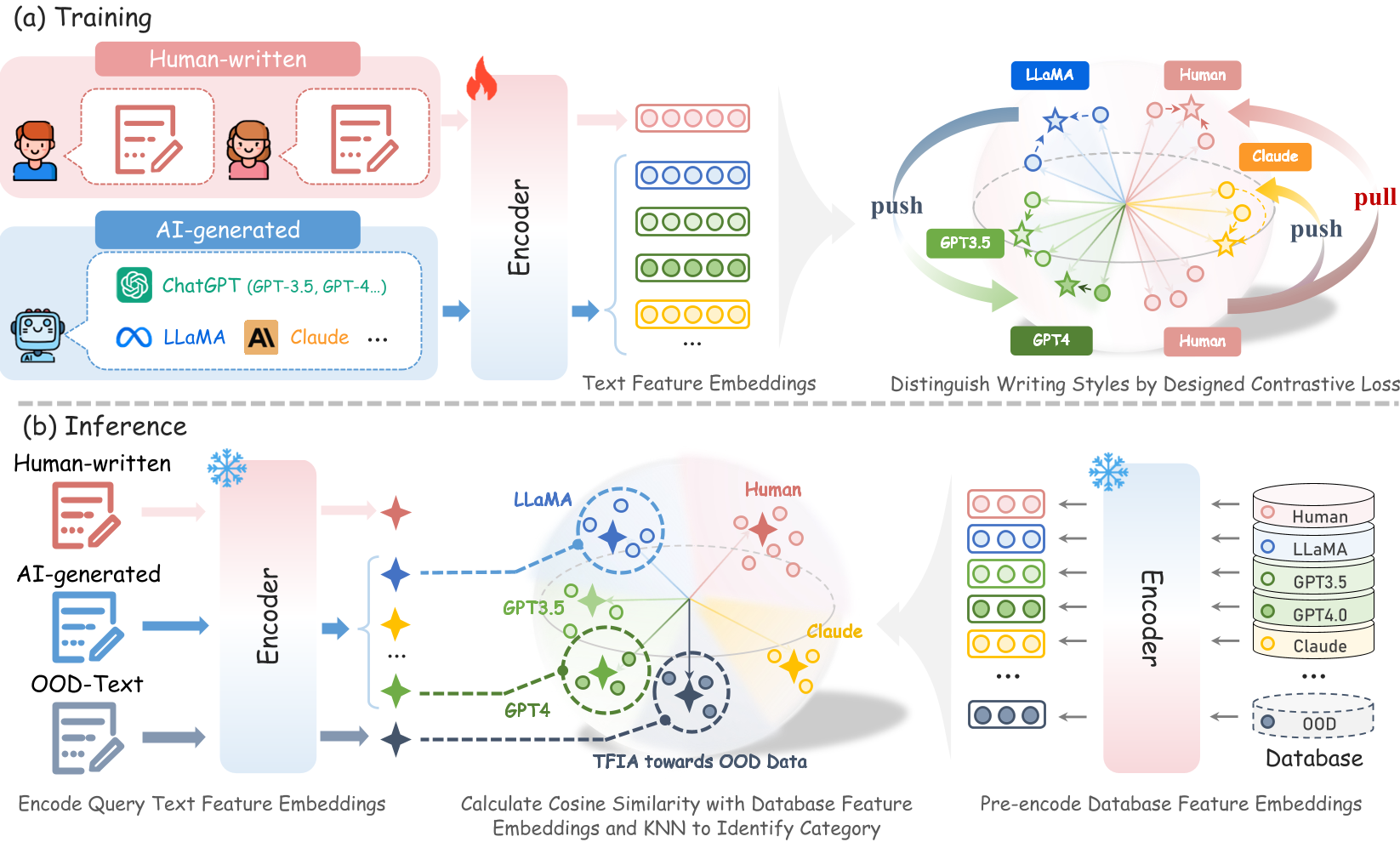
The framework fine-tunes standard encoders (like RoBERTa or T5) using a specialized loss function ().
1. Multi-Level Contrastive Loss ()
Unlike standard contrastive learning that only looks at "same vs. different," DeTeCtive pulls samples closer or pushes them further based on their position in the kinship hierarchy. If two texts are from the same model, they are pulled closest; if they are from different companies but both AI, they are pulled slightly less, and so on.
2. Dense Retrieval Inference
Instead of a "Yes/No" final layer, DeTeCtive uses the encoder to turn text into a feature vector and searches a Feature Database. It uses KNN to look at the "neighbors" of a query—if it's surrounded by GPT-4 samples, it’s likely AI, even if the model wasn't specifically trained on a GPT-4 binary label.
Training-Free Incremental Adaptation (TFIA)
Perhaps the most "product-ready" feature of this paper is TFIA. When a new model is released (e.g., Llama-4), instead of retraining the whole detector (which is expensive and slow), you simply:
- Generate/collect a few samples from the new model.
- Encode them with the existing DeTeCtive encoder.
- Add these vectors to the Feature Database.
The system immediately "learns" to detect the new model with zero gradient updates. The experiments show this improves OOD performance by up to 7.03%.
Experimental Performance
DeTeCtive was tested against heavyweights like DetectGPT and Longformer. It didn't just win; it dominated in Out-of-Distribution scenarios.
| Scenario | Longformer | DetectGPT | DeTeCtive (Ours) |
|---|---|---|---|
| Unseen Models | 86.61 | 62.31 | 93.03 |
| Unseen Domains | 68.40 | 60.48 | 89.63 |
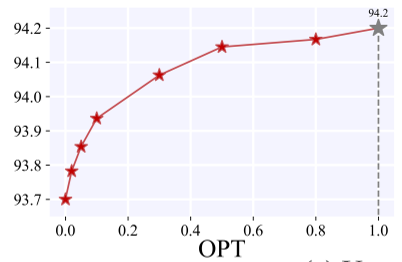
Below is the visualization of the learned embedding space. You can see how the model successfully clusters different LLM families compared to the messy baseline:
Critical Analysis & Conclusion
DeTeCtive's strength lies in its Retrieval-Augmented approach. By decoupling the "feature extractor" from the "classification decision," it provides a level of flexibility that binary classifiers lack.
Takeaways:
- Style Matters: AI detection is effectively a sub-field of Authorship Attribution.
- Retrieval > Classification: Storing known samples in a database is more robust than baking "knowledge" into the weights of a binary head.
- Future Proofing: TFIA provides a viable path for keeping production detectors relevant in the fast-moving LLM landscape.
Limitations: The reliance on a feature database means inference speed depends on the efficiency of the vector search (though Faiss mitigates this). Future work remains to be seen on how this scales to billions of reference samples.