
DeTeCtive: Unmasking AI Writing Styles via Multi-Level Contrastive Learning
DeTeCtive: Detecting AI-generated Text via Multi-Level Contrastive Learning
DeTeCtive is a novel AI-generated text detection framework that utilizes multi-task auxiliary and multi-level contrastive learning to distinguish fine-grained writing styles. By shifting the paradigm from binary classification to style-based retrieval, it achieves state-of-the-art results across major benchmarks like Deepfake, M4, and TuringBench.
TL;DR
As Large Language Models (LLMs) evolve, simple binary classifiers are increasingly failing to detect AI-generated content, especially when faced with "unseen" models. DeTeCtive pivots from "Is this AI?" to "Whose style is this?". By using multi-level contrastive learning and a retrieval-style inference pipeline, it sets new SOTA benchmarks, particularly in out-of-distribution (OOD) scenarios where it outperforms predecessors by up to 14.20%.
The "Binary Trap" in AI Detection
Most existing detectors view the world through a narrow lens: Human vs. AI. This binary formulation is inherently brittle. Every LLM, from Llama to GPT-4, possesses a unique "stylistic fingerprint" shaped by its specific architecture and training data. When a detector trained only on GPT-2 encounters a Llama-3 output, it often fails because the feature distribution is entirely different.
The authors of DeTeCtive argue that detection should be treated as Authorship Attribution. By learning to distinguish between various LLM families and individuals, the model develops a more nuanced understanding of "machine-ness" that generalizes far better than a simple binary boundary.
Methodology: The Hierarchical Kinship Approach
The core innovation of DeTeCtive is the Multi-Level Contrastive Loss. Instead of pulling all AI samples together and pushing them away from human text, the authors define a "Family Tree" of relationships:
- Level 1: Specific Model (e.g., Llama-2-7B vs. Llama-2-13B).
- Level 2: Model Series/Company (e.g., Meta's Llama vs. OpenAI's GPT).
- Level 3: AI-generated vs. Human-written.
The Architecture
The framework utilizes a text encoder (like RoBERTa or T5) fine-tuned with a multi-task objective: a standard classification head plus the specialized contrastive loss.
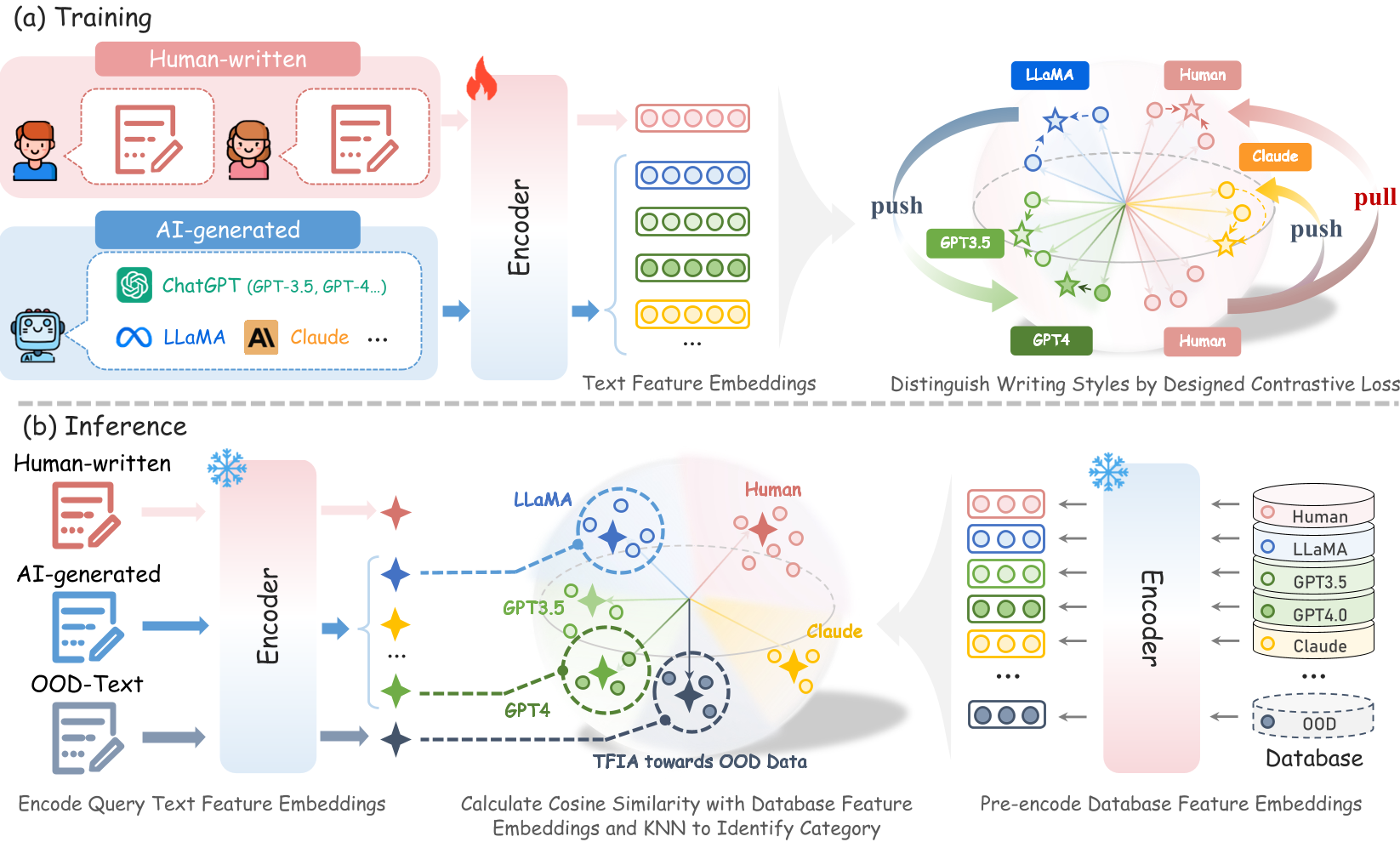
Figure 1: (a) Training focuses on multi-level style encoding. (b) Inference uses a dense retrieval pipeline to find the nearest neighbors in a feature database.
Dense Retrieval Inference
Unlike traditional models that output a probability, DeTeCtive encodes the query text and searches a pre-built Feature Database of known human and AI samples. By using KNN (K-Nearest Neighbors), it makes a decision based on the most similar writing styles it has "seen" before.
Performance: Smashed Benchmarks and OOD Generalization
DeTeCtive was tested against three massive datasets: Deepfake, M4, and TuringBench. The results consistently placed it at the top of the leaderboard.
| Dataset | Previous SOTA (AvgRec) | DeTeCtive (AvgRec) | Gain |
|---|---|---|---|
| M4 Monolingual | 91.92% (SCL) | 98.44% | +6.52% |
| Deepfake (Cross) | 93.49% (T5-Sentinel) | 96.15% | +2.66% |
What is truly impressive is the Out-of-Distribution (OOD) capability. When tested on models or domains not seen during training, DeTeCtive maintained high accuracy, while traditional classifiers' performance plummeted.
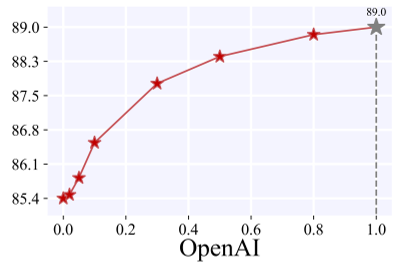
Figure 2: UMAP visualizations show that while pre-trained models struggle (a), DeTeCtive successfully clusters texts by source (b, c, d), effectively mapping the landscape of AI writing styles.
TFIA: Training-Free Incremental Adaptation
One of the paper's most practical contributions is TFIA. In a world where a new LLM is released every week, retraining a detector is expensive. Because DeTeCtive is a retrieval-based system, you can "update" it simply by encoding a few samples of a new model (e.g., the latest Llama-3) and adding those vectors to the database.
- Result: Adding a small amount of OOD data through TFIA increased recall by 7.03% in unseen domains without a single step of gradient descent.
Critical Insight & Conclusion
DeTeCtive proves that granularity is the key to robustness. By forcing the model to distinguish between "siblings" (models from the same family), the encoder learns to extract deep stylistic features rather than surface-level statistical artifacts.
Takeaway: The future of AI safety lies in retrieval-augmented detection. As LLMs become more indistinguishable from humans on an individual prompt level, our best defense is recognizing the collective "style" mapped within high-dimensional vector spaces.