
The Ghost in the Machine: Why Some LLMs are Nearly Impossible to Detect
Which LLMs are Difficult to Detect? A Detailed Analysis of Potential Factors Contributing to Difficulties in LLM Text Detection
This study presents a comprehensive analysis of the detectability of AI-generated (AIG) texts across various domains and model families using the LibAUC library for deep AUC maximization. By training 92 DistilRoBERTa-based classifiers, the researchers demonstrate that while most AI text is detectable, the OpenAI family (GPT-3.5 and GPT-4o) consistently achieves SOTA levels of evasion, appearing significantly more "human-like" than other models.
TL;DR
Not all AI text is created equal. A new study reveals that while models like Llama and Mistral leave distinct digital fingerprints, the OpenAI family (GPT-3.5 and GPT-4o) has reached a level of mimicry that baffles standard classifiers. By analyzing entropy and vocabulary habits, researchers found that OpenAI models produce text that is statistically closer to human writing, especially in academic and scientific contexts.
Background: The Detection Arms Race
As LLMs become ubiquitous, the pressure to identify AI-generated content in academia and journalism has intensified. However, most detectors are tested in "sterile" environments. This paper takes a "wild" approach, testing 27 different models across domains ranging from Reddit opinion threads to scientific journals.
The "Why": Why Detection is Failing
The researchers identified a critical "detectability gap." While it is relatively easy to spot a story generated by an older BigScience model, it is far harder to flag a student essay rewritten by GPT-4o.
The authors suggest two primary reasons for this:
- Domain Sensitivity: Scientific writing is naturally formal and structured, making it easier for AI to blend in compared to the raw, idiosyncratic nature of creative storytelling.
- Model Evolution: High-end models are increasingly trained to capture the "word using habits" of humans, specifically through adversarial prompting.
Methodology: Optimizing for the AUC
To build their detectors, the team used DistilRoBERTa and the LibAUC library. Instead of traditional cross-entropy loss—which can be biased if you have more AI samples than human ones—they optimized for the Area Under the Curve (AUC). This ensures the model is equally good at avoiding false accusations (False Positives) while maintaining high sensitivity.
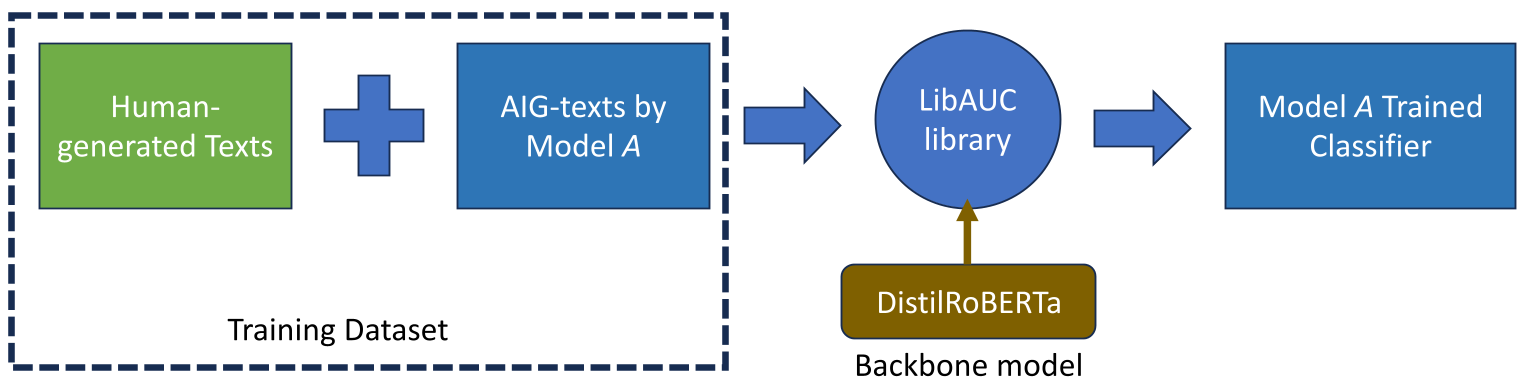 Figure 1: The framework for training cross-family classifiers.
The Results: The OpenAI Exception
The experiment results were striking. When classifiers were trained on "General" AI data, they were nearly perfect at spotting Llama or GLM text. But when faced with OpenAI, the performance plummeted.
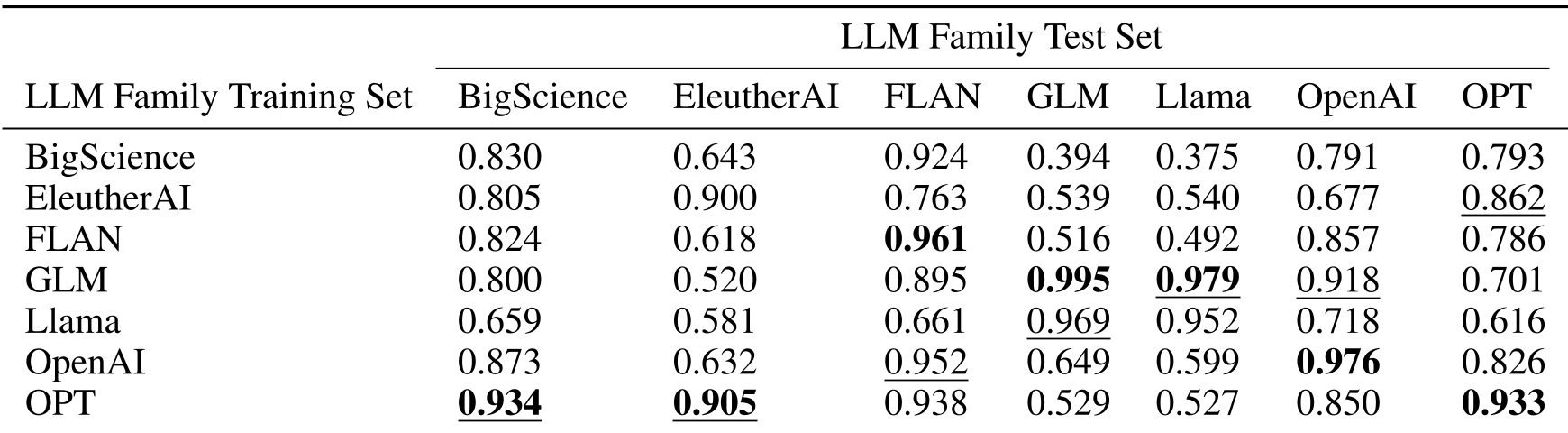 Table: In CMV (Opinion) writing, notice how the OpenAI row/column often shows lower cross-family generalization.
The Statistical smoking gun: Entropy & OOV
To understand why OpenAI is harder to catch, the researchers looked at Shannon Entropy (text complexity) and Out-of-Vocabulary (OOV) ratios.
- Human Text: Highly complex, uses "rare" words (High Entropy, High OOV).
- Standard LLMs: Lower complexity, safer word choices (Lower Entropy).
- OpenAI LLMs: Their distribution shifts significantly to the right, overlapping with human patterns.
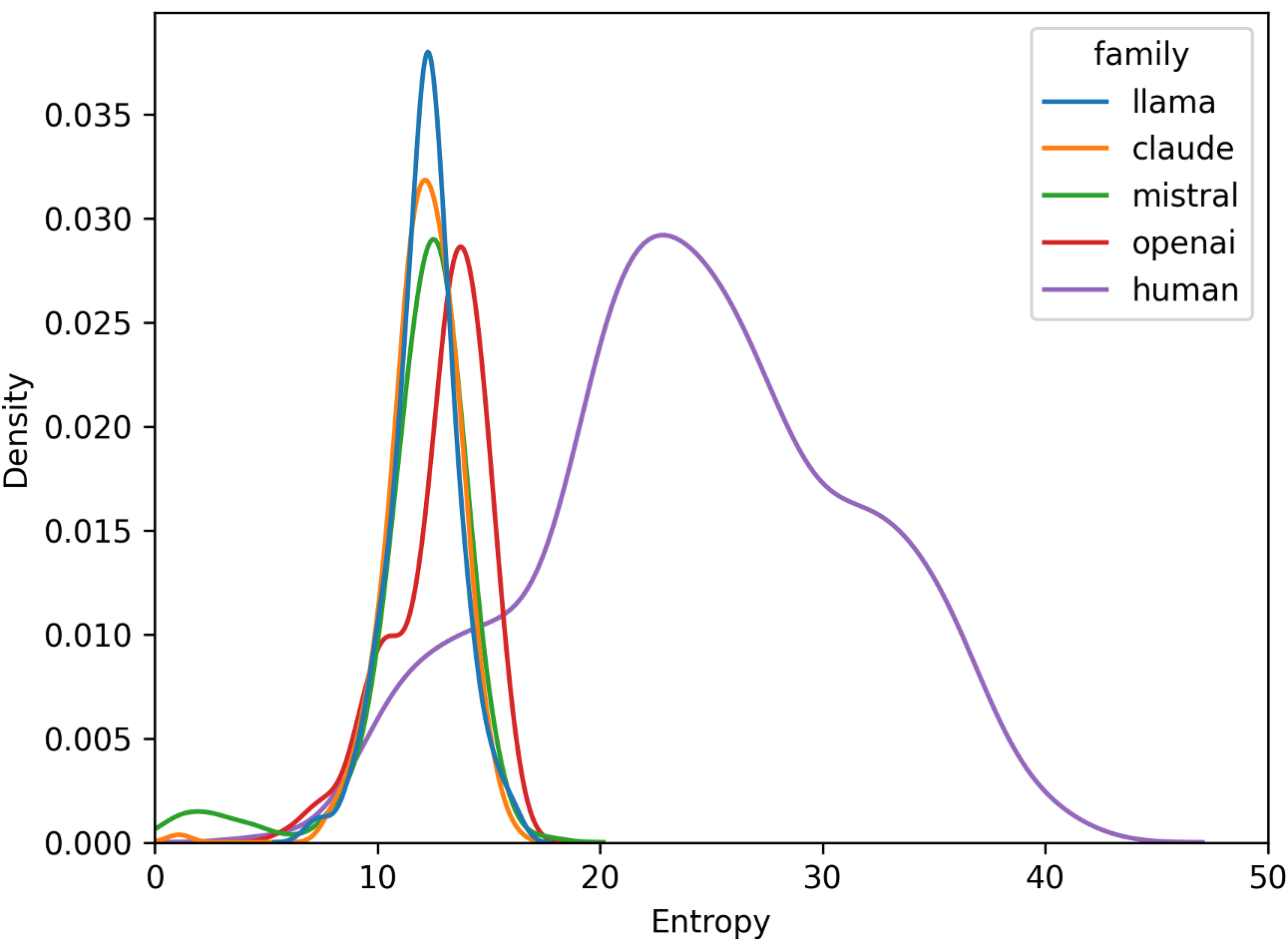 Figure 4: Kernel density estimates showing OpenAI's entropy (purple) mirroring human text (red) more closely than Claude or Llama.
Critical Insight: The "Rewrite" Attack
The study introduced the Rewritten Ivy Panda (RIP) dataset, where LLMs were specifically told to "imitate word using habits" and "be different from the original." This adversarial prompting significantly boosts the model's ability to evade detection, suggesting that the intent of the user is just as important as the architecture of the model.
Conclusion & Future Outlook
The takeaway for the industry is clear: Universal AI detectors are currently a myth. A detector trained on last year's models will likely fail against tomorrow's GPT-5.
The study concludes that for detection to be viable, we must:
- Crate more diverse training sets that include "rewrite" attacks.
- Focus on domain-specific detectors rather than one-size-fits-all solutions.
- Acknowledge the inherent limitations as LLMs continue to close the entropy gap with human authors.
Limitations: The study focused on long-form text (essays, stories). Short-form content (tweets, reviews) remains an open—and perhaps even more difficult—frontier for AIG detection.