
RoG: Synergizing LLMs and Knowledge Graphs for Faithful and Interpretable Reasoning
Reasoning on graphs: Faithful and interpretable large language model reasoning
RoG (Reasoning on Graphs) is a novel planning-retrieval-reasoning framework that synergizes Large Language Models (LLMs) with Knowledge Graphs (KGs) for Knowledge Graph Question Answering (KGQA). It utilizes LLMs to generate relation paths as faithful plans, retrieves specific reasoning paths from KGs, and conducts final reasoning, achieving SOTA results on WebQSP and CWQ datasets.
TL;DR
Large Language Models (LLMs) are brilliant but often "hallucinate" logic. Reasoning on Graphs (RoG) fixes this by forcing the LLM to first generate a Relation Path (a plan grounded in a Knowledge Graph) before searching for answers. This dual-module approach allows the model to achieve State-of-the-Art (SOTA) performance on complex KGQA benchmarks like CWQ while providing a clear, step-by-step explanation of its logic.
The Problem: Hallucinations and Structural Blindness
Even the most powerful LLMs like GPT-4 struggle with specific factual queries that require multi-hop reasoning. Current solutions usually fall into two traps:
- Semantic Parsing: They turn questions into code (like SPARQL). If the code has a tiny syntax error, you get zero answers.
- Retrieval-Augmentation (RAG): They treat Knowledge Graphs (KGs) as a pile of text. They retrieve raw facts but ignore the structural connections—the "paths"—that actually lead to the answer.
Without a structured plan, an LLM might know who Justin Bieber is but hallucinate a relationship like "has a daughter" simply because it sounds plausible, leading to an incorrect reasoning chain.
Methodology: Planning, Retrieval, and Reasoning
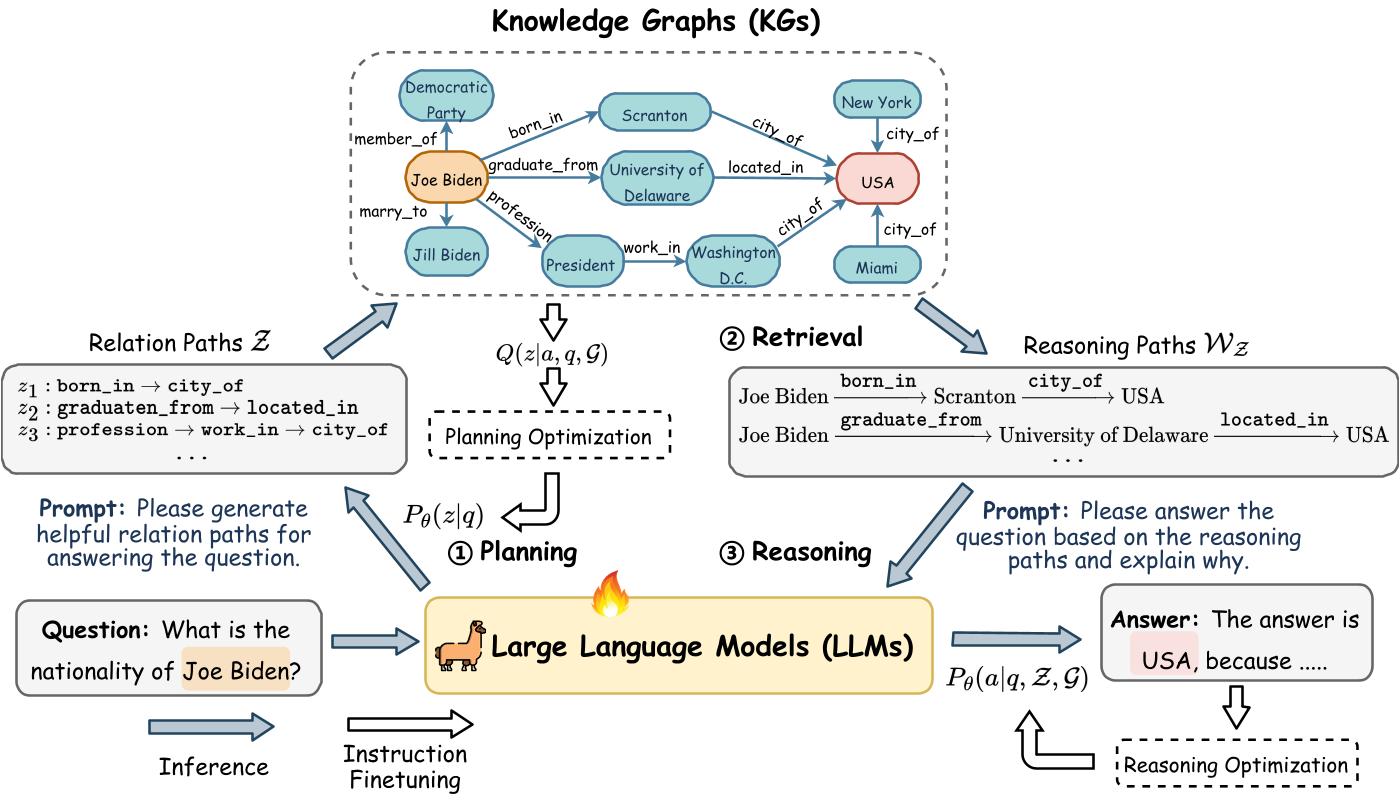
The core insight of RoG is that Relations in a KG are more stable and logically sound than Entities. RoG breaks the task into a three-step pipeline:
1. Planning Module (The Map)
Instead of jumping to an answer, RoG generates a Relation Path. For example, for the question "Who is the brother of Justin Bieber?", the plan might be: child_of → has_son. This plan is grounded in the KG's schema, ensuring it exists in reality.
2. Retrieval Module (The Evidence)
RoG takes that abstract plan and searches the KG for real instances. It finds the actual people matching those relations (e.g., Justin Bieber → child_of → Pattie Mallette → has_son → Jaxon Bieber).
3. Reasoning Module (The Conclusion)
The LLM looks at the retrieved paths and the original question to synthesize the final answer and explain its reasoning in natural language.
Optimization: Distilling Graph Logic
To make this work, the authors didn't just prompt the LLM; they fine-tuned it using two specific losses:
- Planning Optimization: Teaches the LLM to generate paths that actually exist in the KG.
- Reasoning Optimization: Teaches the LLM to ignore "noise" in retrieved paths and focus on those that answer the user's intent.
Experimental Performance: Shattering the Baseline
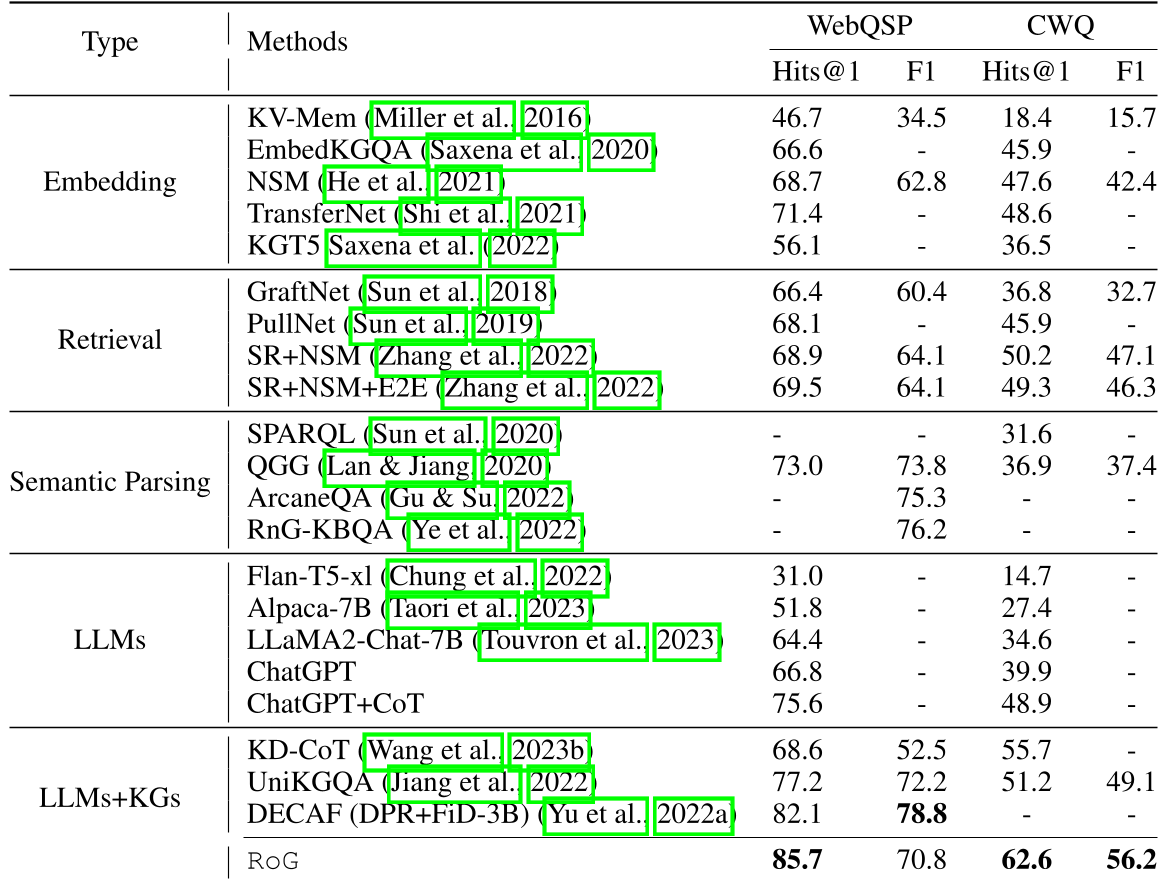
RoG was tested on WebQSP and Complex WebQuestions (CWQ). The results were dramatic:
- CWQ Hits@1: Jumped from a previous SOTA of 51.2% to 62.6%.
- Interpretability: Because RoG follows specific paths, it can explain its answers step-by-step, unlike standard LLMs which are "black boxes."
Plug-and-Play Flexibility
One of the most impressive results is that you don't always need to use the RoG-tuned model for the final reasoning. You can use the RoG Planning Module to get the reasoning paths and then feed those paths to ChatGPT. This improved ChatGPT’s performance on WebQSP from 66.8% to 81.5%.
Critical Insight & Limitations
RoG effectively bridges the gap between symbolic reasoning (graphs) and neural reasoning (LLMs). By using relations as the "bridge," it overcomes the sensitivity of semantic parsing while retaining the factual rigor of KGs.
Limitations:
- Retrieval Speed: As the number of paths () increases, retrieval time grows.
- KG Dependency: It is only as good as the Knowledge Graph it queries. If the KG is missing a relation, RoG cannot "invent" it.
Conclusion: Toward Faithful AI
RoG represents a shift in how we build AI agents. Instead of hoping an LLM remembers a fact, we provide it with a map (the KG) and teach it how to read the signs (the relations). This results in AI that is not only smarter but also miles more trustworthy.
Senior Editor's Note: RoG is a seminal example of "Neuro-Symbolic" AI, proving that the future of LLMs isn't just bigger models, but better integration with structured human knowledge.