
[Survey 2024] LLM-as-a-Judge: The New Frontier of Automated Evaluation and Self-Evolution
From generation to judgment: Opportunities and challenges of llm-as-a-judge
This paper provides a comprehensive survey of the "LLM-as-a-judge" paradigm, a transformative approach where Large Language Models are used to evaluate machine learning outputs through scoring, ranking, or selection. It introduces a systematic taxonomy across three dimensions—attributes (what to judge), methodology (how to judge), and benchmarks (how to evaluate judges)—while highlighting the critical shift from traditional static metrics to dynamic, human-like automated assessment.
TL;DR
The "LLM-as-a-judge" paradigm is replacing static metrics (like BLEU) with dynamic, LLM-driven assessments. This comprehensive survey formalizes the field, detailing how models like GPT-4 are now used to score, rank, and even train other models. By moving beyond simple text matching, this approach allows for the evaluation of "untrackable" traits like helpfulness, logic, and safety at a massive scale.
Problem & Motivation: The Failure of Static Metrics
For decades, NLP relied on lexical overlap (e.g., ROUGE). If a model's output shared words with a reference, it was "good." However, in the era of generative agents, a response can be factually perfect but socially toxic, or logically flawed yet high in word overlap. Traditional metrics are blind to these nuances. LLM-as-a-judge was born from the necessity of having a scalable, "human-like" evaluator that understands context, intent, and subtle reasoning.
Methodology: How to Build a Digital Judge
The paper breaks down the judging process into a clean I/O framework:
- Input: Models can judge a single response (Point-wise) or compare multiple responses (Pair/List-wise).
- Output: Judges don't just say "Pass/Fail"; they provide quantitative Scores, relative Rankings, or final Selections for decision-making.
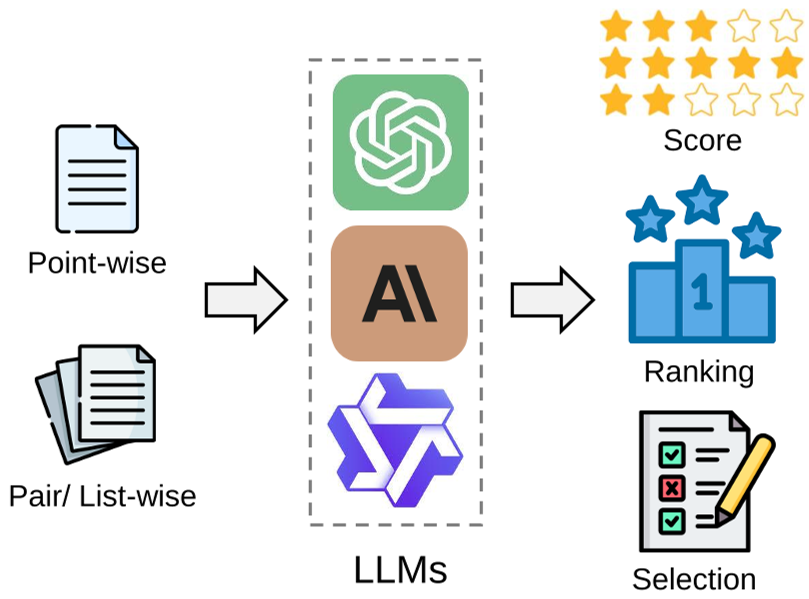
The survey highlights two main paths to improving these judges:
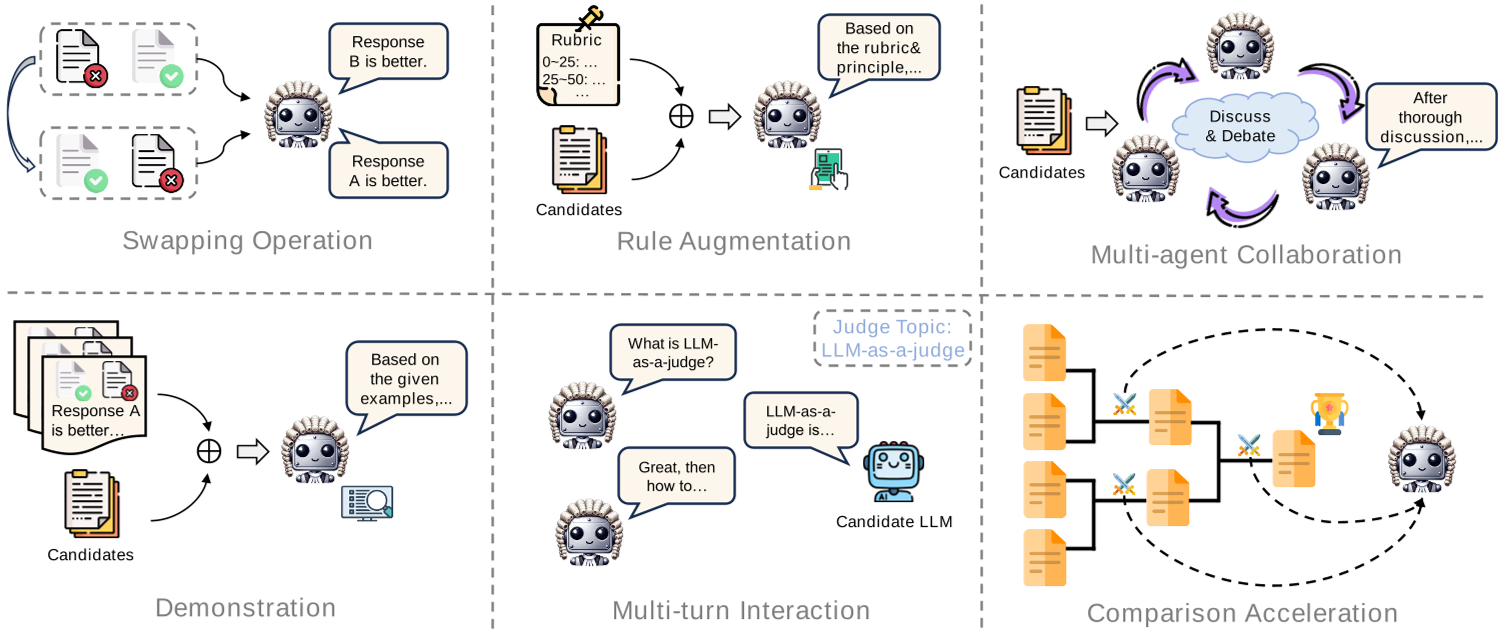
- Tuning: Training smaller "evaluator" models (like PandaLM or Prometheus) using SFT or DPO on human preference data.
- Prompting: Advanced strategies like Multi-agent Collaboration (where models debate a score) and Swapping Operations (to fix the "positional bias" where models favor the first response they see).
Key Dimensions: What are we actually judging?
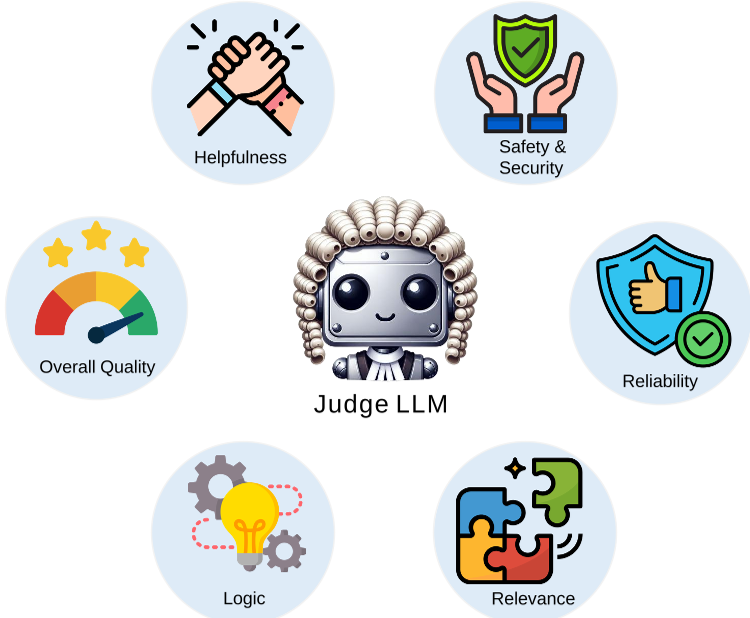
The authors identify six core attributes that LLMs are uniquely equipped to handle:
- Helpfulness: Utility and informativeness.
- Safety: Detecting toxic or adversarial prompts.
- Reliability: Measuring faithfulness (hallucination detection).
- Relevance: Alignment with the user's specific query.
- Logic: Internal coherence of the reasoning steps.
- Overall Quality: A holistic synthesis of multiple metrics.
Critical Insight: Bias and Vulnerability
The most striking part of the survey is the admission that Judges are not perfect. They suffer from:
- Verbosity Bias: Favoring longer responses even if they're redundant.
- Self-Preference: LLMs tend to rank their own generations higher.
- Adversarial Vulnerability: Subtle "prompt injections" can trick a judge into giving a high score to a harmful response.
Experiments & Benchmarking
The paper reviews benchmarks like MT-Bench and Chatbot Arena, which have become the industry standard for evaluating the evaluators. They emphasize that the highest-quality judges today utilize Inference-Time Scaling (ITS)—allowing the judge to "think" or generate a chain-of-thought (CoT) before issuing a verdict.
Conclusion & Future Outlook
The move from Generation to Judgment marks the "closing of the loop" in AI development. When models can judge themselves accurately, we enter the realm of Self-Evolution, where AI improves without constant human labeling. However, the authors warn that until we solve egocentric and length biases, human-in-the-loop "co-judgment" remains essential for high-stakes domains like medicine and law.