
Group Testing: The Information-Theoretic Frontier and Optimal Rates
Group Testing: An Information Theory Perspective
This monograph systemically explores the group testing problem from an information-theoretic perspective, focusing on nonadaptive randomized designs for sparse defective identification. It identifies 'optimal rates'—the amount of information gained per test—and highlights breakthrough spatially-coupled designs and algorithms that achieve the capacity limit with polynomial-time decoding.
TL;DR
Group testing is the art of identifying a few "defective" items among many by pooling samples. This monograph redefines the field by moving from simple scaling laws to precise "optimal rates"—calculating exactly how many bits each test yields. The authors reveal that while adaptive testing is supreme, nonadaptive testing can remarkably reach a rate of 1 bit/test in very sparse regimes, provided we use advanced strategies like near-constant tests-per-item and spatial coupling.
Problem & Motivation: Beyond the Blood Test
The core challenge of group testing (originating from WWII syphilis screening) is to minimize (tests) to find defectives among items. Existing individual testing is wasteful (), while early nonadaptive theories were hindered by the "Zero-Error" trap, which mandates tests—a massive overhead.
The authors argue that by accepting a vanishingly small error probability, we can achieve , potentially saving thousands of tests. The real question is: What is the fundamental limit of this efficiency (Capacity), and can we reach it with practical algorithms?
Methodology: The Information Scale
The monograph assesses algorithms by their Rate: A rate of 1 means every test is perfectly informative.
1. Test Designs: Randomness as a Tool
- Bernoulli Design: Items enter tests with probability . Simple but slightly "clumpy"—some items are tested too often, others not enough.
- Near-Constant Tests-Per-Item: Each item is guaranteed to be in exactly tests. This "regularity" provides a 30% efficiency boost over Bernoulli designs.
2. Spatially Coupled Coding
To reach the optimal rate for all sparsity levels (), the authors highlight Spatial Coupling. This involves breaking items into compartments where information from one "leaks" into the next, creating a wave-like decoding process that allows simple algorithms to handle much denser defectives than they otherwise could.
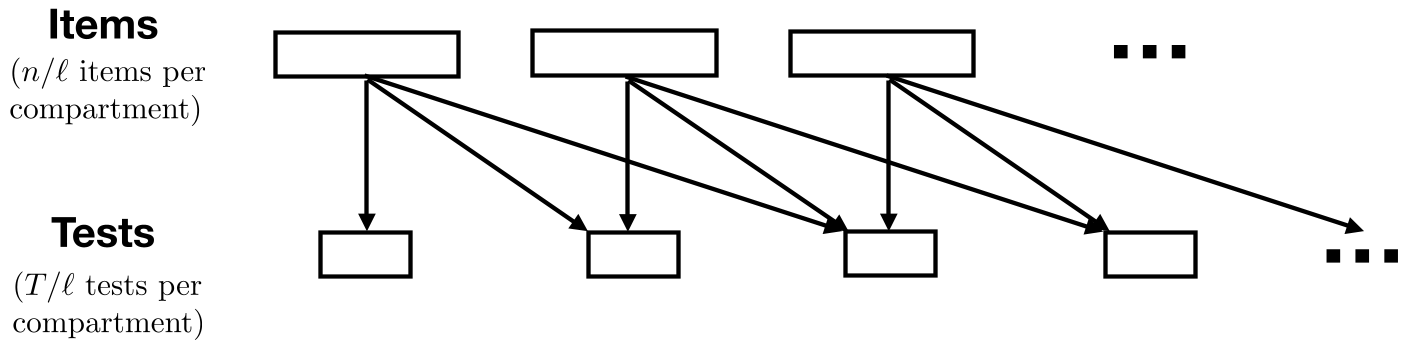 Figure 1: Spatially coupled test design showing information propagation across compartments.
Algorithmic Landscape
The paper categorizes algorithms by their trade-offs between speed and efficiency:
| Algorithm | Optimal Rate? | Decoding Speed | Feature |
|---|---|---|---|
| COMP | No | Very Fast | Discards items in negative tests. |
| DD (Definite Defectives) | Yes (for ) | Fast | Only marks items that are the lone potential defective in a test. |
| SSS (Smallest Satisfying Set) | Yes | Slow (NP-hard) | Brute-force search for the smallest set that fits results. |
| Spatially Coupled SPIV | Yes (All ) | Polynomial | Uses "compartmentalized" decoding to reach capacity. |
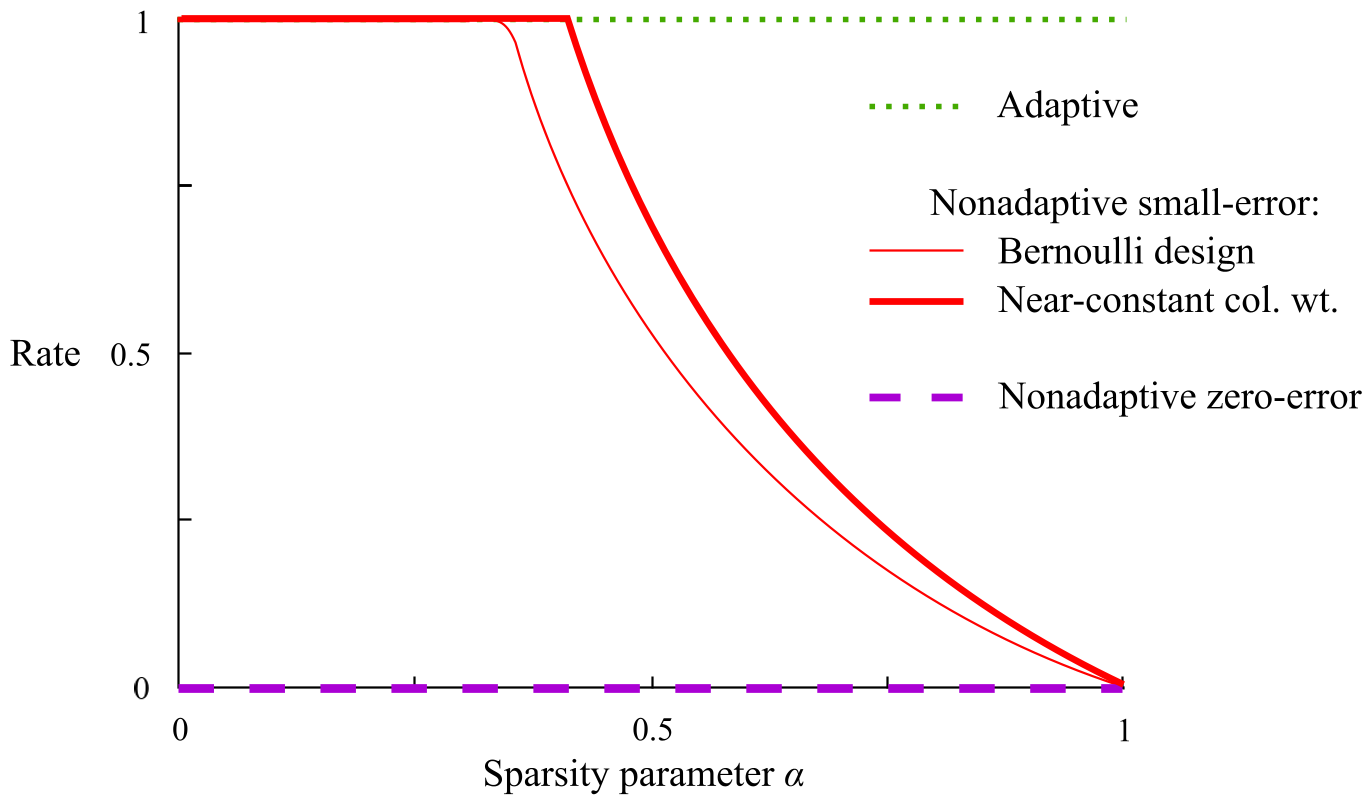 Figure 2: Rate thresholds for different designs. Note the superiority of the Near-Constant Column (NCC) design.
Key Results: Breaking the 1-Bit Barrier
The monograph proves that:
- NCC Design achieves a rate of 1 for .
- Adaptive Testing always reaches a rate of 1, but requires sequential steps that are often too slow for parallel PCR or network tomography.
- Noisy Settings: Even with 11% noise (), the capacity remains strictly bounded by , and we can now precisely calculate the "algorithmic gaps" for practical solvers like Belief Propagation (BP).
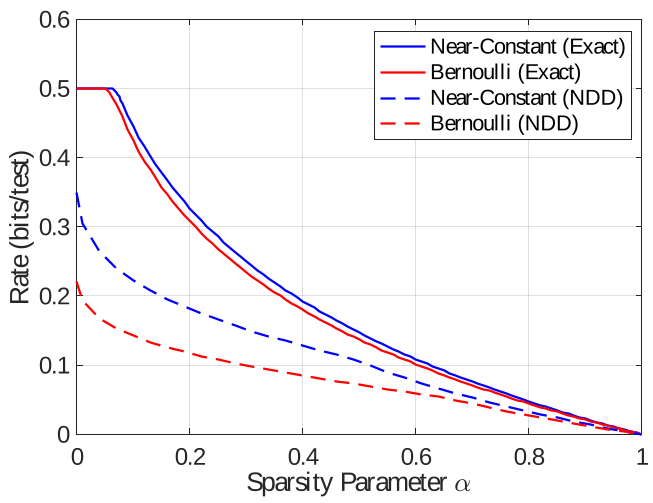 Figure 3: Achievable rates under symmetric noise. BP and LP heuristics often outperform theoretical bounds in practice.
Critical Analysis & Conclusion
Takeaway
This work transforms group testing from a combinatorial curiosity into a rigorous branch of communication theory. The proof that spatially coupled designs are nonadaptively optimal is a theoretical milestone, bridging the gap between "what's possible" and "what's computable."
Limitations & Future Work
- The Practicality Gap: While spatially coupled SPIV is polynomial-time, its "real-world" constant factors compared to simple DD or COMP remain untested at moderate scales (e.g., ).
- Beyond Bernoulli: The search for a test design that is simultaneously optimal, explicit (not random), and sublinear-time in decoding remains the "Holy Grail."
The second edition successfully reflects the surge of interest spurred by the COVID-19 pandemic, proving that information theory isn't just about bits—it's about the efficient management of scarce resources in times of crisis.