
HeartSway: Turning Heartbeats into Poetic Traces in the Urban Wild
HeartSway: Exploring Biodata as Poetic Traces in Public Space
HeartSway is an interactive public installation that uses a haptic-enabled hammock to capture and archive a user's biodata (heart rate and micro-movements) and replay it asynchronously for the next occupant. By physicalizing biometric "traces," it transforms a solitary relaxation experience into a poetic, non-verbal connection between strangers.
TL;DR
HeartSway is an interactive hammock that captures the heart rate and physical restlessness of its occupant, only to "play back" those movements and rhythms for the next stranger who lies in it. By archiving intimate biodata as ephemeral traces, it fosters a unique form of "asynchronous intimacy" on university campuses, proving that even anonymous data can create a profound sense of human connection.
Beyond Data: The Motivation for Urban Traces
Modern urban planning and digital life often strip away the "smudges" of human presence, leaving us in sterile, anonymous spaces. While we might feel the warmth of a recently vacated park bench, most of our biological "traces"—our racing hearts, our sighs, our fidgeting—are invisible and lost to time.
The authors of HeartSway argue that biodata (physiological signals) can be treated as a design material. They moved away from "clinical" biodata (tracking health) and toward "poetic" biodata—using vibrations and swinging motions to evoke the feeling of a person's presence without actually meeting them.
Methodology: The Architecture of a Collective Breath
The system is deceptively simple but philosophically deep. It consists of:
- Sensing: A fingertip pulse sensor and a conductive rubber stretch sensor attached to the hammock strings.
- Archiving: Data is stored in a local time-series database on a Raspberry Pi.
- Actuation: When the next person sits down, a vibration motor in the pillow mimics the previous user’s heartbeat, and a linear actuator pulls the hammock to replicate their tossing and turning.
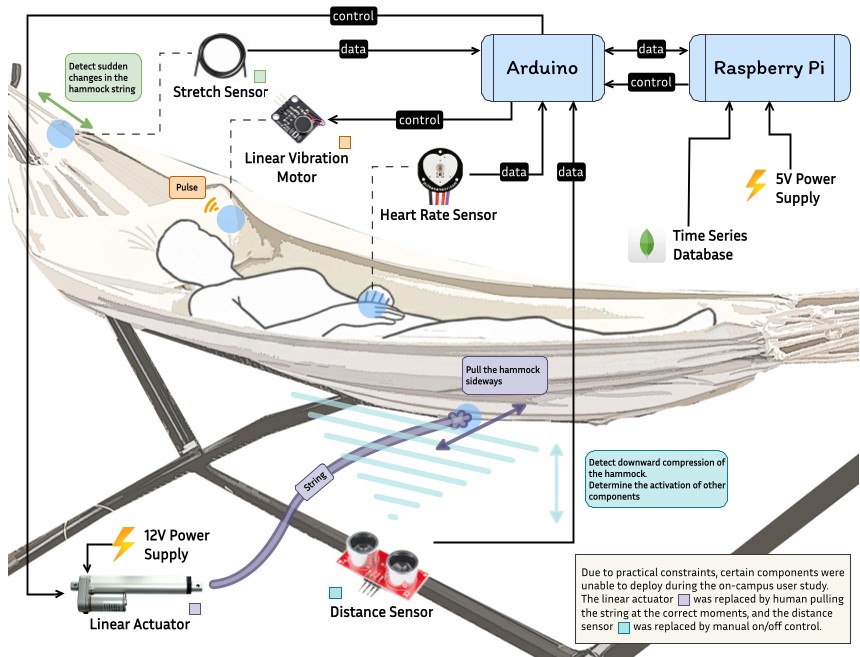
The brilliance here lies in the intentional ambiguity. The system doesn't tell you the prior user was "stressed"; it just lets you feel a fast heartbeat. This forces the user into a state of reverie, where they imagine the life of the person who came before them.
Experimental Insights: Asynchronous Intimacy
During a field study on a university campus, the researchers found that HeartSway triggered three distinct types of reactions:
- Physical Relaxation: Users found the heartbeat vibrations "reassuring" and "comforting," often falling into a meditative state.
- Genuine Connection: Even though the users were strangers, they felt a sense of care. One participant noted they felt "powerless to help" when they felt the previous user's heart racing, showing spontaneous empathy.
- Safe Intimacies: Participants liked the anonymity. It allowed them to feel "human warmth" without the social pressure or "shyness" of a face-to-face encounter.
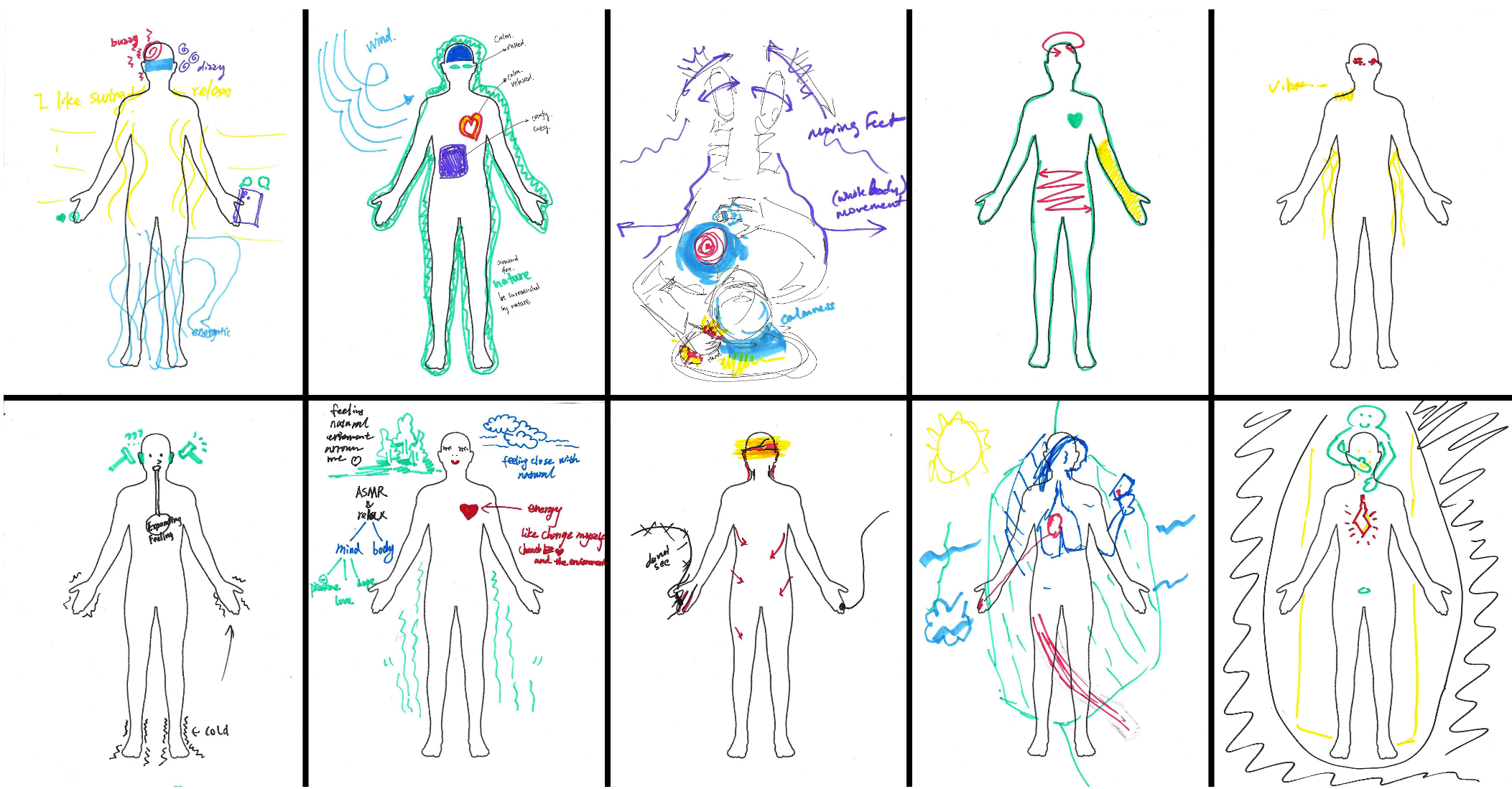 Figure: Participants used body maps to describe where they felt the "presence" of the stranger—often as a spiritual companion or a protective energy.
Critical Insight: The "Materiality" of the Archive
The paper introduces a powerful conceptual shift: Somatic Authoring. Usually, we think of "authoring" as writing or speaking. Here, the body "authors" an experience through its involuntary rhythm.
The authors also embrace Ephemerality. Each trace is overwritten by the next user. This mirrors the natural erosion of memories and physical traces in a city, making the experience feel precious because it is fleeting.
Limitations & Future Outlook
While the study was successful, it was conducted within a tight-knit university community. Whether this "friendly approach" of a stranger's heartbeat would be welcomed in a more high-stress or suspicious environment (like a subway station) remains to be seen. Furthermore, the "power imbalance"—where researchers hold the data while users only experience fragments—is a tension that future designers of public "bio-installations" must resolve.
Conclusion
HeartSway suggests a future where our public amenities—benches, swings, bus stops—don't just serve a function, but act as "vessels" for the collective vitality of the city. It reminds us that even in a world of digital anonymity, we are all "flesh and blood," connected by the simple, rhythmic thrum of a heartbeat.