
*An Information-Theoretic Bound on Thermodynamic Efficiency*: Why Carnot Is Sometimes Too Loose, and How Correlations Tighten the Limit
An Information-Theoretic Bound on Thermodynamic Efficiency and the Generalized Carnot's Theorem
This paper studies thermodynamic efficiency bounds for thermal engines and introduces an information-theoretic upper bound, η*, that depends on correlations between the engine state and Hamiltonian rather than only on bath temperatures. The bound applies to both classical and quantum engines, becomes strictly sharper than Carnot in many finite-time and multi-bath settings, and recovers Carnot exactly in the reversible two-bath limit. The authors also show that a single-level quantum-dot engine can saturate the bound even beyond the quasistatic regime.
Executive Summary
TL;DR
Carnot’s bound is fundamental, but for realistic engines it is often not the bound you actually care about. This paper derives a sharper efficiency ceiling, denoted η*, that depends on the internal statistics of the working medium—specifically on correlations among the engine state, its rate of change, and its Hamiltonian. The result applies to both classical and quantum engines, can be saturated even in finite-time irreversible cycles, and reduces to a generalized Carnot formula for reversible multi-bath processes. A single-level quantum-dot engine provides a concrete example where the new bound is exactly achieved.
Background Positioning
This is not just another finite-time thermodynamics paper tweaking Carnot with phenomenology. Its real contribution is conceptual: it reframes efficiency as an information-geometric constraint arising from the internal dynamics of the engine, not merely from the temperatures of external reservoirs. In that sense, the paper sits between nonequilibrium thermodynamics, information theory, and open quantum systems, and offers a principled design criterion rather than only a looser second-law statement.
Problem & Motivation
Carnot’s theorem says that for a heat engine operating between a hot bath at temperature (T_h) and a cold bath at temperature (T_c), [ \eta \le \eta_C = 1 - \frac{T_c}{T_h}. ]
This is exact, elegant, and historically foundational. But from an engineering perspective, it is often too blunt.
Why?
- It is saturated only in reversible cycles. Real machines operate in finite time, not in the quasistatic limit.
- It depends only on bath temperatures. It says nothing about whether the engine’s internal control protocol is optimal.
- It is least informative exactly where modern thermodynamics is most interesting. Finite-time cycles, multiple baths, noisy control, and nonequilibrium working media are now central in nanoscale and quantum thermodynamics.
The authors target a sharper question:
Given the actual internal state trajectory ( \rho(t) ) and the accessible Hamiltonian ( H(t) ), what is the maximum efficiency physically compatible with those resources?
That is a stronger and more useful notion than a purely environmental limit.
The central intuition
Heat flow is not just “energy entering or leaving.” It is mediated by how the system state changes relative to the energy landscape. If the evolution of the state is statistically well aligned with the Hamiltonian structure, heat exchange can be organized efficiently. If not, dissipation grows.
So the authors look for an efficiency bound expressed directly in terms of correlations internal to the engine.
Methodology - The Core
The formal setting is a driven open system with state ( \rho(t) ) and Hamiltonian ( H(t) ), evolving under a Lindblad equation: [ \dot{\rho}(t) = -i[\rho(t),H(t)] + \mathcal{L}_t(\rho(t)). ]
This covers both quantum and classical engines; the classical case is recovered when ( [\rho(t),H(t)] = 0 ) at all times.
Step 1: Re-express heat current as a covariance
The heat current is defined as [ \dot{Q}(t) = \mathrm{Tr}{\dot{\rho}(t) H(t)}. ]
A core observation of the paper is that this can be rewritten as [ \dot{Q}(t) = \mathrm{Cov}\left(\frac{d\log \rho(t)}{dt}, H(t)\right). ]
This is the conceptual pivot of the whole work.
Instead of viewing heat current as a thermodynamic bookkeeping term, the authors interpret it as a statistical correlation between:
- the instantaneous deformation of the state, (d\log\rho/dt),
- and the system’s energy operator, (H(t)).
That immediately suggests an information-theoretic route: if heat is a covariance, it should be upper-bounded by correlation inequalities.
Step 2: Bring entropy dynamics into the same correlation structure
The entropy rate satisfies [ \dot{S}(t) = -\mathrm{Tr}{\dot{\rho}(t)\log\rho(t)} = -\mathrm{Cov}\left(\frac{d\log\rho(t)}{dt}, \log\rho(t)\right). ]
Now three quantities become naturally linked:
- ( d\log\rho/dt ): how the state changes,
- ( \log\rho ): the information content of the state,
- ( H ): the energy landscape.
This triad defines the correlation geometry of the engine.
Step 3: Use a correlation-matrix consistency condition
The authors build the correlation matrix of [ V(t)=\left{\frac{d\log\rho(t)}{dt},\log\rho(t),H(t)\right}. ]
The requirement that this correlation matrix be physically consistent, i.e. have nonnegative determinant, implies an upper bound on the heat current: [ \dot{Q}(t) \le \mathcal{I}(t), ] where ( \mathcal{I}(t) ) is the maximal admissible instantaneous heat current compatible with the observed correlations.
The explicit form is [ \mathcal{I}(t)=\Big(R_S(t)R_G(t)+\sqrt{(1-R_S^2(t))(1-R_G^2(t))}\Big), \mathrm{SD}(H(t)),\mathrm{SD}!\left(\frac{d\log\rho(t)}{dt}\right), ] with correlation coefficients (R_S) and (R_G) encoding the alignment between entropy production, state information, and energy.
What does this mean physically?
The bound says that heat transfer is limited by three things:
- How broad the accessible energy spectrum is: ( \mathrm{SD}(H) )
- How rapidly the state’s information content is changing: ( \mathrm{SD}(d\log\rho/dt) )
- How well those directions are correlated: the Pearson-type coefficients (R_S, R_G)
So the engine’s performance is constrained not only by temperatures, but by its internal statistical organization.
Step 4: Integrate the instantaneous bound over the cycle
For a cyclic engine, efficiency is [ \eta = 1 - \frac{\int_- |\dot{Q}(t)|dt}{\int_+ \dot{Q}(t)dt}. ]
Replacing the actual heat current by its maximal allowed value yields the main theorem: [ \eta \le \eta^* = 1 - \frac{\int_- -\mathcal{I}(t),dt}{\int_+ \mathcal{I}(t),dt}. ]
This is the new information-theoretic efficiency bound.
Why can finite-time irreversible engines saturate the bound?
This is one of the paper’s most interesting claims.
The bound is saturated when the three variables in the correlation triad become linearly dependent in the appropriate sense. The nontrivial solution is when the system state is Gibbsian with respect to its own instantaneous Hamiltonian: [ \rho(t) = \frac{e^{-\beta(t)H(t)}}{Z(t)}. ]
Crucially, this does not require equilibrium with the environment. The system may have an internal inverse temperature ( \beta(t) ) different from the bath value.
That is the subtle but important message:
- Carnot saturation requires reversibility with the environment
- η saturation only requires a structured internal Gibbs form*
This is why a finite-time irreversible engine can achieve η* while still remaining below Carnot.
From η* to a Generalized Carnot Theorem
The second major result concerns reversible cycles involving multiple baths or effectively time-varying environmental temperatures.
For such reversible engines, the information-theoretic bound reduces to [ \eta \le \eta_{\mathcal R}^* = 1 - \frac{\overline{T}-}{\overline{T}+}, ] where ( \overline{T}- ) and ( \overline{T}+ ) are entropy-weighted average temperatures over heat-release and heat-absorption segments.
This is a genuine generalization of Carnot:
- for the standard two-bath reversible case, it reduces to (1 - T_c/T_h),
- for multi-bath reversible cycles, it gives the exact maximal efficiency,
- and in many cases it is much tighter than simply plugging in extreme temperatures.
This is more than a technical generalization. It clarifies that the relevant thermal scale for reversible efficiency is not necessarily the minimum or maximum bath temperature, but the entropy-weighted thermal profile experienced along the cycle.
Experiments & Results
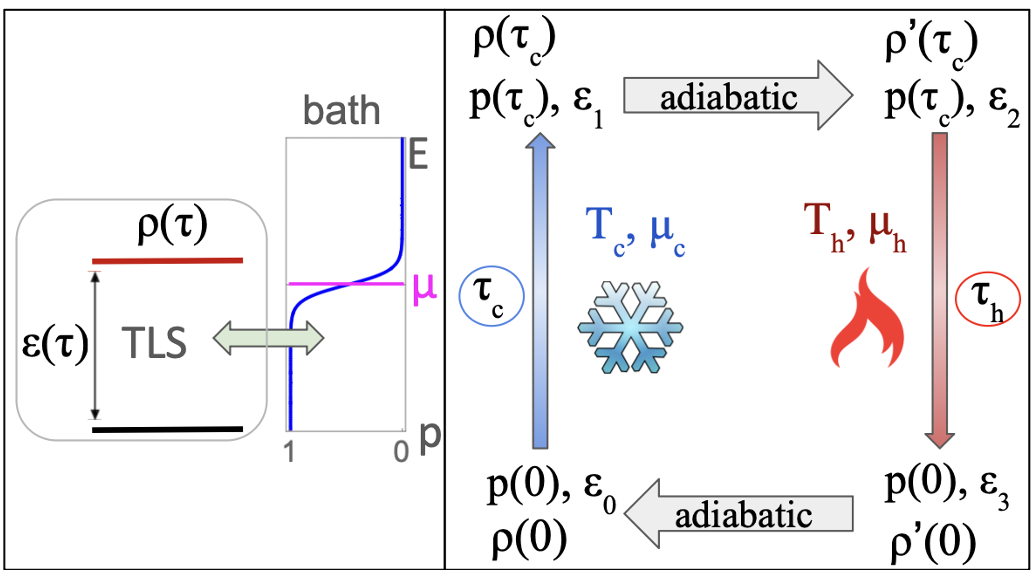
The paper validates the theory with a realistic model: a single-level quantum dot coupled alternately to cold and hot fermionic baths.
Engine setup
The dot is a two-level occupancy system with Hamiltonian [ H(t) = \epsilon(t)\frac{I+\sigma_z}{2}, ] where ( \epsilon(t) ) is the level offset controlled by a gate voltage.
The cycle has four strokes:
- finite-time cold isothermal-like stroke with rising energy level,
- fast adiabatic shift,
- finite-time hot isothermal-like stroke with descending energy level,
- fast adiabatic reset.
Population dynamics in the thermal-contact strokes obey a master equation [ \dot p(t)=\gamma_\uparrow(1-p(t))-\gamma_\downarrow p(t), ] with fermionic transition rates satisfying detailed balance.
Why this example matters
Because the density matrix remains diagonal in the energy basis throughout the cycle, ( \log\rho(t) ) is linearly dependent on ( H(t) ). Therefore, the condition for saturating the bound is naturally met.
So this is not merely an example showing that the bound is valid. It is an example showing that the bound is achievable in an experimentally meaningful platform.
Main empirical message
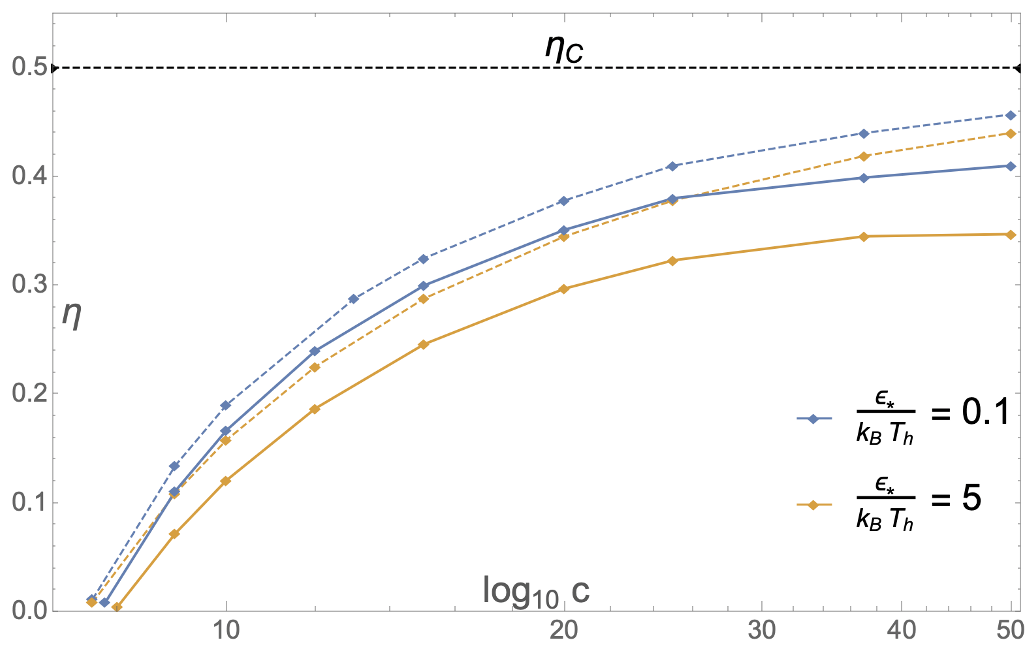
The authors vary the dimensionless coupling parameter (c=\Gamma au), which effectively compares cycle duration to relaxation time.
- Large (c): quasistatic regime, the engine approaches Carnot.
- Finite (c): the engine is irreversible, so efficiency stays below Carnot.
- Nevertheless: the engine still satisfies ( \eta=\eta^* ).
That is the key distinction:
- Carnot is not reachable at finite time.
- The new bound remains sharp and achievable at finite time.
Effect of noisy control
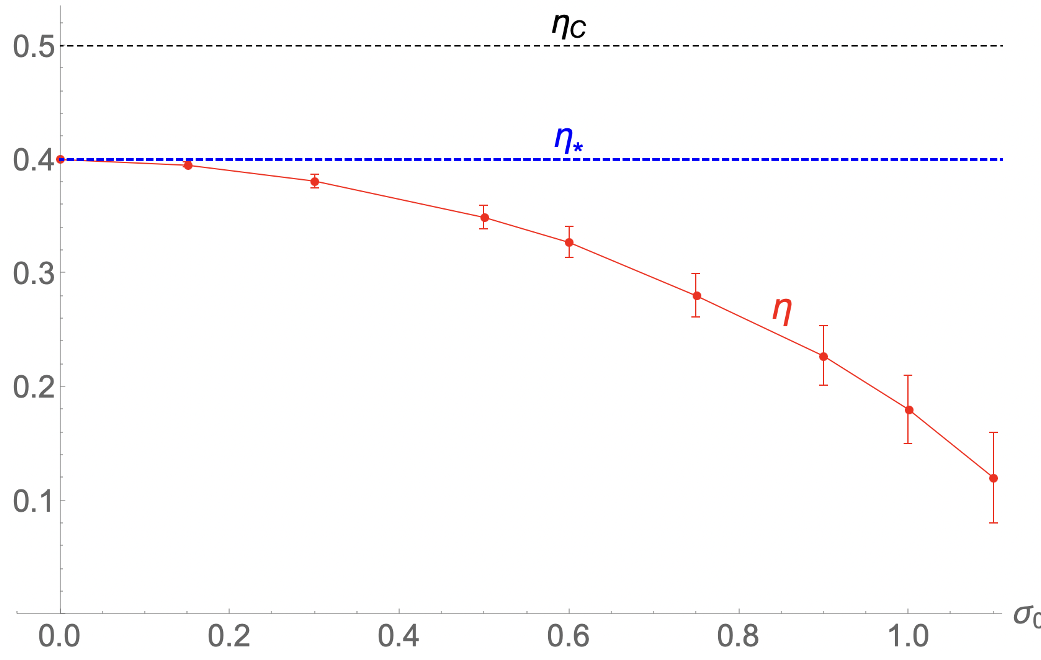
The authors then perturb the control protocol with stochastic fluctuations: [ \epsilon(t) o \epsilon(t)+\sigma \xi(t), ] where ( \xi(t) ) is Gaussian white noise.
This models imperfect gate control in realistic devices.
The outcome is exactly what the theory predicts:
- in the noise-free case, the engine saturates ( \eta^* ),
- with control noise, efficiency drops below ( \eta^* ),
- ( \eta^* ) still remains an informative upper bound,
- Carnot remains valid but is much less diagnostic.
So η* is not just a theorem. It is a design benchmark: if your device falls below it, the shortfall reflects imperfect use of internal resources, not merely the second law.
Ablation-Style Interpretation: What Actually Drives the Gain?
Although this is not a machine learning paper, there is an Ablation Study-like logic in the case study.
Component 1: Finite-time operation
Finite time alone does not destroy tightness of the new bound.
- It destroys reversibility, so Carnot becomes unattainable.
- But it does not prevent the working medium from staying Gibbsian with respect to its own instantaneous Hamiltonian.
- Therefore η* can still be saturated.
This is arguably the paper’s strongest insight.
Component 2: Full Hamiltonian controllability
The bound becomes operational when the Hamiltonian can be tuned to align the internal state dynamics with the energy structure.
- Good control lets the engine exploit the allowed correlation geometry.
- Poor control wastes that structure.
Component 3: Stochastic control noise
Noise breaks the ideal alignment.
- The working medium no longer tracks the intended energy profile cleanly.
- Correlation structure degrades.
- Efficiency drops below η*.
So the main “active ingredient” is not quantumness per se. It is structured alignment between state information and energy levels under controllable driving.
Critical Analysis & Conclusion
Takeaway
This paper provides a principled answer to a long-standing practical limitation of Carnot’s theorem: Carnot is universal, but often not operationally sharp. By expressing heat flow as a covariance and bounding it via correlation geometry, the authors derive an engine-specific efficiency ceiling that is informative in finite-time, irreversible, and multi-bath settings.
The deepest conceptual shift is this:
Efficiency is not only limited by the environment; it is also limited by how well the engine organizes information and energy internally.
Why the result is important
The value of the bound is threefold:
- Theoretical: it links nonequilibrium thermodynamics to information-theoretic correlation constraints.
- Operational: it gives a benchmark for whether an engine protocol is internally optimal.
- Experimental: it is demonstrated on a platform—quantum dots with fermionic reservoirs—that is technologically plausible.
Limitations
The work is strong, but a few limitations are worth stating clearly.
- Markovian open-system assumption: the derivation relies on Lindblad dynamics. Non-Markovian reservoirs may complicate or alter the bound.
- Practical observability: computing ( \mathcal I(t) ) requires fairly detailed knowledge of ( \rho(t) ), ( H(t) ), and their time dependence, which may be nontrivial in larger systems.
- Case study simplicity: the saturating example is effectively classical in the sense that the density matrix remains diagonal. This is enough to prove relevance, but it leaves open how broadly the sharpness extends in genuinely coherence-rich quantum machines.
- No direct power-efficiency tradeoff analysis: the paper shows finite-time attainability of η*, but does not fully map the corresponding power landscape.
Future Work
Several directions naturally follow.
- Beyond Markovianity: can similar correlation-based bounds be derived with memory effects?
- Autonomous and multi-terminal engines: the generalized reversible bound already points in this direction.
- Quantum coherence and complexity: the paper itself hints at a possible relation between efficiency and circuit complexity, which could become important for engineered quantum thermal machines.
- Control-theoretic optimization: η* suggests a new objective for protocol design—maximize the useful alignment between state deformation and energy structure under hardware constraints.
Final Verdict
This is a conceptually sharp paper with genuine explanatory power. It does not overthrow Carnot; rather, it clarifies when Carnot is the wrong lens for realistic engines. The new bound η* is valuable because it is simultaneously:
- more informative than Carnot in many nonequilibrium settings,
- exact for reversible multi-bath cycles,
- and saturable in realistic finite-time devices.
That combination is rare. It makes the paper more than a formal refinement: it offers a usable principle for designing high-efficiency nanoscale thermal machines.