
IOPO: Mastering the Art of Complex Instruction Following via Input-Output Preference Alignment
IOPO: Empowering LLMs with Complex Instruction Following via Input-Output Preference Optimization
Alibaba researchers introduced TRACE, a large-scale benchmark for complex instruction following, and IOPO (Input-Output Preference Optimization), a novel alignment algorithm. IOPO outperforms traditional DPO by simultaneously optimizing both response (output) and instruction (input) preference pairs, achieving state-of-the-art performance in multi-constraint scenarios.
TL;DR
Alibaba's Tongyi Lab has released a major breakthrough in LLM alignment. By introducing TRACE (a 120k complex instruction dataset) and IOPO (Input-Output Preference Optimization), they’ve addressed a critical weakness in modern LLMs: the inability to juggle multiple fine-grained constraints. IOPO doesn't just teach the model which answer is better; it teaches the model why a specific instruction change requires a different answer.
The "Instruction Blindness" Problem
Traditional alignment techniques like RLHF and DPO (Direct Preference Optimization) share a common design: they provide one instruction () and ask the model to distinguish between a "good" response () and a "bad" one ().
While effective for general helpfulness, this approach fails in complex multi-constraint scenarios. If an instruction has 10 constraints (e.g., "Write a JSON, under 100 words, no adjectives, academic tone..."), the model often treats the prompt as a "bag of words" rather than a strict logical requirement. Prior works focused on evaluating this (like IFEval), but few provided a specific algorithmic solution to fix it.
Methodology: The IOPO Paradigm Shift
The core insight of Input-Output Preference Optimization (IOPO) is that the model needs to see how the output should change when the input constraints are slightly modified.
1. Group-Based Preference
Instead of simple triplets, IOPO uses a quadruple: .
- Group 1 (Matched): — The right answers for the right prompts.
- Group 2 (Mismatched): — Mixing up the answers and prompts.
By optimizing the probability that Group 1 is preferred over Group 2, the model learns to "meticulously explore the instruction preferences."
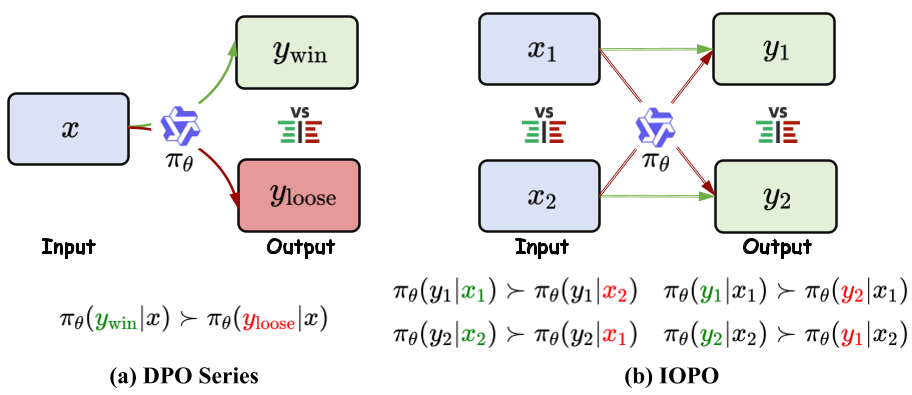 Figure 1: Traditional DPO vs. the proposed IOPO framework.
2. The TRACE Benchmark
To support this, the authors built TRACE, a taxonomy-driven dataset identifying 5 types and 26 dimensions of constraints (Style, Format, Content, etc.). This ensures the model is exposed to a diverse range of logical requirements during training.
Experiments & Results: Beyond SOTA
The researchers tested IOPO against SFT, PPO, and DPO using Qwen2 and Llama 3.1 backbones.
- In-Domain (TRACE): IOPO showed a consistent ~3% lead over DPO in following single and multiple constraints.
- Out-of-Domain (IFEval & CFBench): This is where IOPO shined, proving its generalization. On IFEval, Llama-3.1-8B jumped from 71.5 to 78.2 (Strict Accuracy) after switching from DPO to IOPO.
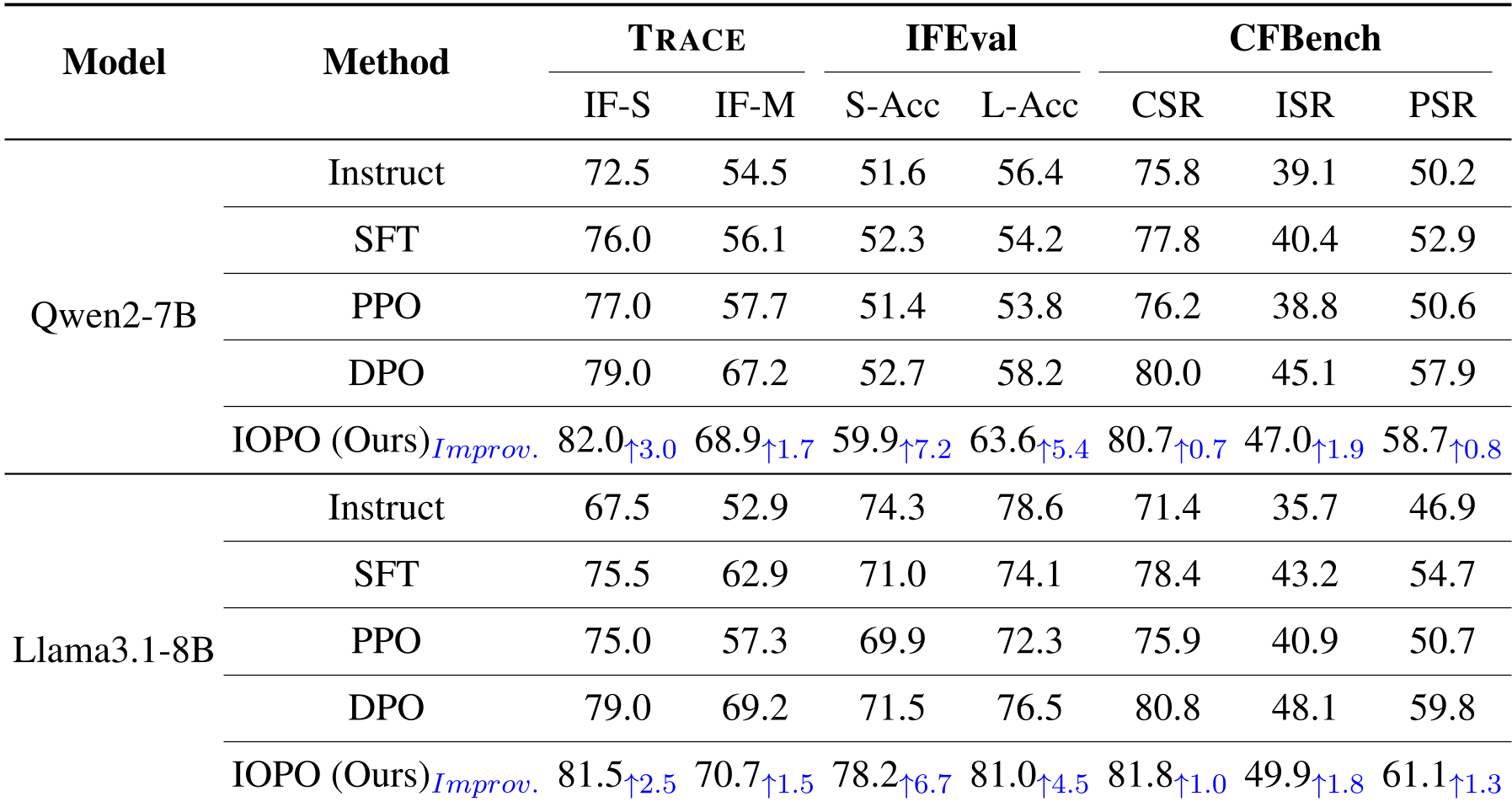 Table 1: IOPO consistently outperforms DPO across multiple benchmarks.
The Token Efficiency Debate
Does IOPO just work better because it "sees" more data (four pairs instead of two)? The authors conducted a controlled study (using more tokens for SFT and DPO, labeled SFT* and DPO*). The results confirmed that even with equal token volume, IOPO’s structure provides a superior inductive bias for constraint adherence.
Critical Insight & Conclusion
IOPO represents a shift from Response Ranking to Constraint Mapping. In the world of AI Agents where instructions are generated by other machines and contain strict technical parameters, "good enough" responses aren't enough—exact compliance is necessary.
Limitations: IOPO currently requires roughly 4x the VRAM of SFT and 2x that of DPO during training (to store the four pairings). However, since the Inference Speed remains 1x (the architecture doesn't change), this is a highly acceptable trade-off for deployment.
Takeaway: If your LLM is "hallucinating" past your negative constraints or failing your formatting requirements, standard DPO isn't the cure—Input-Output alignment is.