
The New Era of NLG Evaluation: From N-Gram Overlap to LLM Judges
LLM-based NLG Evaluation: Current Status and Challenges
This survey systematically reviews the landscape of Large Language Model (LLM)-based Natural Language Generation (NLG) evaluation. It introduces a novel taxonomy comprising LLM-derived metrics, prompting, fine-tuning, and human-LLM collaboration, highlighting how models like GPT-4 are achieving SOTA correlations with human judgment.
TL;DR
Evaluating and measuring progress in Natural Language Generation (NLG) has long been the "Achilles' heel" of NLP. This comprehensive survey from Peking University maps out the transition from rigid, math-heavy metrics like BLEU to the nuanced, instruction-following world of LLM-based evaluators. It provides a clear taxonomy of how we currently use LLMs to judge other AI, identifies the SOTA performers like GPT-4 and Themis, and warns of the inherent biases—like position and verbosity bias—that still plague these digital judges.
The "Broken" Foundation of NLG Metrics
For years, we relied on n-gram overlap. If your machine-translated sentence had the same words as a human reference, it got a high score. But language is fluid; a perfectly faithful summary might not share a single word with the reference. This gap between "math similarity" and "human quality" led to metrics that were easily gamed and didn't reflect reality.
The rise of LLMs changed the game. Instead of calculating overlap, we can now ask a model: "Is this summary faithful to the source?"
Taxonomy: Four Paths to Evaluation
The authors categorize the research landscape into four logical pillars:
1. LLM-derived Metrics
These treat the LLM as a feature extractor. Methods like GPTScore utilize the conditional probability of a model generating the text to assign a quality score. The intuition: a high-quality response is more likely to be generated by a well-trained model.
2. Prompting LLMs (LLM-as-a-Judge)
This is currently the most popular paradigm. By feeding a detailed rubric and the generated text into models like GPT-4 using Chain-of-Thought (CoT), researchers have found that AI can match the reliability of crowdsourced human workers.
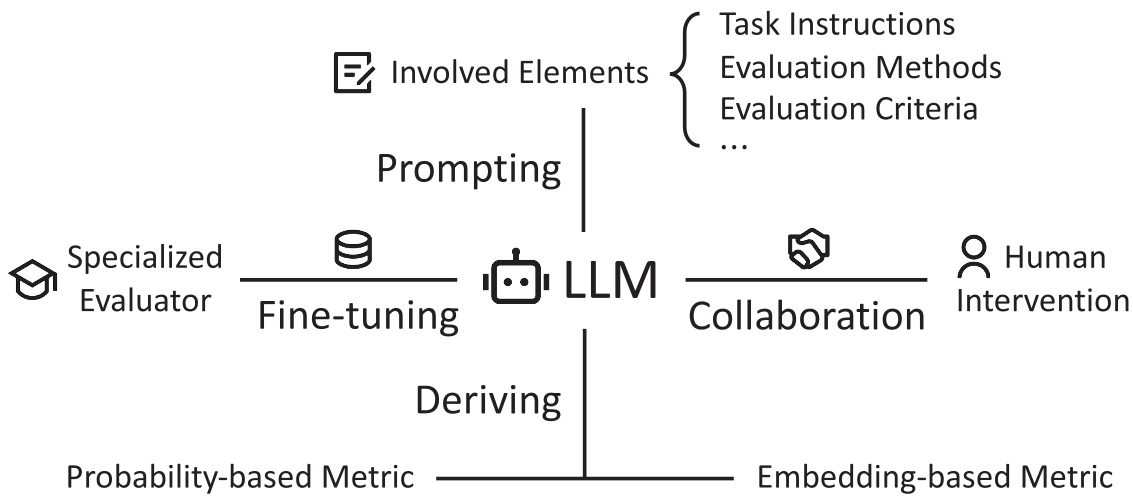
3. Fine-tuning Specialized Judges
Proprietary models like GPT-4 are expensive. Projects like Prometheus, PandaLM, and Themis fine-tune smaller, open-source models (7B–32B parameters) on high-quality evaluation datasets. These "specialist" models often outperform the "generalist" GPT-4 on specific tasks while being 10x cheaper to run.
4. Human–LLM Collaborative Evaluation
Recognizing that AI still hallucinates, this paradigm uses LLMs as "assistants" to humans—for example, generating checklists for humans to verify or flagging potential errors (Error Analysis) to speed up human annotation.
Methodology Deep Dive: How Does GPT-4 Grade?
One of the core mechanisms discussed is the G-Eval framework. Unlike simple scoring, it uses a multi-step process:
- Instruction Generation: The LLM refines the evaluation prompt based on the task description.
- Chain-of-Thought: The LLM explains why a score is given before outputting the final number.
- Probabilistic Weighting: Instead of taking the raw text output, it can use the probabilities of the score tokens to calculate an expected value.
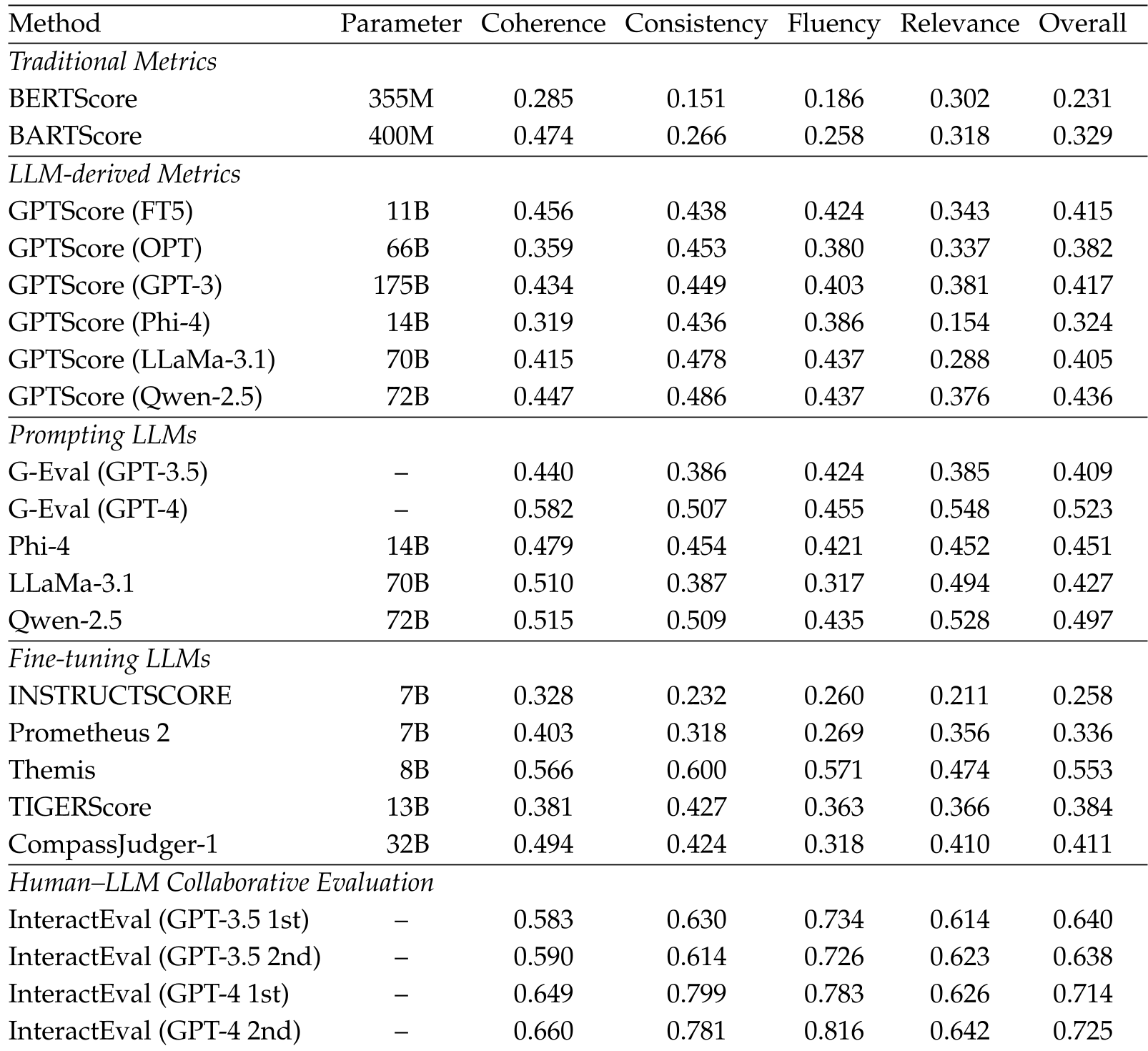 Note: The table above shows how "Human-LLM Collaborative" methods like InteractEval achieve the highest correlation with human ground truth, significantly surpassing traditional metrics.
The Hidden Pitfalls: Bias and Opacity
Acting as a judge comes with its own set of "inductive biases":
- Position Bias: In pairwise comparisons, LLMs often favor the first response presented.
- Verbosity Bias: Models tend to give higher scores to longer, more "professional-sounding" answers, even if they contain factual errors.
- Self-reference Bias: LLMs tend to score their own outputs higher than those from other models.
Critical Analysis & Future Outlook
The authors conclude that while LLMs have made evaluation more flexible and interpretable, we are still missing a "Unified Benchmark." Most current judge models are tested on summaries generated by outdated 2021-era models.
The future lies in Scalable Oversight: As LLMs tackle tasks humans struggle to evaluate (like complex code or scientific reviews), we will need systems where AI helps humans monitor other AI—a concept known as "AI-assisted human evaluation."
Summary: For developers and researchers, this paper is a roadmap. If you are still using ROUGE to evaluate your LLM app, it's time to upgrade to a prompted evaluator or a specialized judge like Themis.