
LLMs in the World of Knowledge Graphs: From Static Extractors to Autonomous Agents
Llms for knowledge graph construction and reasoning: Recent capabilities and future opportunities
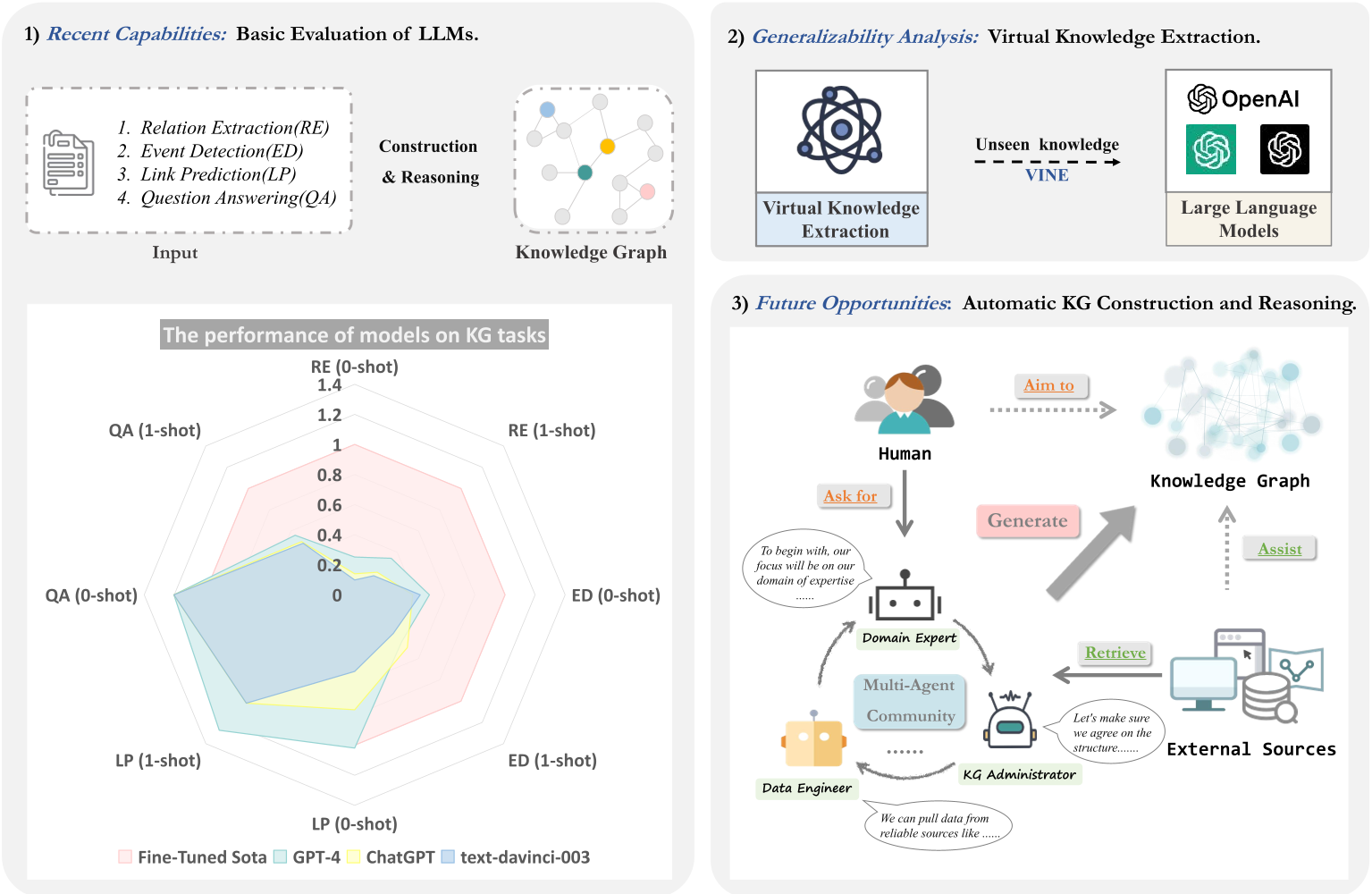
This paper provides a comprehensive quantitative and qualitative evaluation of LLMs (ChatGPT and GPT-4) across eight datasets for Knowledge Graph (KG) construction and reasoning tasks. It introduces VINE, a dataset for "Virtual Knowledge Extraction," and proposes AutoKG, a multi-agent framework that leverages LLMs and external tools for autonomous KG management.
TL;DR
Can GPT-4 replace traditional, laboriously fine-tuned models for building Knowledge Graphs? Not quite—but it’s a powerhouse for reasoning. This paper benchmarks LLMs across KG construction and reasoning, introduces a "Virtual Knowledge" test to prove these models aren't just memorizing, and proposes AutoKG: a future where AI agents build and update their own knowledge bases by browsing the web.
Problem & Motivation: The Generalization Gap
Building a Knowledge Graph (KG) typically requires a pipeline of specialized models for Named Entity Recognition (NER), Relation Extraction (RE), and Link Prediction. While these fine-tuned models are precise, they are brittle—moving from a general news domain to a specialized medical domain requires massive new labeled datasets.
LLMs offer a "few-shot" or even "zero-shot" alternative. However, a critical question haunts their use: Are they actually understanding the task, or are they just recalling the specific triples they saw during their massive pre-training phase? This paper seeks to decouple "memorization" from "generalization."
Methodology: Benchmarking and the VINE Dataset
The researchers categorized tasks into two buckets:
- KG Construction: Extracting entities, relations (RE), and events (EE).
- KG Reasoning: Link prediction and Question Answering (QA).
The "Virtual Knowledge" Litmus Test
To solve the memorization versus generalization debate, the authors created VINE (Virtual Knowledge Extraction). They replaced real entities and relations with made-up ones (e.g., replacing "Father" with "decidiaster"). If the model can still extract the relationship between these made-up entities based on a single example, it proves the model has mastered the logic of extraction, not just the facts of the world.
Experiments: How Do LLMs Rank?
The results provide a nuanced "Reality Check":
- Reasoning > Construction: GPT-4 outperformed traditional SOTA models in Question Answering (FreebaseQA) by a staggering 16%. In Link Prediction (FB15K-237), it nearly matched specialized models.
- The Construction Struggle: In complex relation extraction (e.g., Scientific data like SciERC), LLMs still fall short of fully supervised small models. GPT-4 reached an F1 of 9.1 in SciERC, whereas the fine-tuned SOTA sits at 53.2.
- Domain Sensitivity: LLMs perform significantly better in general domains than in specialized ones (Scientific/Medical), likely because the instruction-following data used during their "alignment" is predominantly general-purpose.
Performance Comparison Table
| Task Type | Dataset | Fine-Tuned SOTA | GPT-4 (One-shot) |
|---|---|---|---|
| Construction (RE) | DuIE2.0 | 69.42 | 41.91 |
| Reasoning (LP) | FB15K-237 | 32.4 | 40.0 |
| Reasoning (QA) | FreebaseQA | 79.0 | 95.0 |
Future Opportunity: The Rise of AutoKG
The most exciting contribution is the proposal of AutoKG. Recognizing that LLMs have a "knowledge cutoff" (they don't know what happened yesterday), the authors propose a multi-agent framework:
- Assistant Agent (Consultant): The primary logic engine.
- User Agent (Expert): Provides domain-specific constraints.
- Web Searcher: Feeds real-time data from the internet to the agents.
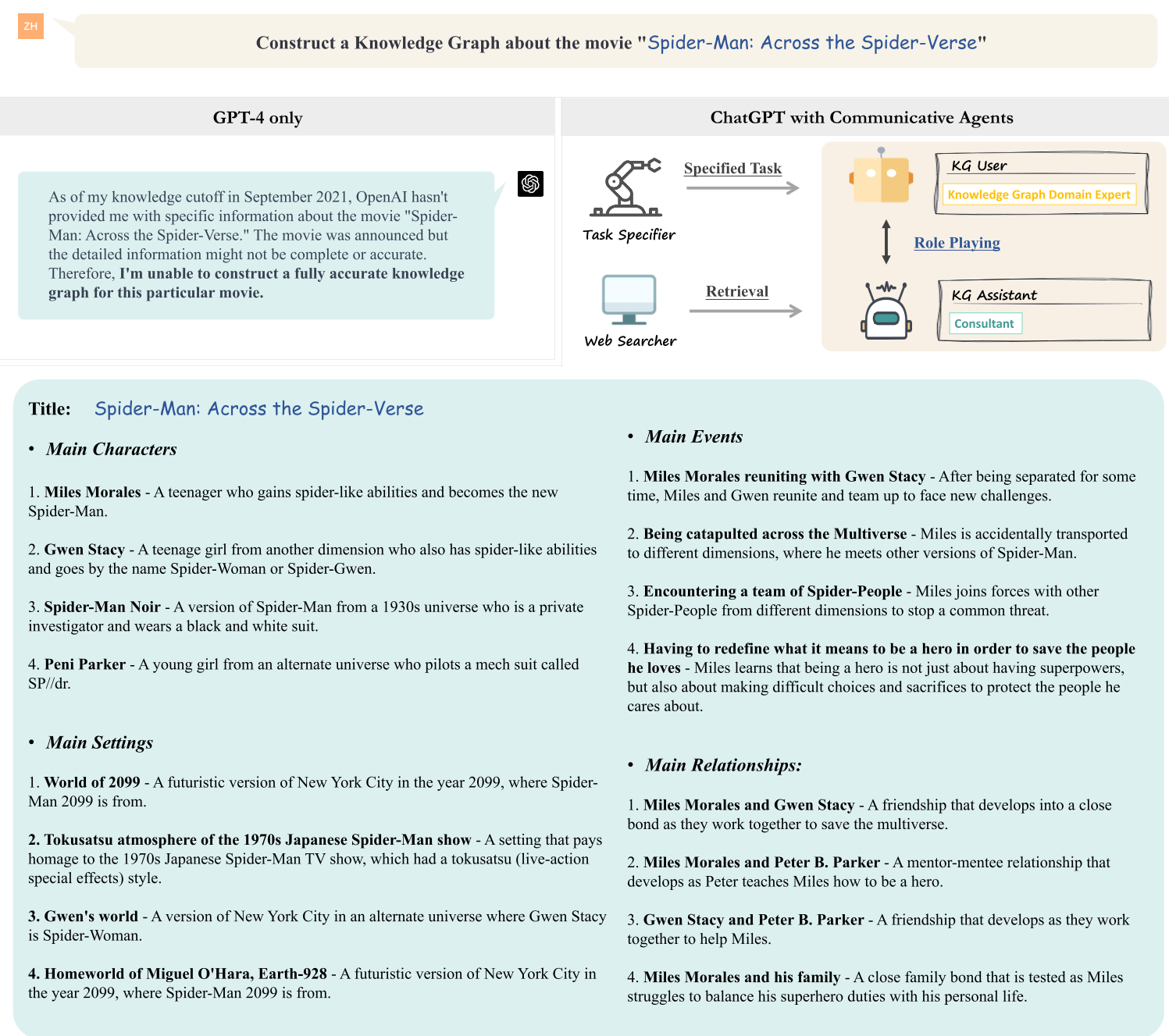
This setup allows for the autonomous construction of KGs for modern events (like the 2023 Spider-Man movie), which would be impossible for an "offline" LLM.
Critical Analysis & Conclusion
Takeaway: GPT-4 is a brilliant reasoning assistant but a mediocre high-precision extractor for complex, niche schemas. The paper proves that LLMs do possess true generalization (via the VINE results), but their performance is hampered by "alignment tax"—a phenomenon where making models safer for humans actually degrades their ability to do raw in-context learning.
Limitations:
- Token Limits: Building massive KGs is expensive and limited by the context window.
- Hallucinations: Without the "Web Searcher" module, the model is prone to inventing facts to fill structured templates.
Future Outlook: We are shifting away from training specific models for every new KG. Instead, the field is moving toward Autonomous Knowledge Engineering, where the focus is on designing the right agents and prompts rather than the right weights.