
LLMs in the World of Knowledge Graphs: From Extraction Tools to Autonomous Agents
Llms for knowledge graph construction and reasoning: Recent capabilities and future opportunities
This paper provides a comprehensive quantitative and qualitative evaluation of LLMs (ChatGPT and GPT-4) across eight datasets for Knowledge Graph (KG) construction and reasoning tasks. It concludes that while LLMs show promise, they serve better as "inference assistants" than "information extractors," and proposes AutoKG, a multi-agent framework to automate KG workflows.
TL;DR
Can GPT-4 replace traditional pipelines for building Knowledge Graphs (KGs)? This paper from Zhejiang University and NUS provides a definitive "not yet, but almost." While LLMs struggle to outshine fine-tuned models in specialized extraction (KG Construction), they excel tremendously in Link Prediction and Question Answering (KG Reasoning). The authors argue for a shift from using LLMs as simple extractors to treating them as Autonomous Agents (AutoKG) that collaborate with external tools.
The Motivation: Memorization vs. Generalization
A long-standing skepticism in the AI community is whether LLMs are just "stochastic parrots"—simply regurgitating facts they saw during pre-training. If an LLM extracts a triple correctly, did it reason through the text, or did it already know the fact?
To solve this, the researchers created the VINE dataset, which uses "Virtual Knowledge"—completely made-up entities like Schoolnogo and relations like decidiaster. Their findings were striking: GPT-4 succeeded in 80% of these virtual extractions, proving that its power lies in linguistic generalization, not just a massive internal database.
Methodology: The Architecture of Evaluation
The study divides the KG lifecycle into two phases:
- Construction: NER, Relation Extraction, and Event Extraction.
- Reasoning: Link Prediction and Knowledge-Base Question Answering (KBQA).
Basic Evaluation Framework
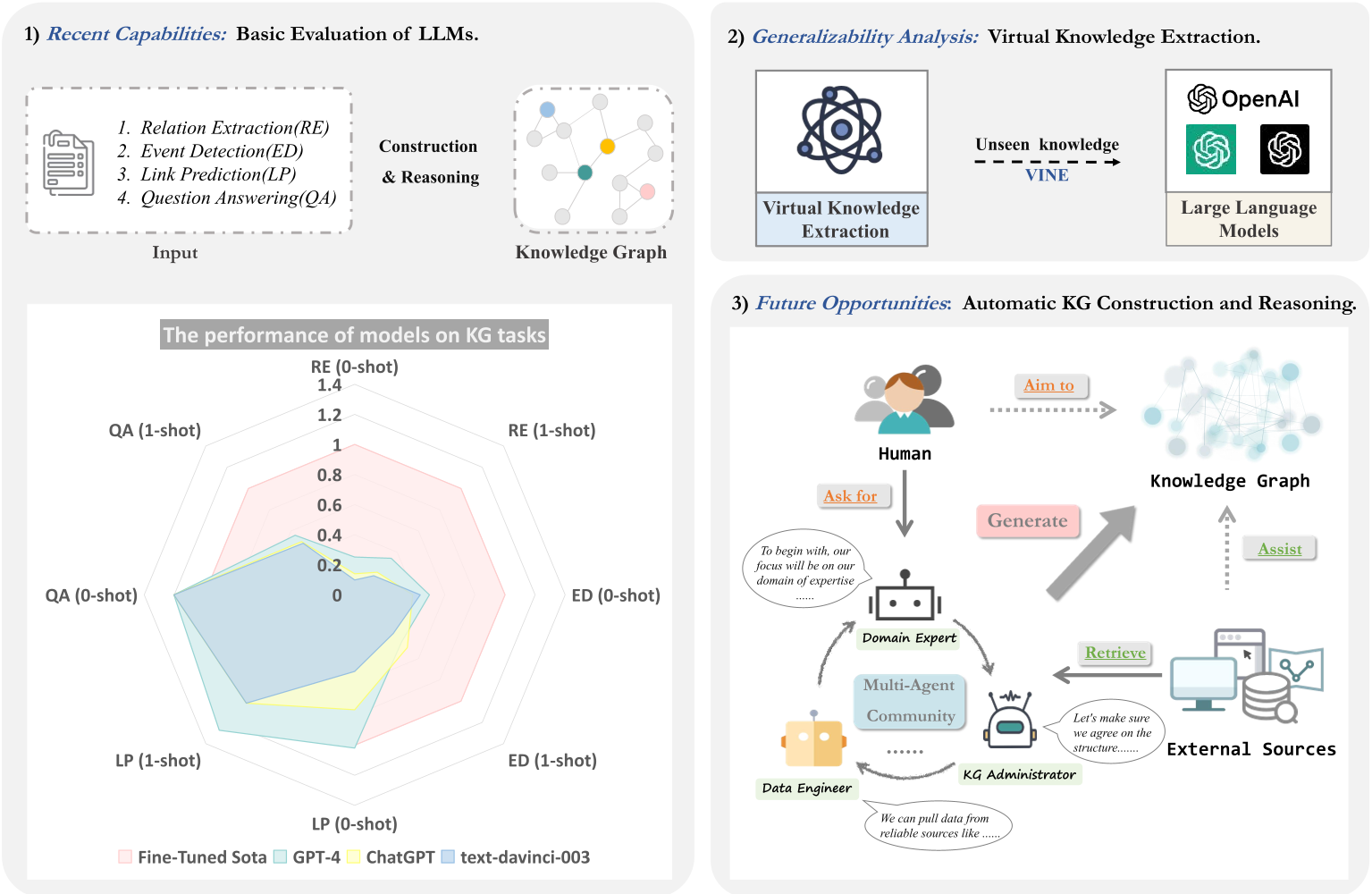
The authors tested text-davinci-003, ChatGPT, and GPT-4 in Zero-shot and One-shot settings.
The Proposing of AutoKG
Recognizing that individual LLMs still suffer from hallucinations and knowledge cut-offs, the authors proposed AutoKG. This multi-agent system uses:
- A Consultant (KG Assistant): To perform the heavy lifting.
- A Domain Expert (KG User): To verify and guide.
- A Web Searcher: To fetch real-time data from the internet.
Experiments: Where LLMs Win and Lose
The results revealed a clear "capabilities gap" between construction and reasoning.
The Construction Struggle
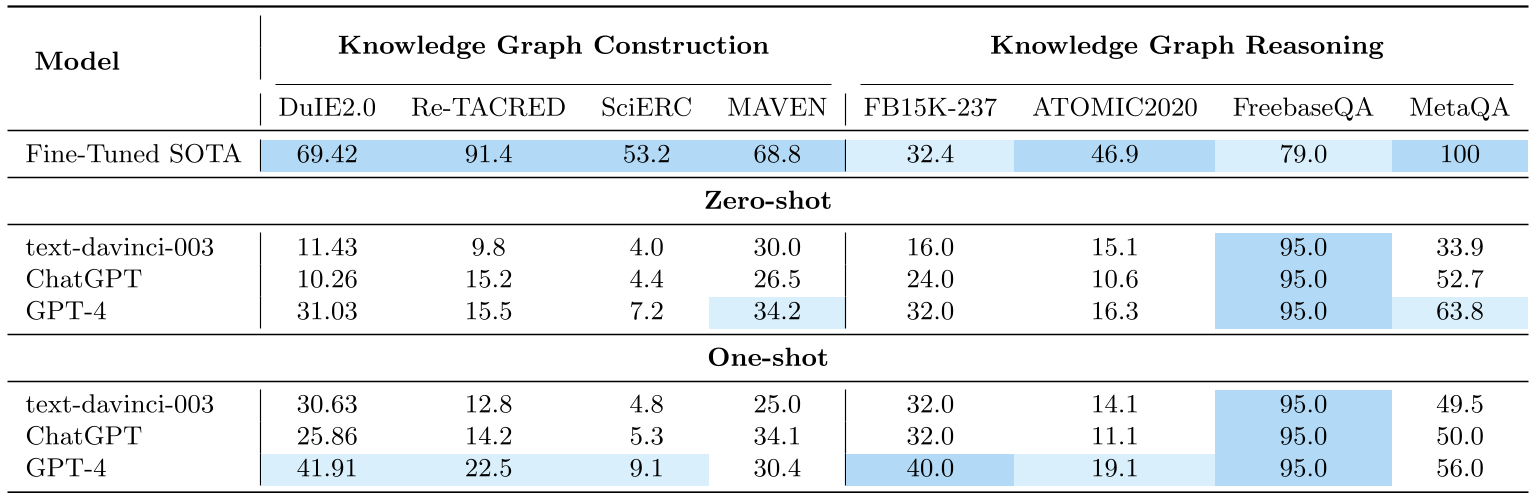
On specialized datasets like SciERC (Scientific abstracts), GPT-4's F1 score was significantly lower than fine-tuned SOTA models. The "Alignment Tax"—where models become more conversational but potentially less precise in following rigid extraction schemas—was evident here.
The Reasoning Triumph
In Link Prediction (FB15K-237) and KBQA (FreebaseQA), GPT-4 was a powerhouse.
- FreebaseQA: LLMs outperformed the supervised SOTA by 16%.
- Multi-hop Reasoning: GPT-4 demonstrated a superior ability to connect dots across multiple sentences compared to ChatGPT.
Deep Insights: The Future is Multi-Agent
The paper concludes with a forward-looking vision: AutoKG. Instead of a single prompt, we should use a "Society of Agents."
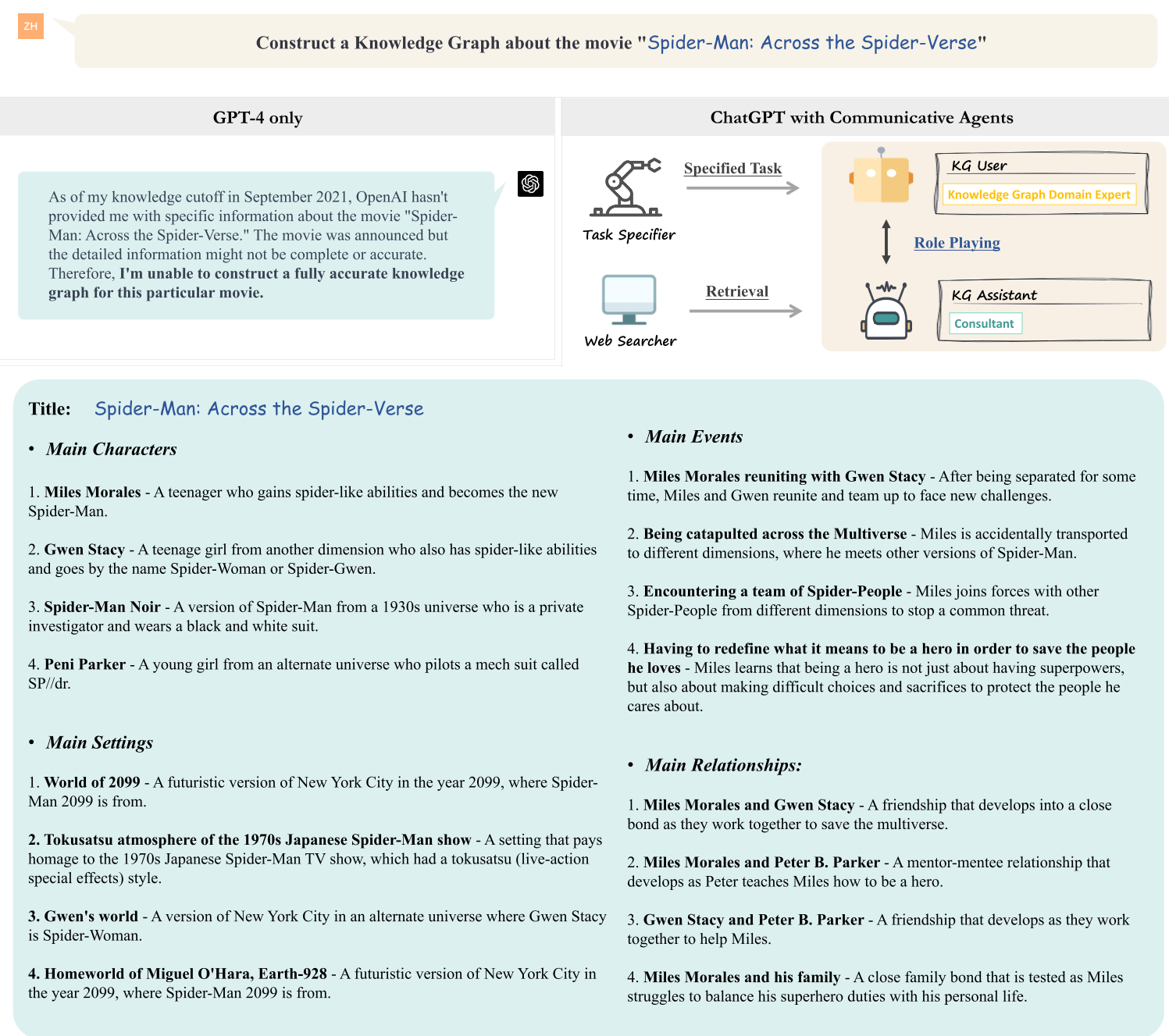
By assigning roles (e.g., a "Web Searcher" that supplements the LLM's internal knowledge), the system built a comprehensive KG for the 2023 film Spider-Man: Across the Spider-Verse—data that was technically past the model's knowledge cutoff.
Takeaway & Critical Analysis
The value of this paper is in its realism. It acknowledges that while LLMs aren't perfect extractors (especially in specialized domains), they are revolutionary at interpreting and reasoning with structured data.
Limitations to watch:
- Token Limits: High-density KGs quickly exceed context windows.
- Human-in-the-loop: Fully autonomous KG construction still produces hallucinations that require manual verification.
In the future, we expect to see LLMs acting not as developers of KGs, but as the orchestrators that bridge the gap between unstructured web data and structured knowledge bases.