
MagicAgent: Decoding the DNA of Generalized Agent Planning
MAGICAGENT TOWARDS GENERALIZED AGENT PLANNING
MagicAgent is a series of foundation models (32B Dense and 30B MoE) specialized for generalized agent planning. It utilizes a scalable synthetic data framework and a two-stage training paradigm (SFT + Multi-objective RL) to achieve SOTA performance on benchmarks like Worfbench (75.1% accuracy) and BFCL-v3 (86.9% accuracy), outperforming even leading closed-source models.
TL;DR
MagicAgent represents a significant leap in turning LLMs into autonomous agents. By introducing a scalable synthetic data framework and a specialized Two-Stage Reinforcement Learning paradigm (including the novel χPO algorithm), researchers from Honor and Fudan University have produced 32B models that outperform ultra-scale models like GPT-4o in planning accuracy and execution stability.
Background: Beyond Single-Point Optimization
Current LLM agents often suffer from "brittleness"—they might be great at calling a single API but fail miserably when asked to coordinate a 21-day multi-city trip with interdependent constraints. The fundamental issue is Data Scarcity and Task Interference (the "seesaw effect"). MagicAgent addresses these by treating planning as a unified cognitive skill rather than a collection of isolated tasks.
Methodology: The Magic Under the Hood
1. Scalable Synthetic Data Pipeline
Instead of expensive human labeling, MagicAgent uses a "Graph-to-Trajectory" approach. It models tool dependencies as directed graphs () and shared parameters as undirected graphs ().
- Hierarchical Decomposition: Breaking complex intents into atomic plans (Serial, Parallel, Isolated).
- Long-Horizon Execution: Chaining outputs of one tool as prerequisites for the next to ensure "logical coupling."
2. The χPO Algorithm (eXploration-eXploitation Policy Optimization)
Standard RL often leads to policy collapse in sparse-reward environments. MagicAgent introduces χPO, which features:
- Think-level Entropy Smoothing: High entropy is allowed during internal "thinking" to explore various reasoning paths.
- Action-level Entropy Constraints: Low entropy is enforced for final actions to ensure decisiveness.
- Information Bottleneck (IB): It compresses reasoning to retain only what is necessary for the action, effectively removing "hallucinated" thoughts.
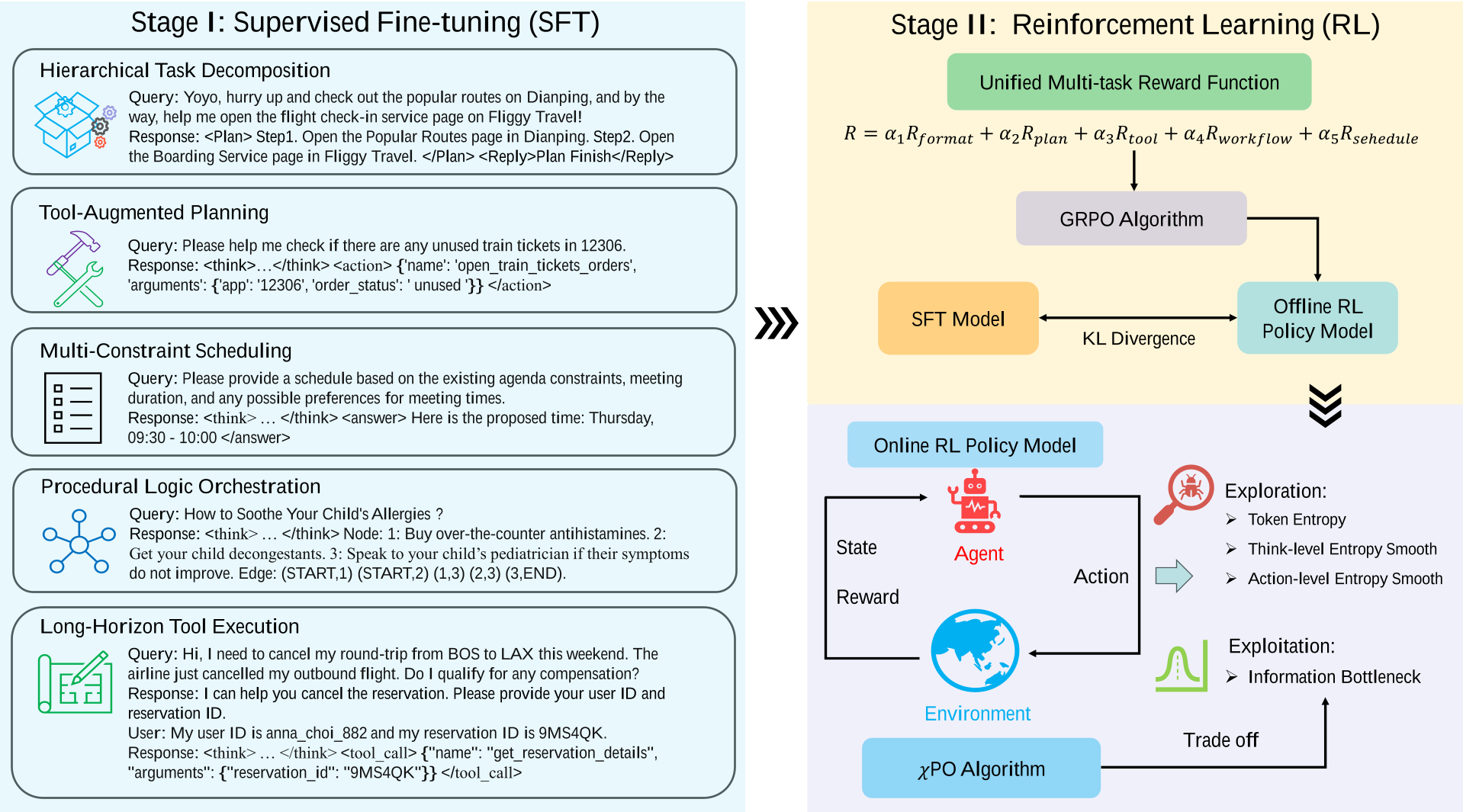 Figure: The two-stage training paradigm combining SFT with Global/Online RL.
3. Load-Balanced MoE for Agents
To make deployment feasible, the team developed a Global Batch Load-Balancing strategy. Unlike local balancing which can crush expert specialization, global balancing allows experts to specialize in specific planning types (e.g., one expert for "Scheduling," another for "Tool Calling") while ensuring no expert stays idle.
Experiments: Surpassing the Giants
The results are striking. In WorfBench (graph orchestration), MagicAgent-30B-A3B scored 69.9% on F1 Graph, significantly higher than GPT-5.2's 39.1%.
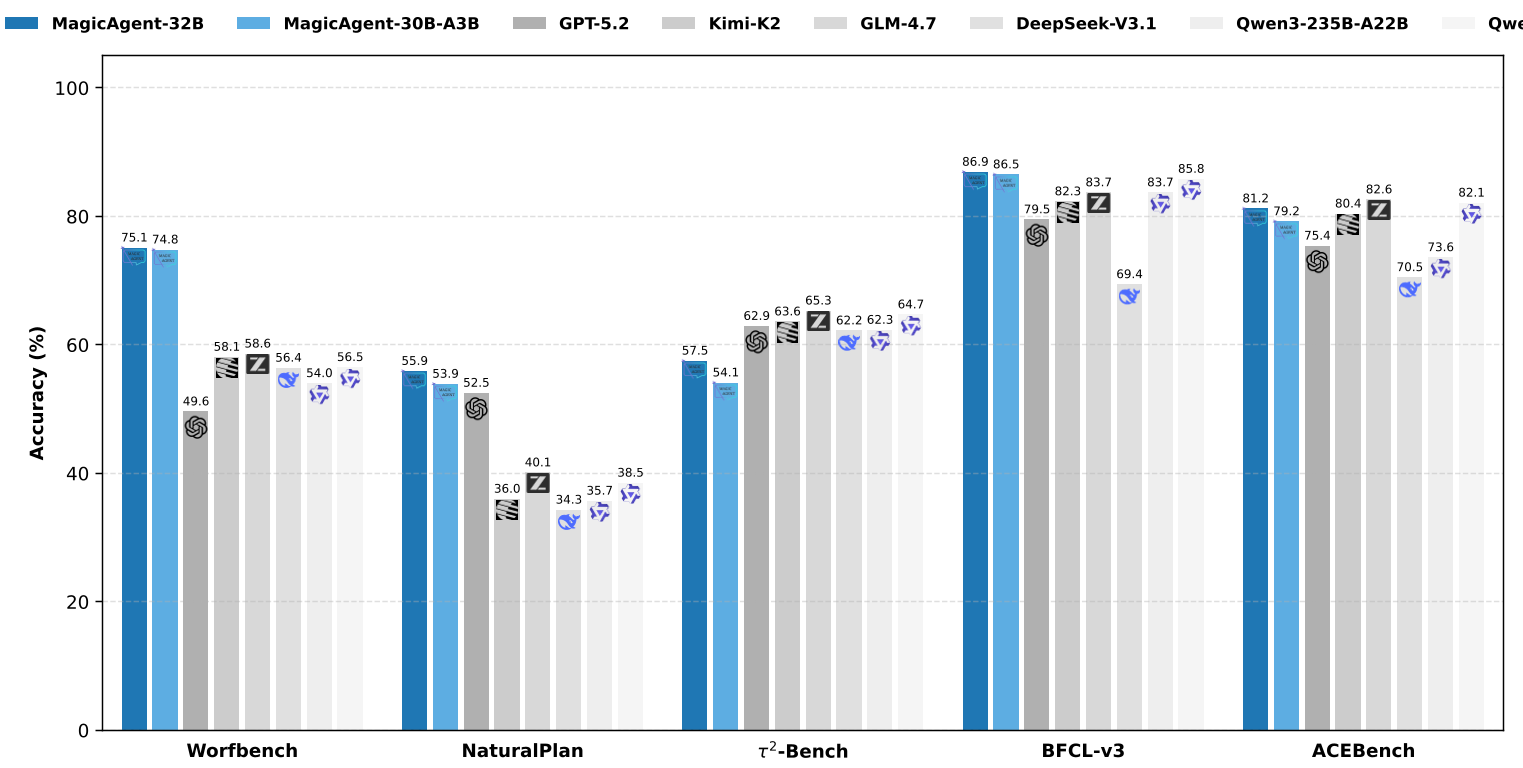 Figure: Performance comparison across major planning benchmarks.
Key Outcomes:
- Efficiency: The MoE model (30B-A3B) offers a 40-54% reduction in latency compared to the dense 32B model, making it ideal for real-time mobile assistant deployment.
- Robustness: On BFCL-v3 (API calling), MagicAgent-32B achieved 86.9% average accuracy, proving that specialized fine-tuning can bridge the gap created by parameter scale.
Critical Insights & Future Work
The success of MagicAgent underscores a shift in AI: Architecture matters, but the "curation logic" of trajectories matters more. By explicitly modeling the exploration-exploitation tradeoff at the reasoning level through χPO, the authors have provided a blueprint for more stable agentic RL.
Limitations: While MagicAgent excels at planning, its performance still relies on the base model's world knowledge. Future iterations focusing on personalized information and long-memory retention will be the next frontier for truly "magic" autonomous assistants.
Conclusion
MagicAgent proves that high-performance agentic intelligence is not the exclusive domain of trillion-parameter models. Through structured data synthesis and multi-objective reinforcement learning, sub-100B models can provide the reasoning depth and execution reliability required for real-world autonomy.