
The Silicon Pen: Mapping the Surge of LLMs in Scientific Publishing
Mapping the increasing use of LLMs in scientific papers
This study presents a large-scale analysis of 950,965 scientific papers (arXiv, bioRxiv, Nature) using a distributional statistical framework to quantify LLM-modified content. The researchers found a steady surge in AI-aided writing post-ChatGPT, with Computer Science papers leading the trend at a 17.5% modification rate by early 2024.
TL;DR
A comprehensive analysis of nearly one million papers reveals a staggering truth: Large Language Models (LLMs) are no longer just tools for code—they are ghostwriting the very fabric of science. Since the release of ChatGPT, "AI-modified" content has surged, particularly in Computer Science where nearly 1 in 5 sentences in paper abstracts now shows signs of LLM modification.
Background: Beyond the "AI Detector" Hype
We have all seen the tells: "As an AI language model..." or the occasional "Regenerate response" button left in a published PDF. However, these are just the tip of the iceberg. Most AI-assisted writing is subtle, involving prose polishing and abstractive summarization.
The Stanford researchers behind this paper shifted the focus from individual detection (which is notoriously unreliable) to population-level quantification. By looking at the statistical "fingerprints" of a corpus, they can pinpoint exactly how much science is being filtered through silicon.
Problem & Motivation: The Structural Pressure
Why are scientists turning to LLMs? The authors argue it isn't just "laziness." Instead, they identify structural "publish-or-perish" pressures. The study investigated several factors:
- Productivity: Do high-output authors use AI more?
- Crowdedness: Do researchers in hyper-competitive fields use AI to keep pace?
- Language: Is AI being used as a linguistic equalizer for non-native speakers?
Methodology: The Distributional Approach
Instead of a binary classifier, the team used a Distributional LLM Quantification Framework.
- Counterfactual Training: They took human-written papers and asked an LLM to "summarize into an outline" and then "re-expand into a paragraph." This mimics the real-world workflow of a scientist using AI.
- Token Frequency Analysis: By comparing the probability of specific tokens (like "realm," "intricate," and "pivotal") between human and AI corpora, they could estimate the mixture ratio () of a given dataset.
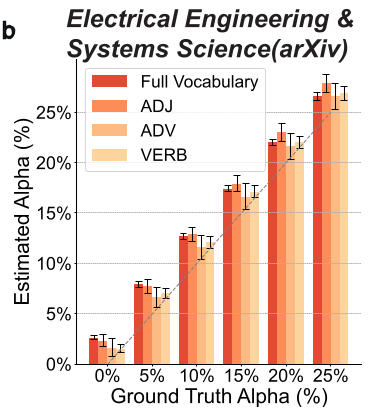 Figure: Validation across multiple categories (arXiv, Nature, bioRxiv) shows that the estimation error is consistently below 3.5%, proving the framework's robustness.
Key Insights: Who is using LLMs?
The results provide a demographic and behavioral map of AI adoption in academia:
1. Computer Science is the Epicenter
Unsurprisingly, CS researchers—who are closest to the technology—adopted LLMs the fastest. By February 2024, the modification rate reached 17.5%. In contrast, Mathematics remained relatively "pure" (under 5%), likely due to the rigorous symbolic nature of the field which current LLMs still struggle to emulate perfectly.
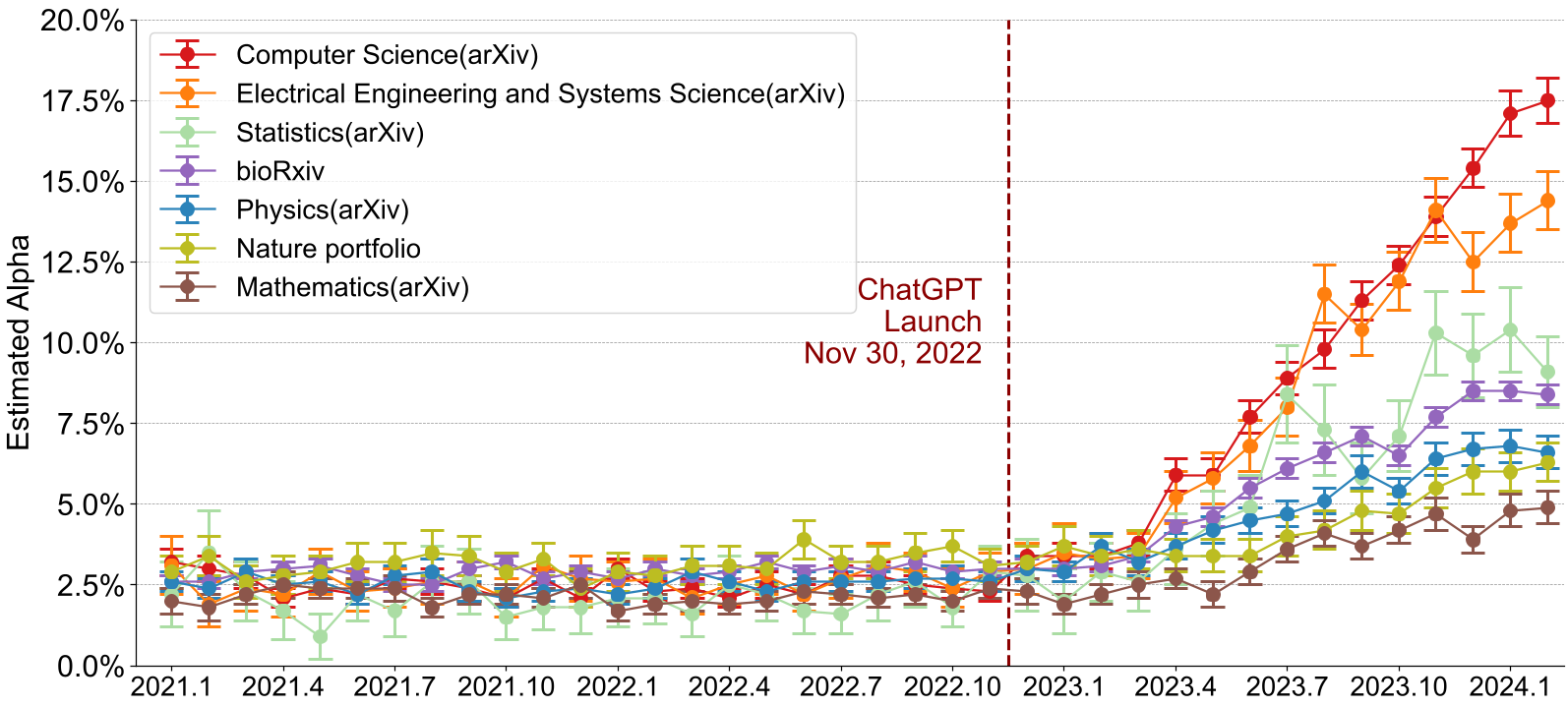
2. The "Fast and Frequent" Correlation
Authors who post three or more preprints per year show significantly higher LLM usage (19.3%) than those who post fewer. This confirms the intuition that LLMs are being used as a "velocity multiplier" in fast-paced research cycles.
3. The Vocabulary Shift
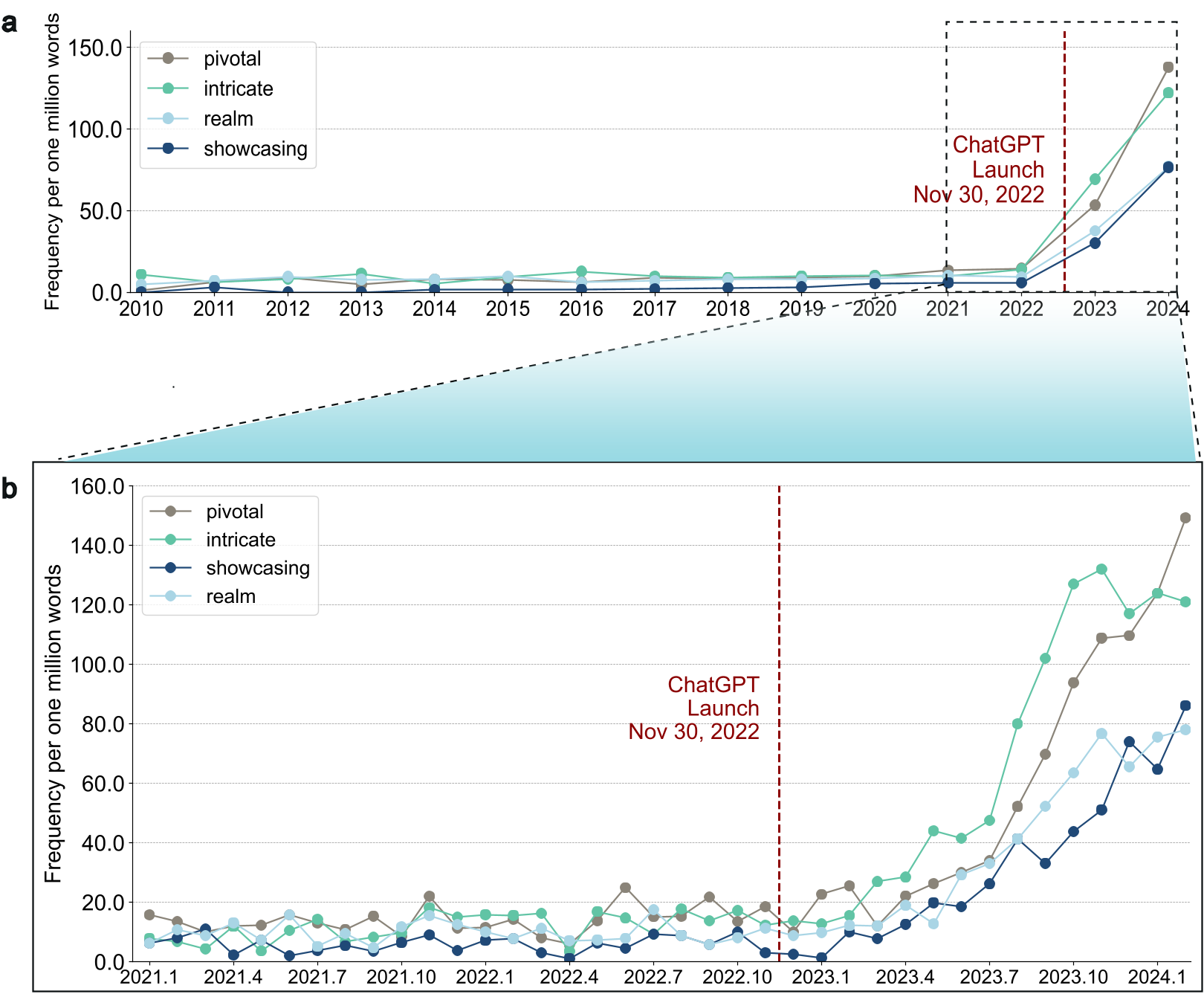
The study identified "LLM-indicator" words that have exploded in usage since 2023. If you find yourself reading about a "pivotal" discovery in an "intricate realm," you are likely reading GPT-assisted prose.
Critical Analysis & Conclusion
This paper is a wakeup call for the scientific community. While LLMs can help non-native speakers overcome linguistic barriers, the "flattening of diversity" is a real risk. If every paper starts to sound the same—using the same "pivotal" and "showcasing" adjectives—we lose the nuance of human scientific thought.
The takeaway: Scientific publishing is changing forever. We must move beyond "prohibiting" AI and toward transparency. If the data used to train future AI is itself generated by current AI (a phenomenon lurking in the 17.5% of CS arXiv papers), we risk a feedback loop that could stall genuine scientific innovation.
Limitations: The study focuses primarily on English-language journals and the GPT family of models. Future work will need to track the impact of open-source models (like Llama) and local LLM usage in non-Western research hubs.