
MaskLLM: Unlocking SOTA Semi-Structured Sparsity via Differentiable Mask Learning
MaskLLM_ Learnable Semi-Structured Sparsity for Large Language Models
MaskLLM is a novel pruning framework that introduces learnable semi-structured (N:M) sparsity to Large Language Models (LLMs). By modeling mask selection as a distribution learning problem using Gumbel-Softmax sampling, it achieves state-of-the-art results, such as reducing Wikitext perplexity from over 10 to 6.72 on Llama-2 7B at 2:4 sparsity.
TL;DR
MaskLLM is a breakthrough in LLM compression that shifts pruning from "handcrafted heuristics" to "end-to-end learning." By utilizing the Gumbel-Softmax trick, it enables LLMs to learn optimal 2:4 sparse masks across massive datasets, achieving significant performance gains over SparseGPT and providing a 1.4x inference speedup with virtually no loss in accuracy for downstream tasks.
Background: The Scalability Wall of One-Shot Pruning
As Large Language Models (LLMs) grow, their redundancy becomes more evident. Semi-structured (N:M) sparsity is the "holy grail" of pruning because it is natively supported by modern hardware (like NVIDIA Ampere/Hopper GPUs), offering real-world speedups.
However, current SOTA methods like SparseGPT and Wanda are limited by:
- Small Calibration Sets: They typically only use ~128-256 samples. Increasing this doesn't help because their underlying importance metrics (like Hessian or weight magnitude) are stationary.
- Hand-crafted Heuristics: Using weight magnitude or gradients as proxies for "importance" is an approximation that grows less accurate as models scale.
MaskLLM addresses these by asking: What if we could simply "train" the masks the same way we train weights?
Methodology: Pruning as a Differentiable Sampling Problem
The core innovation of MaskLLM is treating the selection of an N:M mask as a probabilistic sampling process.
1. The Gumbel-Softmax Trick
In 2:4 sparsity, each block of 4 weights has 6 possible binary mask candidates. Choosing one is a discrete, non-differentiable operation. MaskLLM uses the Gumbel-Softmax reparameterization to make this selection differentiable. It assigns a "logit" (a learnable score) to each candidate mask, allowing the model to flow gradients back to the mask selection logic.
2. Architecture & Gradient Flow
While the weights of the LLM remain frozen, the mask logits are optimized. To prevent the "vanishing gradient" problem (where zeroed-out weights stop learning), the authors introduce Sparse Weight Regularization, encouraging the model to keep weights with larger magnitudes active.
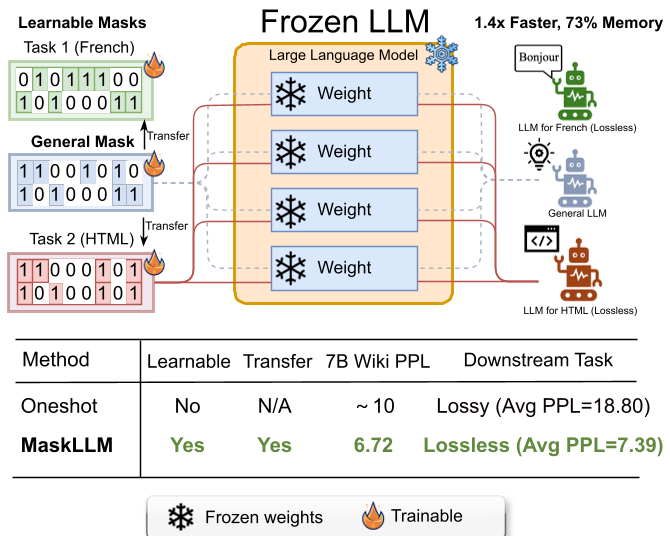 Figure 1: MaskLLM allows for the end-to-end optimization of sparsity patterns across large-scale data.
Experimental Performance: Shattering the Baseline
The results of MaskLLM are a significant step up from traditional one-shot pruning.
1. Quantitative Superiority
On Llama-2 7B, MaskLLM achieves a Perplexity (PPL) of 6.72, whereas SparseGPT lags at 10.42. This margin is huge in the context of LLM evaluation, representing a much higher retention of the original model's reasoning capabilities.
2. Scaling with Data
Unlike SparseGPT, which plateaus quickly, MaskLLM's performance continues to improve as it sees more data (up to 512k samples). This proves that the learnable approach can truly "digest" the vast distribution of knowledge inherent in LLMs.
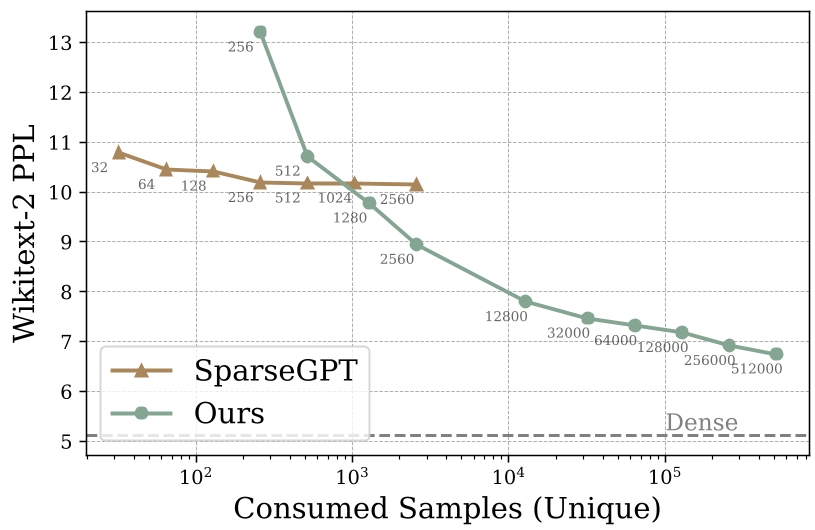 Figure 2: Perplexity vs. Consumed Samples. MaskLLM effectively leverages large datasets to refine mask quality.
3. Real-world Acceleration
Benchmarks on NVIDIA A6000 GPUs using TensorRT-LLM show that Llama-2 models pruned with MaskLLM achieve 1.36x to 1.57x throughput increases and significant memory savings.
Transfer Learning: Task-Specific "Expert" Masks
One of the most exciting aspects of MaskLLM is Transfer Learning. You can take a "General Mask" (learned on a broad dataset) and fine-tune it for a specific domain (like Code or Law) in just 2,000 steps.
Because only the masks change, and not the weights, you can store "expert masks" for different tasks at a negligible cost (0.65 bits per parameter), allowing one base model to serve dozens of specialized industries with zero accuracy loss.
Critical Insight & Conclusion
MaskLLM proves that the "Lottery Ticket Hypothesis" holds true even for frozen LLMs: there exist sparse sub-networks within pre-trained weights that are nearly as capable as the dense version. The key was not finding a better heuristic, but building a better search mechanism through differentiable optimization.
Limitations to Consider:
- Compute Cost: While inference is faster, finding the mask requires ~1,000+ GPU hours for a 7B model, which is much higher than the "one-shot" approach of SparseGPT (~1 hour).
- Frozen Weights: The paper focuses on frozen weights; a joint optimization of masks and weights might yield even higher compression ratios.
Final Takeaway: For enterprises looking to deploy specialized LLMs on the edge or in high-throughput environments, MaskLLM provides the blueprint for hardware-aligned, near-lossless 2:4 sparsity.