
Can Less be More? How Model Compression Unexpectedly Sanitizes Language Models
Can Model Compression Improve NLP Fairness
This paper investigates the impact of model compression—specifically Knowledge Distillation (KD) and Pruning—on the fairness of generative language models like GPT-2. The authors demonstrate that smaller, distilled models consistently exhibit lower toxicity and reduced social bias compared to their larger counterparts, establishing KD as a potential fairness-enhancing regularization technique.
TL;DR
In the race to make Large Language Models (LLMs) faster and smaller, we might have accidentally stumbled upon a "fairness filter." This paper explores how Knowledge Distillation and Pruning—traditionally used for efficiency—actually reduce the toxicity and social bias of GPT-2. The core discovery? Compressed models forget the "bad habits" (toxic data) they learned from the internet more easily than they forget general language capabilities.
Background: The Fair-Efficiency Tradeoff
As we deploy AI on edge devices (phones, IoT), we must compress them. But does a smaller brain mean a more biased brain? Two conflicting theories exist:
- Memorization (The Optimist's View): Large models are over-parameterized; they "overfit" to the toxic corners of the web. Compressing them acts as a filter, removing these rare, harmful memorized patterns.
- Winner Takes It All (The Pessimist's View): Smaller models simplify the world into stereotypes. They might ignore "marginal" balanced data and double down on the strongest (and often most biased) signals.
This paper shows that for NLP, the Memorization hypothesis (regularization) seems to win.
Methodology: Shrinking the Transformer
The researchers focused on two primary levers to squeeze GPT-2:
- Knowledge Distillation (KD): Training a smaller "student" model to mimic a "teacher" model's outputs. They reduced the number of decoder blocks from 12 down to as few as 4.
- Pruning: Removing specific attention heads based on importance scores, achieving 1.2x to 1.5x speedups.
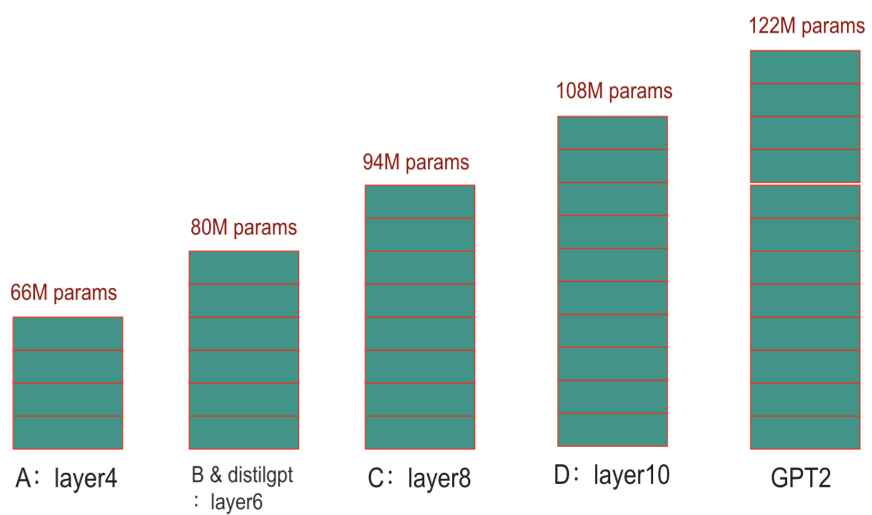 Figure 1: Distillation reduces the stack of decoding blocks, effectively shortening the model's "memory depth."
Experimental Battleground: Toxicity vs. Size
The team tested the models using RealToxicityPrompts and the Toxic Comment Classification Challenge (TCCC).
The results were strikingly consistent. Whether the model had seen the prompts during training or not, smaller models were consistently less toxic.
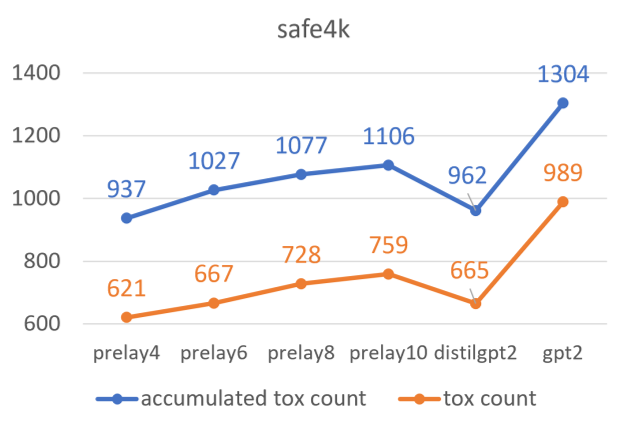 Figure 2: A clear downward trend in toxicity as we move from the original GPT-2 to more compressed "prelay" (distilled) versions.
Key Findings:
- Consistent Toxicity Drop: In every tested scenario, distillation led to a monotonic reduction in toxic output.
- Gender Bias: Using the Winobias dataset, the authors found that distilled models were less likely to default to gendered stereotypes (e.g., assuming a "farmer" is a "he").
- The "Regularization" Effect: An ablation study showed that it wasn't just the model size—distillation itself acted as a form of "knowledge cleaning."
Critical Analysis: Is There a Catch?
While the results are promising, the authors raise a crucial point: Perplexity (PPL).
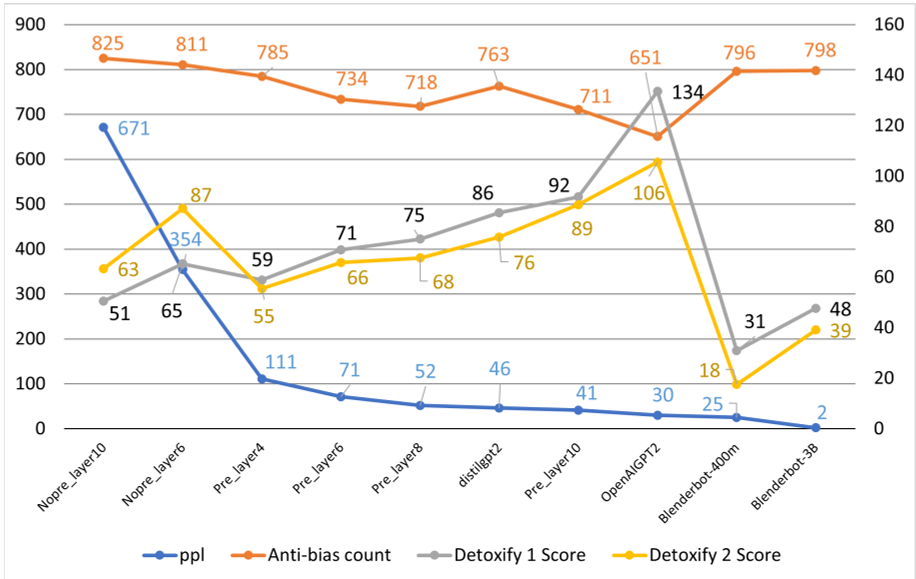 Figure 3: High perplexity (lower language fluency) often correlates with lower bias. Is the model safer just because it's "dumber"?
There is a valid concern that as a model becomes less "fluent" (higher perplexity due to high compression), it simply lacks the capacity to generate complex toxic thoughts. However, even when comparing models with similar performance levels, the distilled versions often remained safer than their full-sized counterparts.
Conclusion & Future Outlook
This work flips the script on model compression. Instead of viewing it as a necessary evil to save memory, we can view it as a fairness-aware regularization technique.
Takeaways for Practitioners:
- Deploy Distilled Models: If you are worried about your chatbot going rogue or exhibiting bias, a distilled version might be inherently safer than the full-scale model.
- Compression as a Shield: Combining compression with adversarial training could lead to the next generation of robust, "safe-by-design" NLP systems.
The future of AI fairness might not just be about better data, but about better pruning.