
NSA: Mastering Long-Context Intelligence via Hardware-Aligned Native Sparse Attention
Native Sparse Attention: Hardware-Aligned and Natively Trainable Sparse Attention
DeepSeek-AI presents NSA (Native Sparse Attention), a natively trainable sparse attention mechanism designed for efficient long-context modeling. It utilizes a dynamic hierarchical strategy—combining token compression, sliding windows, and blockwise selection—to achieve significant speedups while matching or exceeding Full Attention performance across general and reasoning benchmarks.
TL;DR
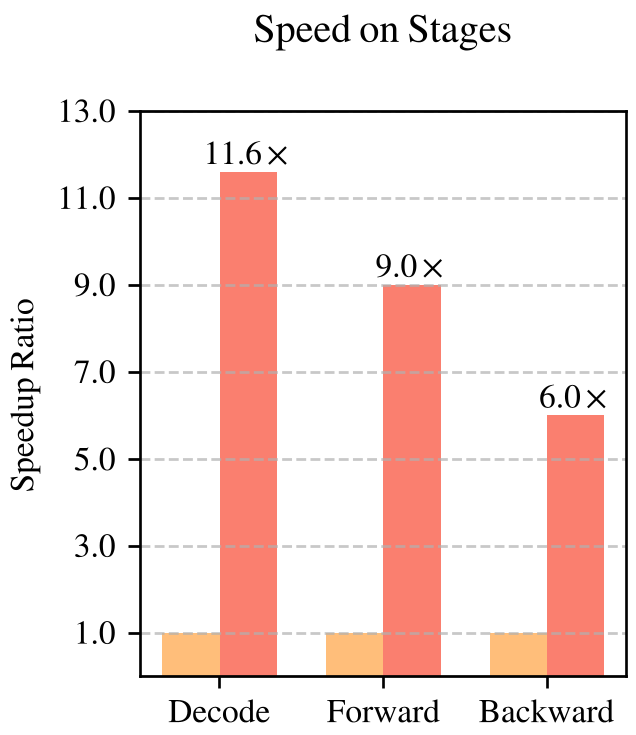
DeepSeek-AI has introduced Native Sparse Attention (NSA), a breakthrough that allows Large Language Models (LLMs) to be trained and deployed with extreme efficiency without sacrificing performance. By integrating hierarchical token modeling and hardware-optimized Triton kernels, NSA achieves up to 11.6x faster decoding and superior reasoning capabilities compared to standard Full Attention models.
The Problem: The Latency Wall in Long-Context LLMs
As we push LLMs to process entire codebases or 64k+ token documents, the "Attention Tax" becomes unbearable. In a standard Transformer, attention computation can consume up to 80% of total inference latency.
While many "Sparse Attention" methods exist, they usually suffer from two fatal flaws:
- The Efficiency Illusion: They might reduce "FLOPs," but their scattered memory access patterns don't translate to actual wall-clock speedups on GPUs.
- The Training Gap: Most sparse methods are "inference-only," meaning the model was trained on Full Attention and then "pruned" during inference, which often breaks its ability to retrieve distant information.
Methodology: The Hierarchical Approach
NSA solves this by making sparsity native. Instead of looking at every token, each query in NSA utilizes three distinct branches of information:
- Token Compression (Coarse-grained): Groups of K-V pairs are compressed into a single representation to provide a "summary" of the global context.
- Token Selection (Fine-grained): The model dynamically identifies and selects the few most important blocks of raw tokens to inspect with high precision.
- Sliding Window (Local): A fixed window for immediate neighbors to maintain local fluency.
Hardware-Aligned Kernel Design
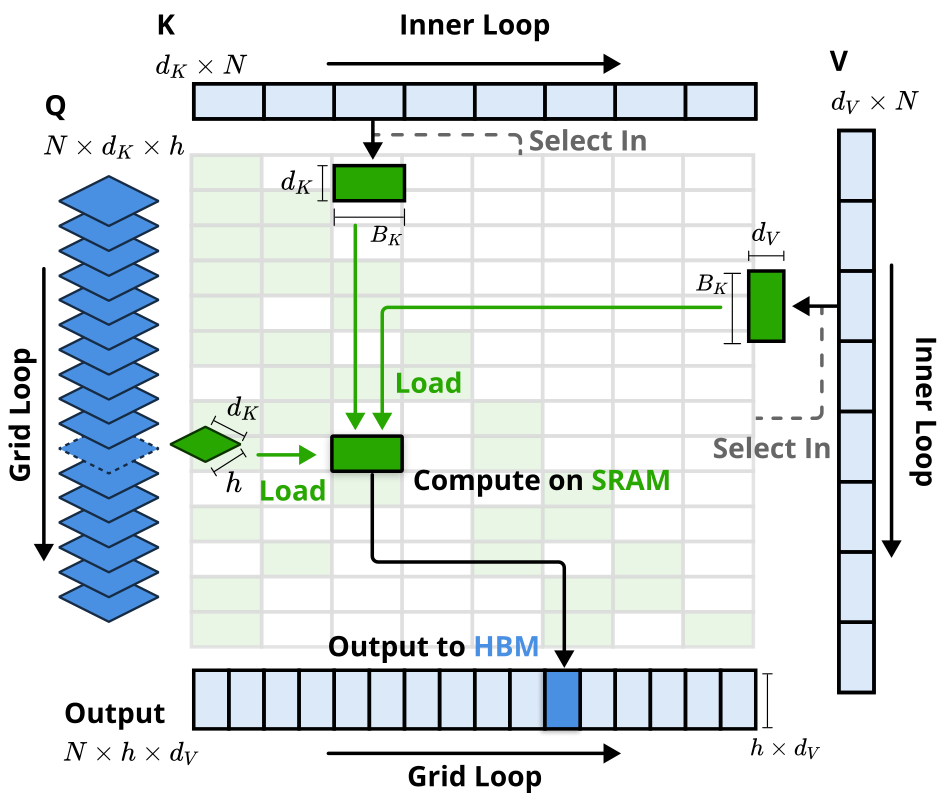
The true "secret sauce" of NSA is its Triton-based kernel. Most sparse methods load data randomly, which GPUs hate. NSA uses a Group-Centric strategy: it loads queries by GQA (Grouped-Query Attention) groups, ensuring that all query heads sharing the same KV-cache work together, maximizing memory coalescing and Tensor Core utilization.
Experimental Battle: Performance vs. Efficiency
Does sparsity hurt performance? Surprisingly, the researchers found the opposite. NSA models actually outperformed Full Attention baselines on several key benchmarks.
- Reasoning Power: On the AIME (math reasoning) benchmark, NSA outperformed the Full Attention baseline by 7.5%, suggesting that the sparse structure helps the model filter out "noise" and focus on critical logical dependencies.
- Retrieval: NSA achieved perfect 100% accuracy on the "Needle-in-a-Haystack" test up to 64k tokens.
Speedup Metrics (A100 GPU)
| Stage | Context Length | Speedup Ratio |
|---|---|---|
| Forward Pass | 64k | ~9.0x |
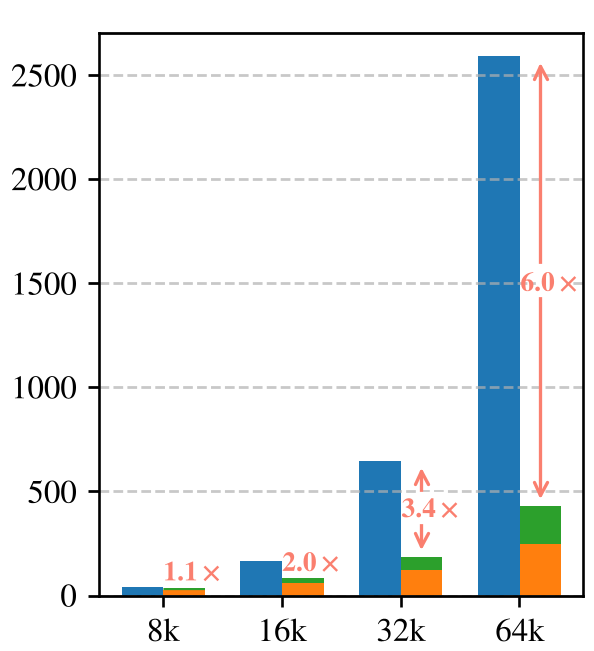
| Backward Pass | 64k | ~6.0x |
| Inference/Decoding | 64k | ~11.6x |
Deep Insights & Conclusion
NSA represents a shift from "Post-hoc Sparsity" (trying to fix a model after training) to "Native Sparsity" (designing the model to be efficient from day one). By aligning the mathematical algorithm with the physical realities of GPU HBM and SRAM architecture, NSA proves that we can have our cake and eat it too: Extreme efficiency with state-of-the-art intelligence.
For future researchers, NSA's success indicates that blockwise clustering of attention is a natural property of LLMs that we should exploit in all future architectures.