
[CVPR 2024] OCRBench: Unveiling the Hidden Mystery of OCR in Large Multimodal Models
Ocrbench: on the hidden mystery of ocr in large multimodal models
This paper introduces OCRBench, the most comprehensive evaluation benchmark for Optical Character Recognition (OCR) in Large Multimodal Models (LMMs), covering 29 datasets across five key tasks. The study evaluates 14 prominent LMMs, including GPT-4V and Gemini, providing a systematic analysis of their capabilities and limitations in text-centric visual understanding.
TL;DR
Is GPT-4V actually "seeing" the letters, or is it just a very good guesser? This paper introduces OCRBench, a rigorous benchmark comprising 1,000 tasks across 29 datasets. It reveals that while LMMs are competitive in artistic and scene text, they fail significantly in handwritten math, non-semantic strings, and fine-grained document extraction due to a heavy reliance on "semantic guessing" over actual visual perception.
Problem: The "Black Box" of Multimodal OCR
Recent Large Multimodal Models (LMMs) have shown "surprising" zero-shot OCR abilities. However, the academic community lacked a unified way to measure why they work or where they fail. Standard VQA metrics are too lenient, and most benchmarks don't distinguish between a model's ability to "read" (perception) and its ability to "predict" (language modeling).
The authors identify several critical pain points:
- Semantic Reliance: Models excel at common words but fail at random character sequences.
- Resolution Bottlenecks: Most LMMs use a 224x224 or 336x336 visual encoder (CLIP), which is like trying to read a legal contract through a foggy window.
- Instruction Following: Models often reformat output (e.g., changing "01/01" to "January 1st"), which breaks traditional evaluation scripts.
Methodology: Building a Better Yardstick
The authors constructed OCRBench by filtering and manually correcting 1,000 QA pairs across five representative tasks:
- Text Recognition: From regular scene text to "Artistic WordArt."
- Scene Text VQA: Reasoning about text in natural environments.
- Document-Oriented VQA: Parsing complex charts and infographics.
- Key Information Extraction (KIE): Structure-aware extraction from receipts.
- HMER: The "final boss"—Handwritten Mathematical Expression Recognition.
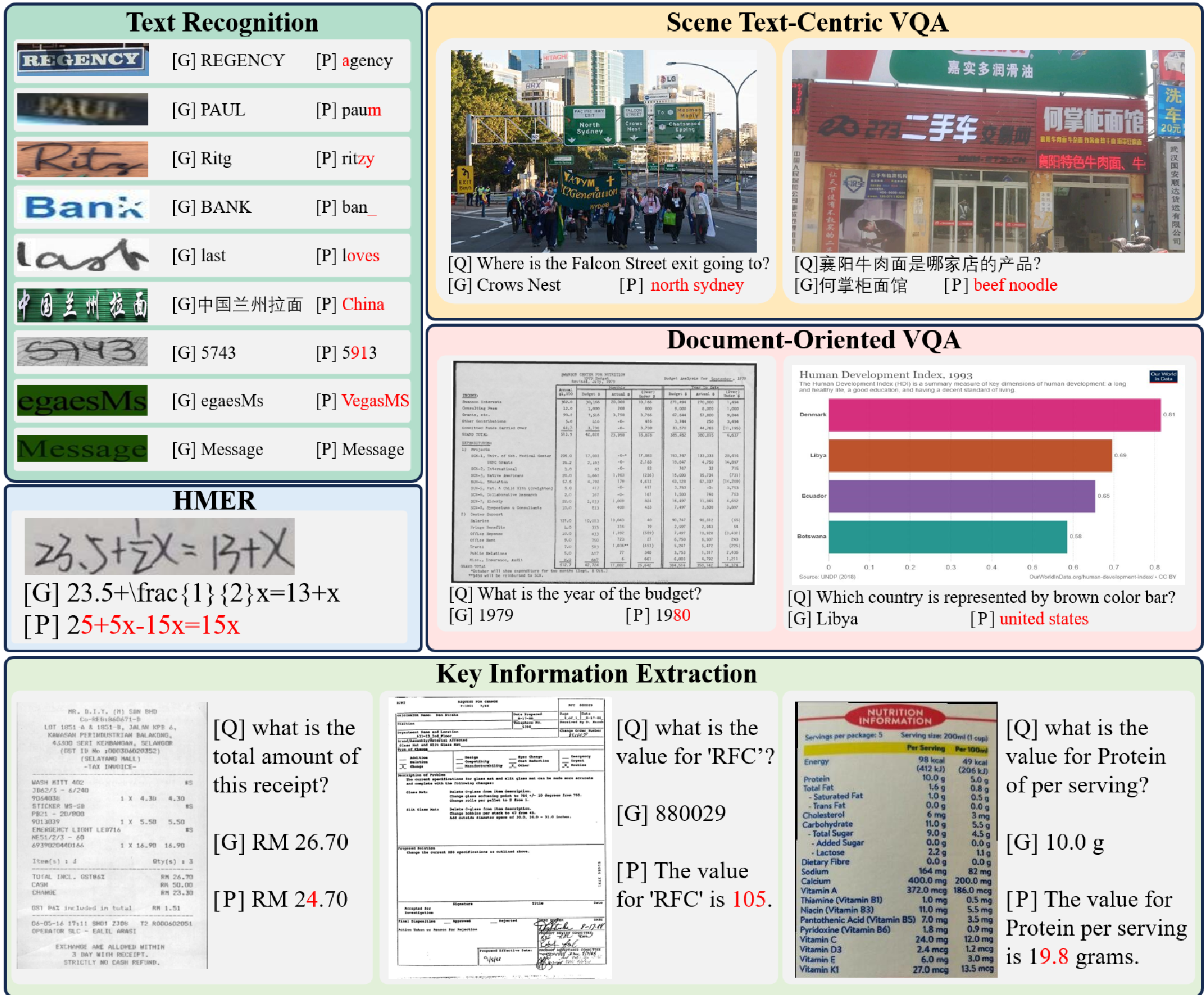 Figure 1: Examples of the five benchmarked tasks, showing the Gap between Ground Truth (G) and Prediction (P).
Key Insights: Why LMMs Underperform
Through extensive ablation and comparison against Supervised SOTA (like PARSeq), the paper uncovers four "Hidden Mysteries":
1. The Semantic Trap
LMMs are "too smart" for their own good. The authors created a Non-Semantic Text (NST) dataset by shuffling characters. While Supervised SOTA models only dropped 4.6% in accuracy, LMMs dropped by an average of 57%. This proves they rely on their internal Language Model to fill in the gaps rather than truly recognizing the characters.
2. The Resolution Wall
OCR is a high-frequency task. Models like Monkey (which supports up to 1344x896 resolution) showed massive jumps in Document VQA scores compared to BLIP-2 or LLaVA-1.5. This suggests the "vision" part of the LMM is often the bottleneck, not the "brain."
3. HMER is the Great Filter
Almost all models—including Gemini and GPT-4V—score near zero on handwritten mathematical expressions. The combination of structural complexity (LaTeX) and messy handwriting remains an unsolved frontier for general-purpose LMMs.
Experimental Battleground
The results show a clear hierarchy. Gemini and GPT-4V lead the pack, but open-source models like Monkey are catching up, especially in high-resolution tasks.
 Table 1: LMMs vs. Supervised SOTA across various text recognition scenarios.
Qualitative Failures
The paper provides a sobering look at how even the best models hallucinate when the text is blurry or non-semantic.
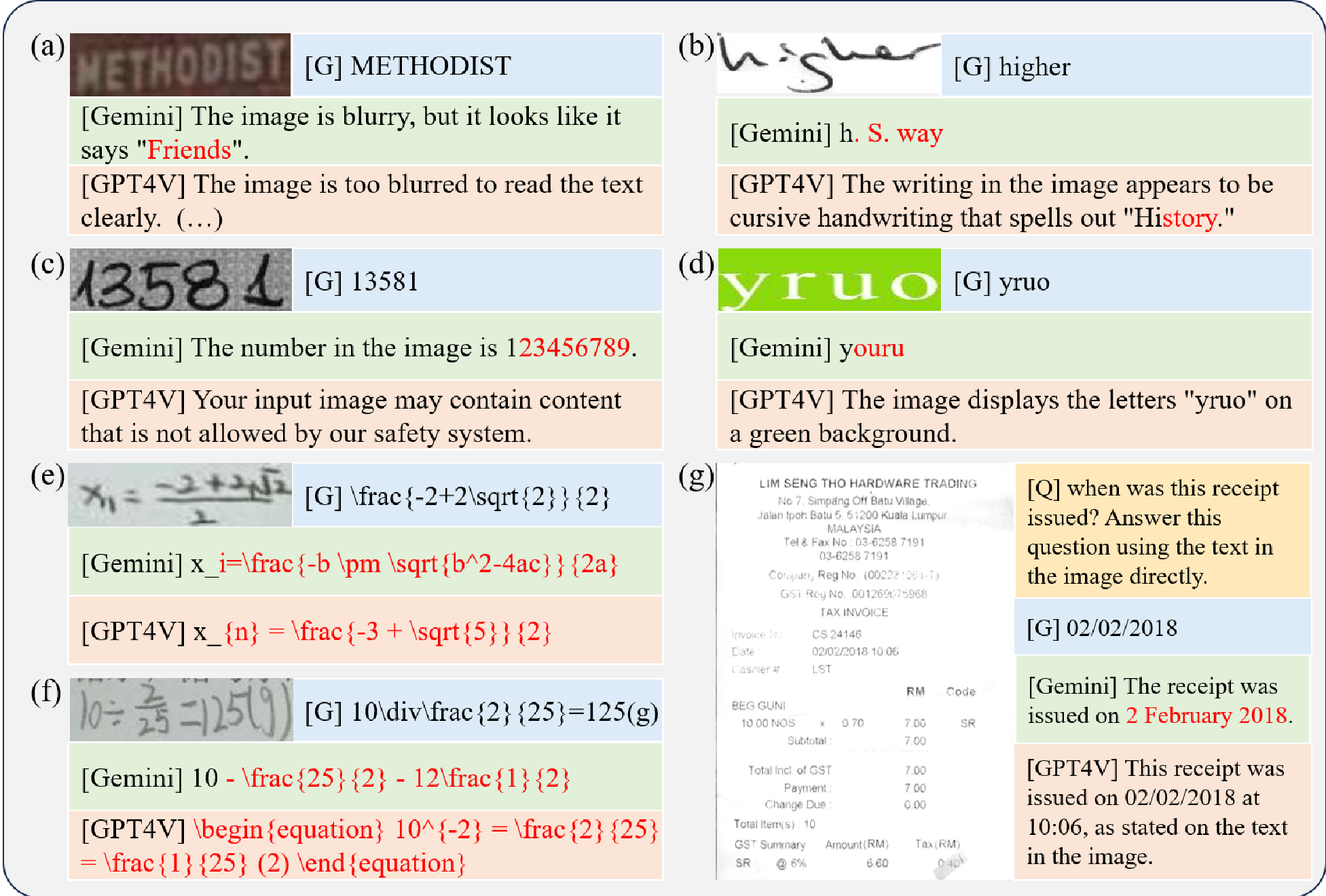 Figure 2: Hallucinations in Gemini and GPT-4V. Note how they struggle with scrambled letters ("egaesMs") and math.
Critical Analysis & Future Directions
The takeaway for researchers is clear: OCR is not "solved" by LMMs.
- The Resolution Fix: We need adaptive visual tokenization to handle large documents without exploding the sequence length.
- Beyond Semantics: Training needs to incorporate more "meaningless" character strings to force the model to look at pixel-level features rather than just predicting the next token.
- Instruction Adherence: Models need better alignment to extract text verbatim rather than "helpful" reformatting.
In conclusion, OCRBench provides the community with a high-fidelity diagnostic tool. It moves the conversation from "Does it work?" to "Why did it fail?"—a necessary step for moving towards truly intelligent document understanding.