
[v1.1 February 2026] AUTODISCOVERY: Pushing the Scientific Frontier via Bayesian Surprise
Open-ended Scientific Discovery via Bayesian Surprise
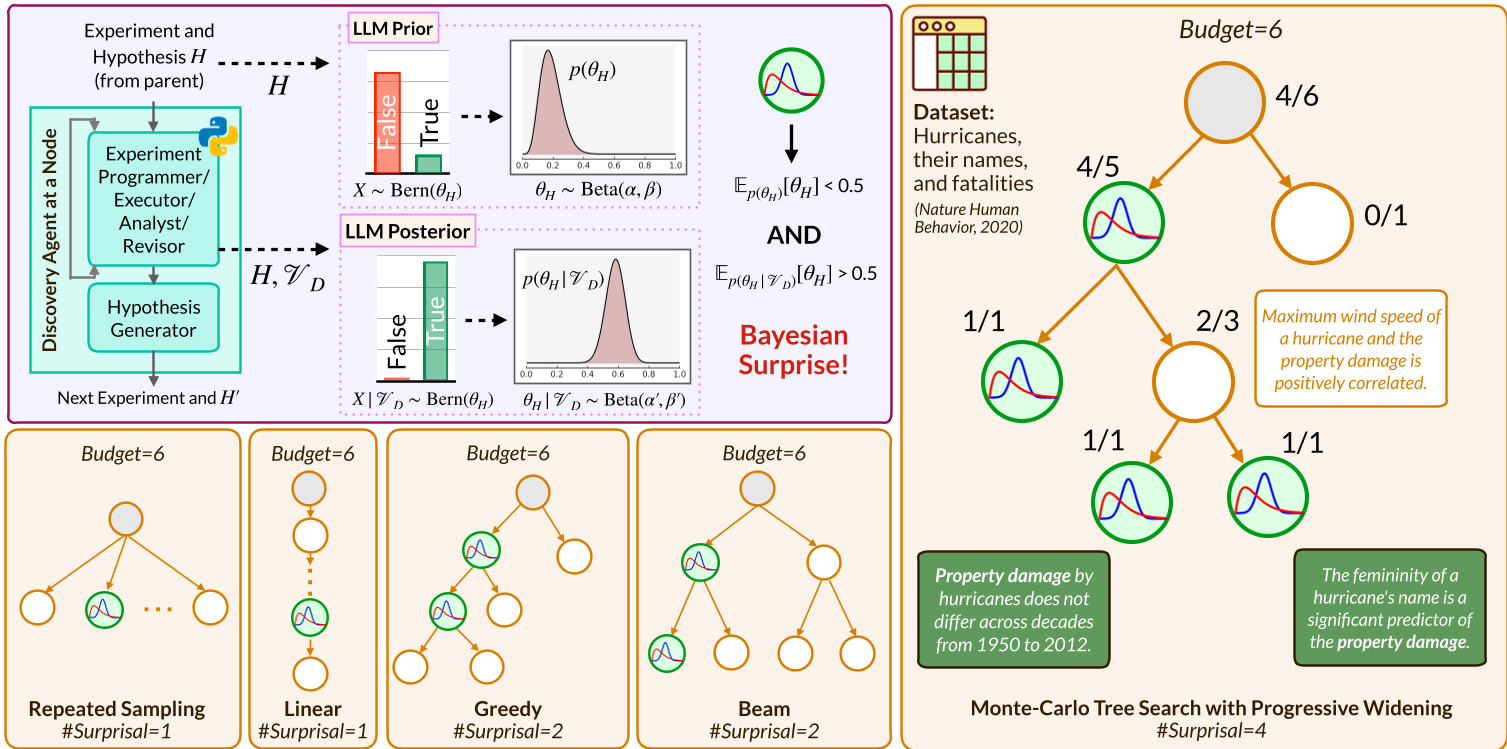
AUTODISCOVERY is an open-ended autonomous scientific discovery (ASD) framework that utilizes <b>Bayesian Surprise</b> and <b>Monte Carlo Tree Search (MCTS)</b> to iteratively generate and verify scientific hypotheses. It achieves a 5-29% increase in surprising discoveries across 21 real-world datasets compared to traditional search baselines.
TL;DR
AUTODISCOVERY is a framework designed to transform LLMs from passive "answer-bots" into autonomous scientists. By optimizing for Bayesian Surprise—the delta between what the model thinks will happen and what the data actually shows—it navigates massive spaces of possible hypotheses using Monte Carlo Tree Search. It consistently finds 5-29% more non-obvious scientific insights than traditional methods across 21 diverse domains.
The Problem: AI with No Curiosity
Most current Autonomous Scientific Discovery (ASD) systems suffer from a "creative bottleneck." They are goal-driven, meaning a human must tell them what to look for. When left to their own devices in "open-ended" mode, they often fall into two traps:
- The Diversity Trap: They generate many different ideas, but most are trivial or irrelevant.
- The Subjectivity Trap: They use LLMs to judge "interestingness," a metric so subjective that even human scientists rarely agree on it.
The Insight: Quantification of "Aha!" Moments
The authors argue that the best measure of scientific value is Surprisal. If an experiment changes your mind, it’s valuable.
They formalize this using Bayesian Surprise:
- Prior Belief (): The LLM's confidence in a hypothesis before seeing data.
- Posterior Belief (): The confidence after a Python-based agent executes an experiment and provides results.
- The Reward: The KL-Divergence between these two distributions.
Methodology: Searching the Infinite
To explore hypotheses, AutoDiscovery uses Monte Carlo Tree Search (MCTS).
- Selection: Use the UCT (Upper Confidence Bound) function to pick a hypothesis "node" that has high potential for surprise.
- Expansion: Use Progressive Widening to prevent the tree from becoming too narrow, ensuring the agent keeps sampling diverse ideas.
- Execution: An agentic loop (Experimenter, Programmer, Analyst) writes Python code, runs it against real data, and reports back.
- Backpropagation: The surprisal score is fed back up the tree, teaching the system which "areas of inquiry" yield the most mind-bending results.
Experiments & Results
The system was tested on 21 datasets, including DiscoveryBench and SEA-AD (Alzheimer’s research).
Key Findings:
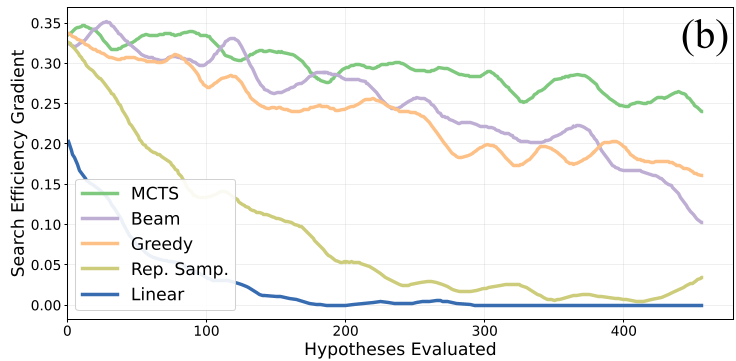
- Performance: MCTS found significantly more surprisals than Greedy or Beam search.
- Efficiency: Unlike other methods, AutoDiscovery's efficiency didn't drop off as the "budget" was used up; it kept finding new insights.
- Expert Alignment: 67% of the system's "discoveries" were validated as surprising by STEM PhDs.
Critical Analysis & Conclusion
AutoDiscovery represents a shift from "AI as a tool" to "AI as a peer." By grounding its curiosity in a statistical measure (Bayesian Surprise) rather than human prompts, it can find correlations and relationships that a human might never think to ask about.
Limitations:
- Ungrounded Generations: LLMs sometimes hallucinate variables not in the dataset.
- Latency: High API costs and time-per-node (avg. 75s) limit massive scaling without programmatic speedups.
Takeaway: The future of science may not just be about faster calculations, but about building machines that know how to be "surprised."