
OrderGrad: Moving Beyond the "Mean" Mindset in AI Optimization
OrderGrad: Optimizing Beyond the Mean with Order-Statistic Policy Gradient Estimation
OrderGrad is a novel family of gradient estimators for optimizing order-statistic objectives, such as CVaR, medians, and Top-M@K. It enables policy-gradient and reparameterization updates to target specific parts of a reward distribution (e.g., tail risk or exploration) beyond mere expected returns, achieving SOTA pass@k performance in LLM math post-training tasks.
Executive Summary
In the world of Reinforcement Learning (RL) and Large Language Model (LLM) fine-tuning, the expected return is king. We typically train models to maximize the average reward. However, the average is a blunt instrument. It doesn't care if a model occasionally produces catastrophic failures (tail risk) or if it only succeeds by "getting lucky" once in a thousand tries (exploration).
OrderGrad is a powerful new framework from researchers at the University of Tokyo that allows us to optimize for the shape of the reward distribution. By leveraging order statistics (sorted rewards), OrderGrad provides a unified, unbiased gradient estimator for objectives like Value-at-Risk (VaR), medians, and the critical pass@k metric.
The Problem: The "Mean" is Not Enough
Standard policy-gradient methods (like REINFORCE or PPO) collapse a complex distribution of outcomes into a single scalar mean. This leads to several failure modes:
- Risk Sensitivity: An autonomous car shouldn't care about its average safety; it must minimize the probability of its worst-case failure.
- Exploratory Success: In math reasoning, we often sample 100 answers and pick the best one. We should optimize for the Best-of-K, not the average of all attempts.
- Robustness: Outliers in training data can pull the mean away from the true signal, leading to biased models.
Methodology: The Power of Sorting
OrderGrad’s core insight is to treat a batch of rewards as a "finite population." By sorting these rewards (), we can assign weights () to specific ranks.
- To focus on Safety: Weight the bottom ranks (the "losers").
- To focus on Exploration: Weight the top ranks (the "winners").
- To focus on Robustness: Use a "trimmed mean" (discard the extremes).
The Unbiased Advantage
Technically, OrderGrad derives a Batch Advantage (). It calculates how much including a specific sample changes the expected rank-weighted reward of a size- subset compared to leaving it out. This ensures that the gradient updates remain mathematically "honest" (unbiased) relative to the target distributional objective.
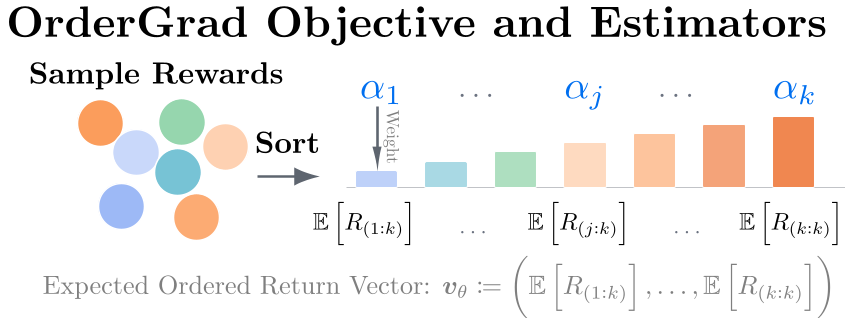 Figure 1: Traditional Mean optimization vs. OrderGrad's rank-weighted L-statistics approach.
LLM Reasoning: Solving the "Overthinking" Problem
One of the most impressive applications shown in the paper is in LLM math post-training.
LLMs often "overthink"—they write extremely long, rambling responses that are frequently incorrect. Standard RL (like GRPO) struggles to fix this because a blanket length penalty often ruins accuracy.
The OrderGrad Solution: The authors applied a dual-weighting scheme:
- Top-M Ranks: Optimized for correctness.
- Bottom-M Ranks: Optimized for length penalty.
Results showed that the model learned to be correct and concise. It maintained high pass@k performance while effectively "trimming the tail" of long, useless responses.
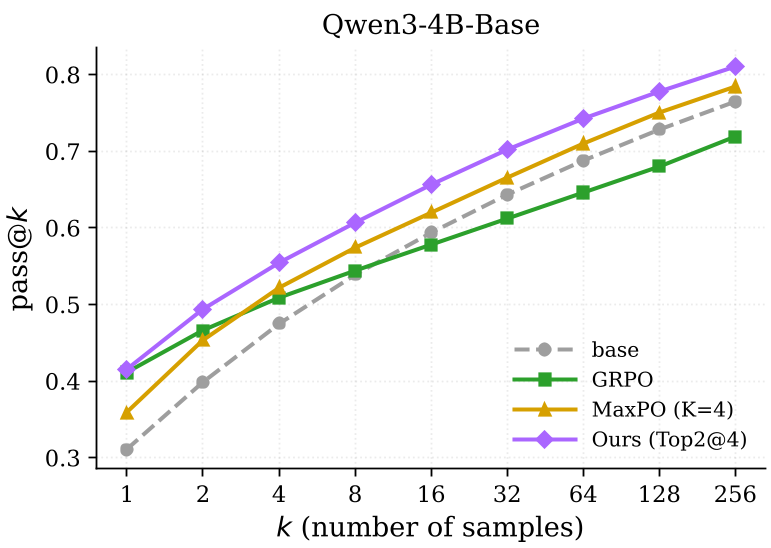 Figure 2: Performance comparison on Qwen models. OrderGrad (Top2@4) significantly outperforms standard GRPO across varying k-values.
Critical Insight & Conclusion
OrderGrad is essentially a "reward transformer." Because it can be implemented as a simple wrap-around for existing advantages, it is remarkably easy to integrate into existing pipelines.
The Takeaway: As we move toward more complex agentic behaviors and safety-critical AI, the ability to specify how we want the reward distribution to look—rather than just asking for "more"—will be a foundational skill for AI researchers. OrderGrad provides the mathematical bridge to get there.
Limitations: While powerful, larger subset sizes () can increase gradient variance, requiring careful hyperparameter tuning and potentially larger batch sizes to remain stable.