
PaSa: How Reinforcement Learning Creates the World's Best Academic Search Agent
PaSa: An LLM Agent for Comprehensive Academic Paper Search
PaSa is an LLM-powered academic search agent that autonomously crawls and selects research papers through search tools and citation network exploration. Optimized via reinforcement learning (PPO) and the AGILE framework, PaSa-7B achieves state-of-the-art performance, significantly outperforming GPT-4o and Google-based baselines in recall and precision.
Executive Summary
TL;DR: PaSa (Paper Search agent) is a new autonomous system that doesn't just "search" for papers—it researches them. By mimicking human scholars, it uses search tools, reads through abstracts, and follows citation trails. Despite being built on a modest 7B parameter backbone (Qwen2.5), it destroys GPT-4o and Google Scholar on complex, fine-grained academic queries.
Background: While LLMs have become the "go-to" for general questions, they often hallucinate or provide surface-level results for deep academic inquiries (e.g., "Which UCB-based value methods work in non-stationary RL?"). PaSa positions itself as a specialized autonomous agent optimized via Reinforcement Learning (RL) to bridge the gap between simple retrieval and comprehensive literature review.
The Core Problem: Why Google Scholar Isn't Enough
The "Information Literacy Gap" is a well-known pain point in academia. Traditional search engines rely on keyword matching or embedding similarity, which fails when:
- Queries are fine-grained: Complex constraints (specific algorithms + specific environments) confuse standard rankers.
- Citation Context is Missing: Valuable papers are often discovered by "walking" through the bibliography of a related work, a process standard search engines don't simulate.
- Static Ranking: Existing systems don't "read" the paper to verify if it actually answers the user's specific technical nuance.
Methodology: The Crawler and The Selector
PaSa's architecture is a "divide and conquer" strategy between two core agents:
1. The Crawler (The Explorer)
The Crawler handles the exploration. It utilizes three primary actions:
- [Search]: Generates optimized search queries for external engines.
- [Expand]: Pivots on the current paper to find cited works in specific relevant sections.
- [Stop]: Concludes the session for the current paper and moves to the next.
2. The Selector (The Gatekeeper)
The Selector acts as the quality control. It reads the title and abstract, provides a boolean decision (True/False), and—crucially—generates a rationale. This rationale not only improves user trust but is used during training as an auxiliary reward for the Crawler.
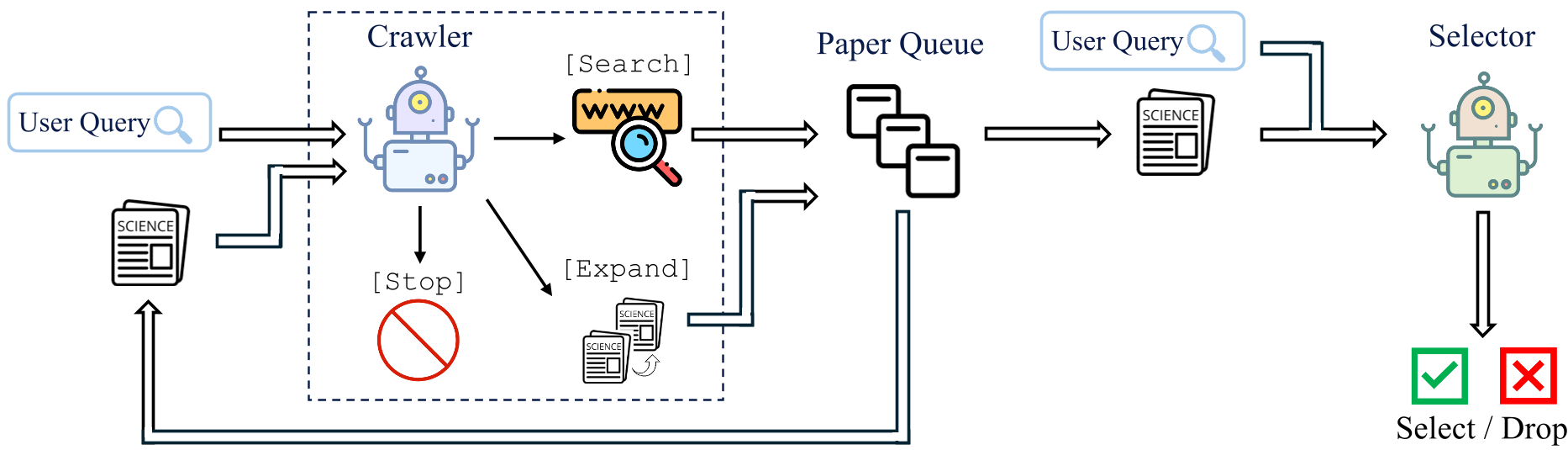 Figure 1: The dual-agent architecture of PaSa featuring the Crawler and Selector workflow.
RL and Synthetic Data: Turning a 7B Model into a Specialist
The authors solved the data scarcity problem using AutoScholarQuery: they took the "Related Work" sections of 35k papers from top-tier AI conferences (ICLR, ICML, CVPR) and used GPT-4o to "reverse-engineer" the queries that would lead to those specific citations.
To train the 7B model, they used Session-level PPO (Proximal Policy Optimization).
- Challenge: Trajectories are too long for standard LLM contexts.
- Solution: They break the process into "sessions" (from query to search, or from paper to expansion).
- Reward Function: The model gets points for finding "Ground Truth" papers and extra points if the Selector deems a new discovery highly relevant.
Experimental Results: Surpassing GPT-4o
In their "RealScholarQuery" benchmark (real-world queries from AI researchers), PaSa-7B showed dominant leads:
- Recall@20: 57.98% (vs. Google Scholar's 15.14%)
- Improvement: It outperformed GPT-4o (running a similar agentic loop) by 30.36% in recall.
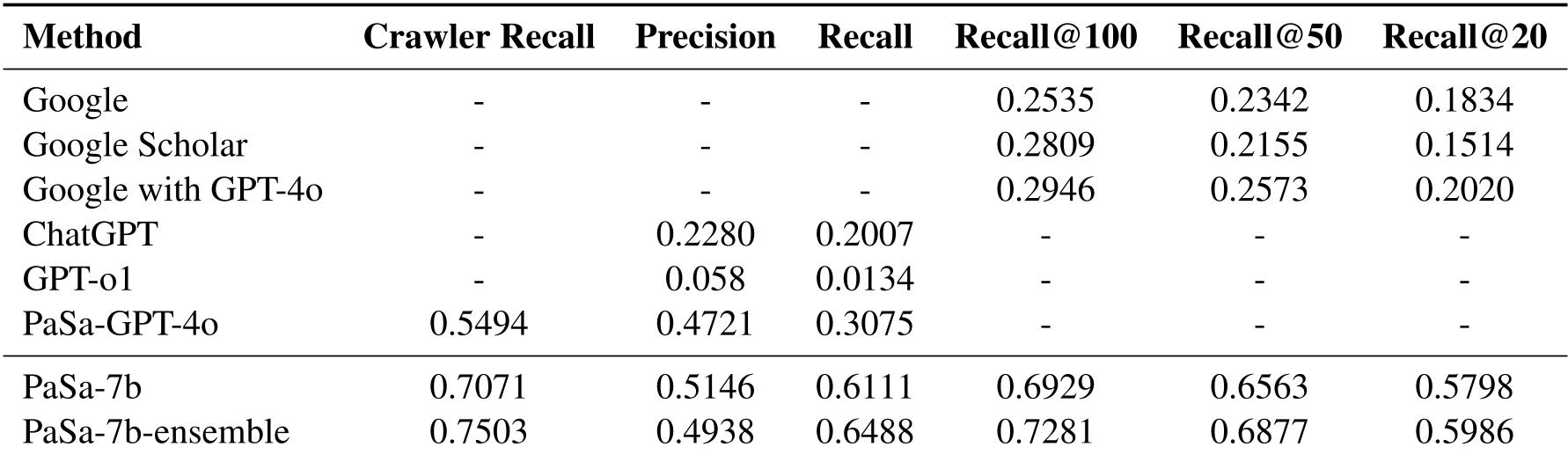 Table 6: Comparison of PaSa against various baselines on the RealScholarQuery benchmark.
Ablation Insight
One of the most striking findings: removing the [Expand] action (citation crawling) caused the recall to tank by over 32%. This proves that "following the trail" is the single most important behavior for comprehensive search.
Critical Analysis & Conclusion
Takeaway: PaSa proves that for complex, specialized tasks, an agentic framework combined with task-specific RL is more effective than simply using a larger "General Intelligence" model like GPT-o1 or Clause 3.5.
Limitations:
- Cost/Latency: Running a recursive agent is significantly slower than a single Google search.
- Scope: Currently focused heavily on the AI field (due to the training data).
Future Outlook: The transition from Search Engines to Search Agents is inevitable. PaSa provides the blueprint for how we will interact with scientific literature in the future—not by typing keywords, but by delegating research missions to autonomous agents that can truly "understand" the citation graph.