
Plan×RAG: Mastering Multi-Hop Reasoning via Planning-Guided Retrieval
Plan×RAG: Planning-Guided Retrieval Augmented Generation
This paper introduces Plan×RAG, a novel framework that shifts the Retrieval-Augmented Generation paradigm from "retrieve-then-reason" to "plan-then-retrieve." By formulating a reasoning plan as a Directed Acyclic Graph (DAG), it achieves SOTA performance on multi-hop reasoning datasets like HotpotQA and StrategyQA using frozen, plug-and-play language models.
TL;DR
Plan×RAG revolutionizes the standard Retrieval-Augmented Generation (RAG) workflow by moving from a reactive "retrieve-then-reason" model to a proactive "plan-then-retrieve" architecture. By structuring reasoning as a Directed Acyclic Graph (DAG), it decomposes complex queries into atomic, parallelizable units. This approach achieves state-of-the-art results on multi-hop benchmarks like HotpotQA without the need for costly model fine-tuning, while providing inherent "attribution by design."
The Bottleneck: Why Standard RAG Fails at Complex Queries
Standard RAG frameworks operate on a simple premise: take a query, find documents, and generate an answer. However, when faced with multi-step questions (e.g., "In what year was the coach who led the 2007 Gamecocks born?"), this linear approach breaks down.
The core issues are:
- Hallucination: LLMs "fill in the blanks" when retrieved context is broad or slightly off-target.
- Context Dilution: Packing 10+ retrieved documents into a prompt creates noise, often confusing smaller models (SLMs).
- Lack of Attribution: It is difficult to verify which specific document supported which part of a long-form answer.
Methodology: The Reasoning DAG and Plug-and-Play Experts
The heart of Plan×RAG is the Reasoning DAG. Instead of treating a query as a single string, the system generates a structural plan where nodes represent "atomic" sub-queries—questions so simple they can be answered by a single document.
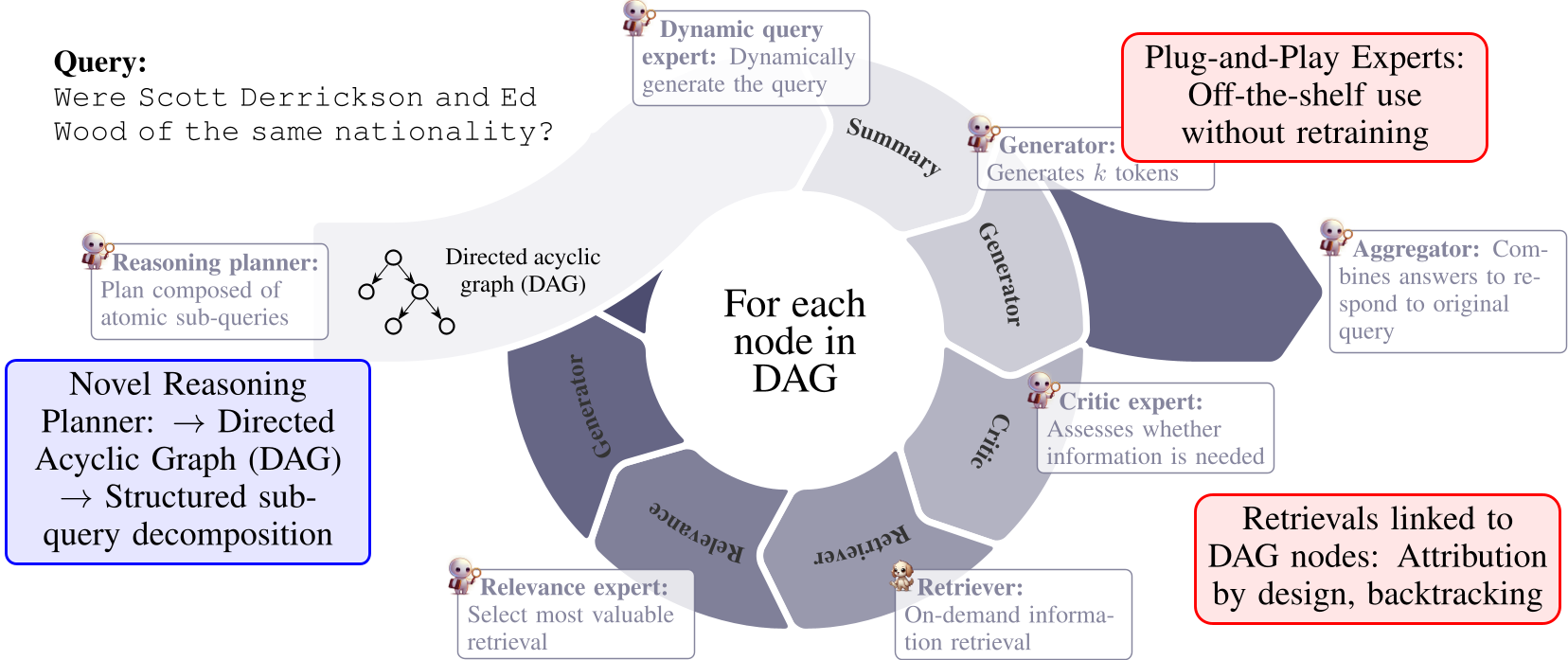
The Four Expert Pillars:
- Dynamic Query Expert: Handles dependencies. If Query B depends on the answer to Query A, this expert injects the result into the next node dynamically.
- Critic Expert: A "gatekeeper" that decides if the model actually needs to retrieve external data for a specific node, saving computational tokens.
- Relevance Expert: Filters the top-K retrieved documents to find the one perfect match, reducing noise for the generator.
- Aggregator: Synthesizes the sub-answers into a final, coherent response.
Performance: Small Models, Big Results
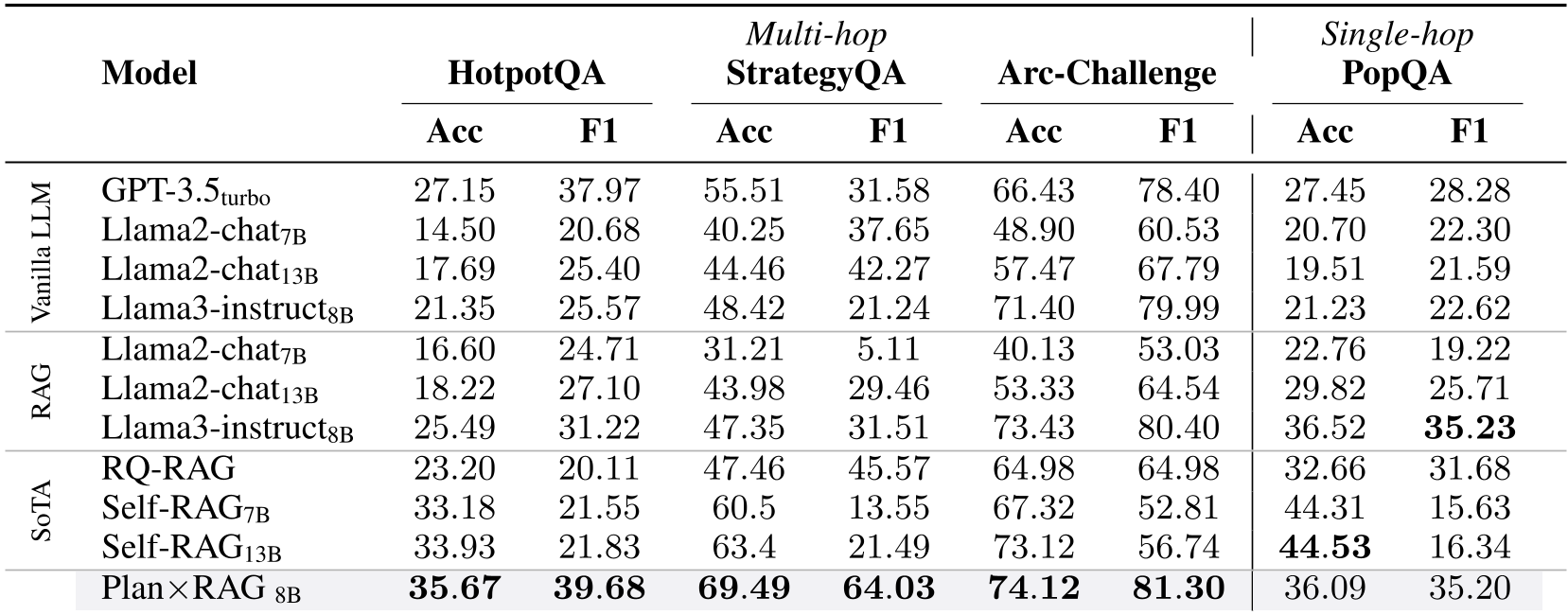
One of the most impressive findings is that Plan×RAG, using a frozen Llama3-8B as the backbone, outperformed Self-RAG 13B—a model specifically fine-tuned for retrieval tasks—across multiple complex datasets.
| Dataset | Self-RAG 13B (Acc) | Plan×RAG 8B (Acc) |
|---|---|---|
| HotpotQA | 33.93% | 35.67% |
| StrategyQA | 63.40% | 69.49% |
| Arc-Challenge | 73.12% | 74.12% |
Why it works: The Power of Filtering
In ablation studies, the authors found that removing the Relevance Expert caused accuracy to plummet from 39.33% to 31.60%. This proves their core insight: less is more. By using atomic sub-queries and filtering for the single most relevant document, the model avoids the "lost in the middle" phenomenon common in long-context RAG.
Deep Insights: Attribution and Debuggability
Beyond accuracy, Plan×RAG introduces two industry-critical features:
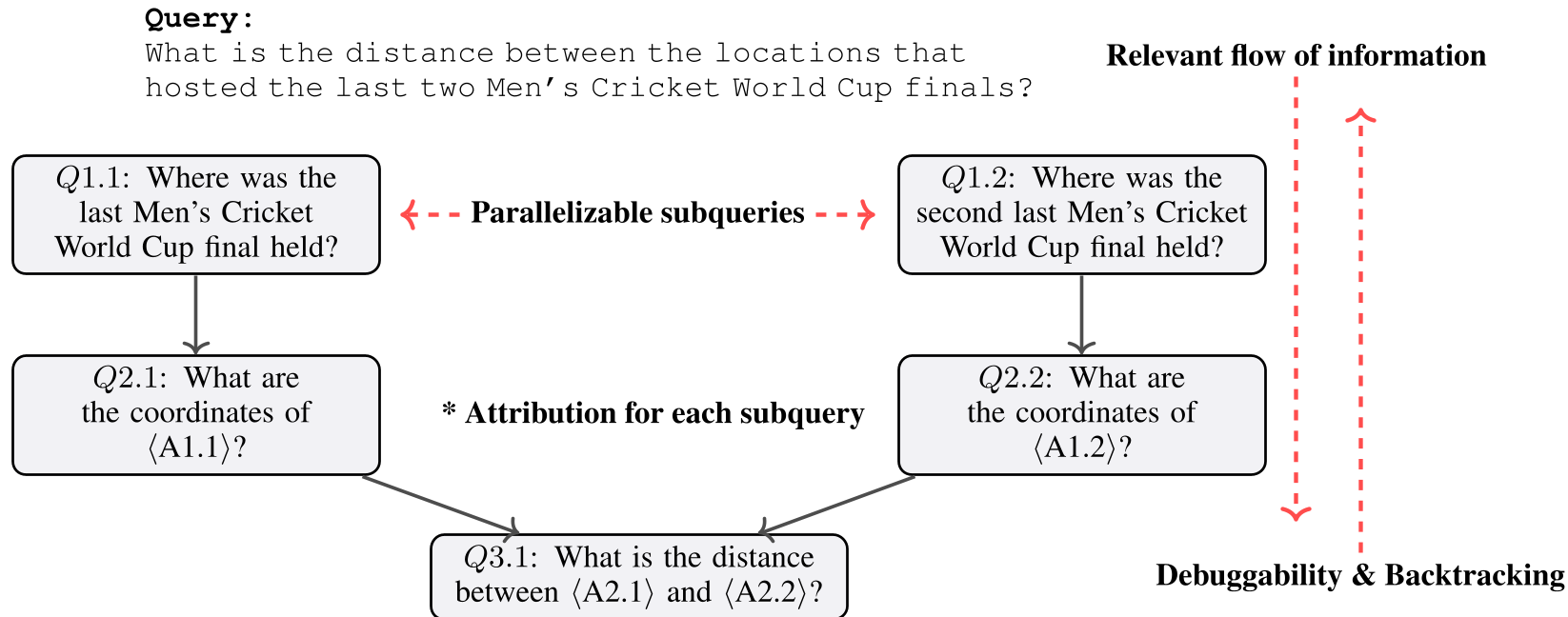
- Attribution by Design: Because each sub-query node typically maps to exactly one document, the system can provide hard links for every claim it makes. 76% of its answers were found to be direct substrings of the retrieved text.
- Backtracking/Debuggability: Since the reasoning is a DAG, if the final answer is wrong, developers can pinpoint exactly which node in the graph failed, provide a correction, and re-run only the affected paths.
Conclusion and Future Outlook
Plan×RAG demonstrates that the future of RAG isn't just about bigger retrievers or longer contexts; it's about better planning. By shifting the intelligence effort to the "Pre-Retrieval" phase, we can use smaller, faster, frozen models to achieve superior accuracy and reliability.
Future versions of this work might include "early-exit" mechanisms for simpler queries or specialized "Math Experts" to handle quantitative nodes within the DAG.