
The Quantum Bridge: How Matter Superpositions Reshape Spacetime Geometry
Quantum gravitational contrast in creating Schrödinger cat state
The paper investigates how a matter-wave interferometer creates a Schrödinger cat state that induces a displaced vacuum in the graviton field, effectively treating matter and gravity on an equal perturbative footing. It demonstrates that the overlap (contrast) between the coherent graviton states corresponding to different matter paths determines the entanglement between matter and quantum spacetime.
TL;DR
In a groundbreaking theoretical exploration, physicists Anupam Mazumdar and Tian Zhou have bridged the gap between quantum matter and perturbative gravity. By treating the graviton vacuum as a state that can be "displaced" by matter, they show that a particle in a spatial superposition actually creates a superposition of classical geometries. This results in entanglement between the particle and the graviton field, a phenomenon that could soon be the "smoking gun" for the quantized nature of gravity.
Contextualizing the Quantum-Gravity Interaction
For decades, the standard approach to gravity in the lab has been to treat it as a background force. However, recent interests in mesoscopic interferometry have pushed researchers to ask: If matter is quantum, must the gravitational field it creates also be quantum?
The authors position this work within the framework of the QGEM (Quantum Gravity-induced Entanglement of Masses) protocol. They move beyond seeing gravity as a mere "channel" for interaction, analyzing how the coupling at a perturbative level leads to a unique state: a displaced graviton vacuum.
The Core Intuition: Gravity as a Coherent State
The central "Aha!" moment of the paper is the application of the displacement operator to the graviton vacuum .
- Matter-Graviton Coupling: In the presence of a mass with a Gaussian spread , the interaction Hamiltonian doesn't just attract other masses; it "shifts" the state of the graviton field.
- The Displaced Vacuum: This shift creates a coherent state . In the classical limit, this state reproduces the familiar Schwarzschild geometry.
- The Multi-Branch Reality: When a particle enters a spatial superposition (Left path and Right path), it doesn't just create one geometry; it creates a superposition of two coherent graviton states: and .

Methodology: Quantifying the Contrast
The paper defines a "Quantum Bridge" through the overlap .
- If , the geometries are indistinguishable; the graviton field is not entangled with the matter.
- If , the geometries are orthogonal. The graviton field has "recorded" the position of the particle so perfectly that it has extracted maximum information, leading to maximum entanglement.
The authors derive the contrast formula for a static mass:
This formula reveals an incredible insight: as the mass increases, the exponent grows, forcing toward zero. This means heavier objects are much "better" at entangling with the fabric of spacetime, making them ideal candidates for quantum gravity experiments.
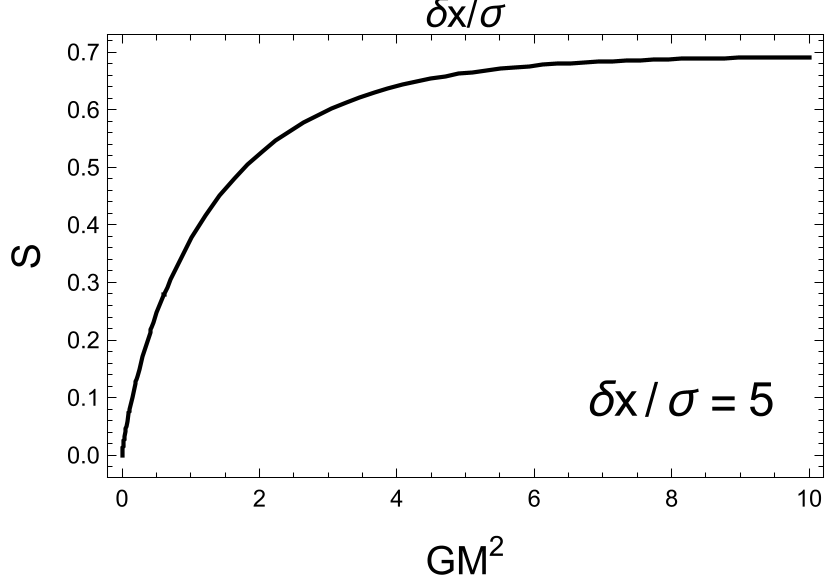 Figure 1: Entanglement entropy as a function of the superposition size and mass . Notice the rapid climb to maximum entropy () as mass increases.
Deep Dive: Time-Dependent Gravitons
In the Appendix, the authors extend this to a dynamic scenario: a Quantum Harmonic Oscillator. As the mass oscillates, it emits "propagating gravitons" (gravitational waves). They calculate that even here, the overlap of the waves emitted from the two superposed paths determines the decoherence rate.
For an oscillation with amplitude and frequency , the overlap after one period is:
Critical Analysis & Conclusion
Takeaway: This paper elegantly demonstrates that gravity is not just an "invisible string" between masses, but a quantum field that carries state information. The "Schrödinger cat" isn't just in the box; its gravitational field is also in a cat state.
Limitations: The study is strictly perturbative. As the authors note, going beyond the "tree level" (e.g., higher-order vertex corrections or post-Newtonian effects) is essential for a complete theory. Furthermore, experimental realization requires masses of kg to be held in superposition—a monumental engineering challenge.
Future Outlook: This work provides the mathematical rigorousness needed to design "Entanglement Witnesses." If we can measure the entanglement between two such interferometers, we aren't just measuring a force; we are proving that spacetime itself is a quantum entity.