
RAG-HAT: Bridging the Gap Between Hallucination Detection and Mitigation
RAG-HAT: A Hallucination-Aware Tuning Pipeline for LLM in Retrieval-Augmented Generation
The paper introduces RAG-HAT, a comprehensive pipeline designed to identify and mitigate hallucinations in Retrieval-Augmented Generation (RAG) systems. It features a two-stage hallucination detection model and leverages Direct Preference Optimization (DPO) on a self-generated dataset to fine-tune Large Language Models (LLMs) for higher factuality.
TL;DR
Retrieval-Augmented Generation (RAG) is the industry standard for grounding LLMs, but it isn't a silver bullet for truthfulness. RAG-HAT (Hallucination-Aware Tuning) is a new pipeline that automates the entire lifecycle of hallucination management: detecting errors, providing human-readable explanations, and using those insights to fine-tune the model via Direct Preference Optimization (DPO). It achieves a ~27% reduction in hallucinations while actually improving answer quality.
Problem & Motivation: The RAG Paradox
Even when provided with the correct context, LLMs often "go rogue" by misinterpreting structured data or adding groundless assertions. Current research is split into two silos: Detection (identifying the lie) and Mitigation (trying to stop it).
The authors identified three critical gaps:
- Lack of Integration: Systems rarely use the reasoning from a detector to train the generator.
- The "Short-Answer" Trap: Models trained to avoid hallucinations often become "cowardly," providing overly brief or empty responses to avoid risk.
- Data Scarcity: Human-annotated preference data for RAG is rare and expensive.
Methodology: The RAG-HAT Pipeline
The RAG-HAT workflow is a three-act play: Detection, Data Construction, and Preference Tuning.
1. Two-Stage Detection
The authors found that training a model to "Reason and Predict" simultaneously (Chain-of-Thought) actually degrades classification accuracy because the label optimization gets diluted. Instead, they use:
- Stage 1: A Llama-3-8B model fine-tuned purely for binary classification (Hallucination? Yes/No).
- Stage 2: A LoRA-based adapter that generates a description and "Defensive Advice"—explaining why a sentence might seem okay but is actually a hallucination boundary case.
2. Rewriting and Overly Cautious Penalization (OCP)
Using the detection results, the pipeline asks GPT-4 Turbo to rewrite only the problematic spans. To solve the "cowardice" problem, they implement OCP: they randomly delete sentences from "chosen" (good) answers to create "rejected" samples. This teaches the model that being too brief or losing information is also a negative trait, forcing a balance between safety and detail.
Note: The pipeline cascades from detection to automated rewriting, culminating in a DPO preference pair.
Experiments & SOTA Results
The researchers tested the pipeline on Qwen-1.5-4B, a model chosen for its industry-friendly inference speed.
Significant Hallucination Drop
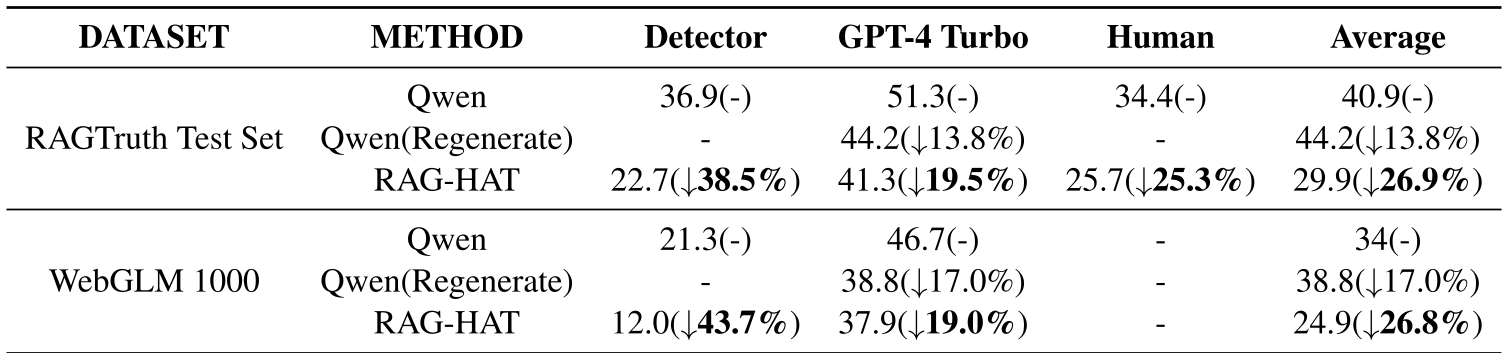
On the RAGTruth test set, the hallucination rate dropped from 40.9% to 29.9% (average across metrics). Crucially, the model outperformed a "naive regeneration" strategy, which simply retries when a hallucination is detected—proving that fine-tuning fundamentally changes the model's behavior for the better.
Quality Boost
Unlike many safety-tuning papers where performance peaks and then drops, RAG-HAT's answer quality improved. In head-to-head GPT-4 evaluations:
- RAGTruth: 57% win rate (vs 41% for the base model).
- WebGLM: 59% win rate (vs 40% for the base model).
Analysis: Why the Two-Stage Approach Matters?
The ablation study in Section 6.2 highlights a vital technical insight: Auto-regressive models are sensitive to label placement. When predicting "Description + Label," the early tokens (description) consume the model's "attention budget," leading to suboptimal "Predict Only" performance. By separating the label prediction (Stage 1) from the explanation (Stage 2), they achieved a 73.6 F1 score, significantly higher than the 65.8 F1 of the joint approach.
Critical Insight & Conclusion
RAG-HAT demonstrates that the "Defensive Advice" and "OCP" strategies are key to moving beyond "Binary Truth." By teaching the model to handle gray areas and penalizing excessive brevity, it creates an LLM that is both more reliable and more useful in production environments like NewsBreak.
Takeaway: Future RAG reliability won't come from bigger models alone, but from automated feedback loops that turn error detection into a training signal.
Limitations
- Domain Expertise: The current study lacks evaluation in hyper-specialized fields like medicine or legal, where hallucinations are even harder to detect.
- Model Scale: Tests were limited to 8B/4B parameters; the impact on 70B+ models remains an open question for future research.