
SANA-WM: Revolutionizing Minute-Scale World Modeling with Hybrid Linear Transformers
SANA-WM: Efficient Minute-Scale World Modeling with Hybrid Linear Diffusion Transformer
SANA-WM is a 2.6B-parameter world model from NVIDIA designed for high-fidelity, minute-scale (60s) 720p video generation with precise 6-DoF camera control. It utilizes a novel Hybrid Linear Diffusion Transformer (Hybrid Linear DiT) and a two-stage refinement pipeline, achieving state-of-the-art action-following accuracy and visual quality with significantly higher throughput than industrial baselines.
TL;DR
NVIDIA researchers have unveiled SANA-WM, a 2.6B open-source world model capable of generating 60 seconds of 720p video with precise 6-DoF camera control. By ditching pure Softmax Attention for a Hybrid Gated DeltaNet (GDN) architecture and utilizing a high-compression VAE, SANA-WM slashes the computational barrier, allowing a single RTX 5090 to generate a minute of high-fidelity world simulation in just 34 seconds.
Behind the Scenes: The Motivation for Efficiency
The goal of a "World Model" is to act as a simulator: you provide an initial frame and a sequence of actions (in this case, camera movements), and the model predicts the future. However, standard Transformers (Diffusion Transformers or DiTs) hit a "memory wall" when dealing with the thousands of tokens required for 720p videos.
Previous methods either:
- Lowered resolution (e.g., to 480p) to fit in memory.
- Shortened horizons, leading to "forgetting" or scene drift after a few seconds.
- Required massive clusters for inference.
SANA-WM addresses this by asking: Can we build a model that remembers the past efficiently without the quadratic cost of Softmax Attention?
Methodology: The "Hybrid" Secret Sauce
1. Hybrid Linear-Softmax Backbone
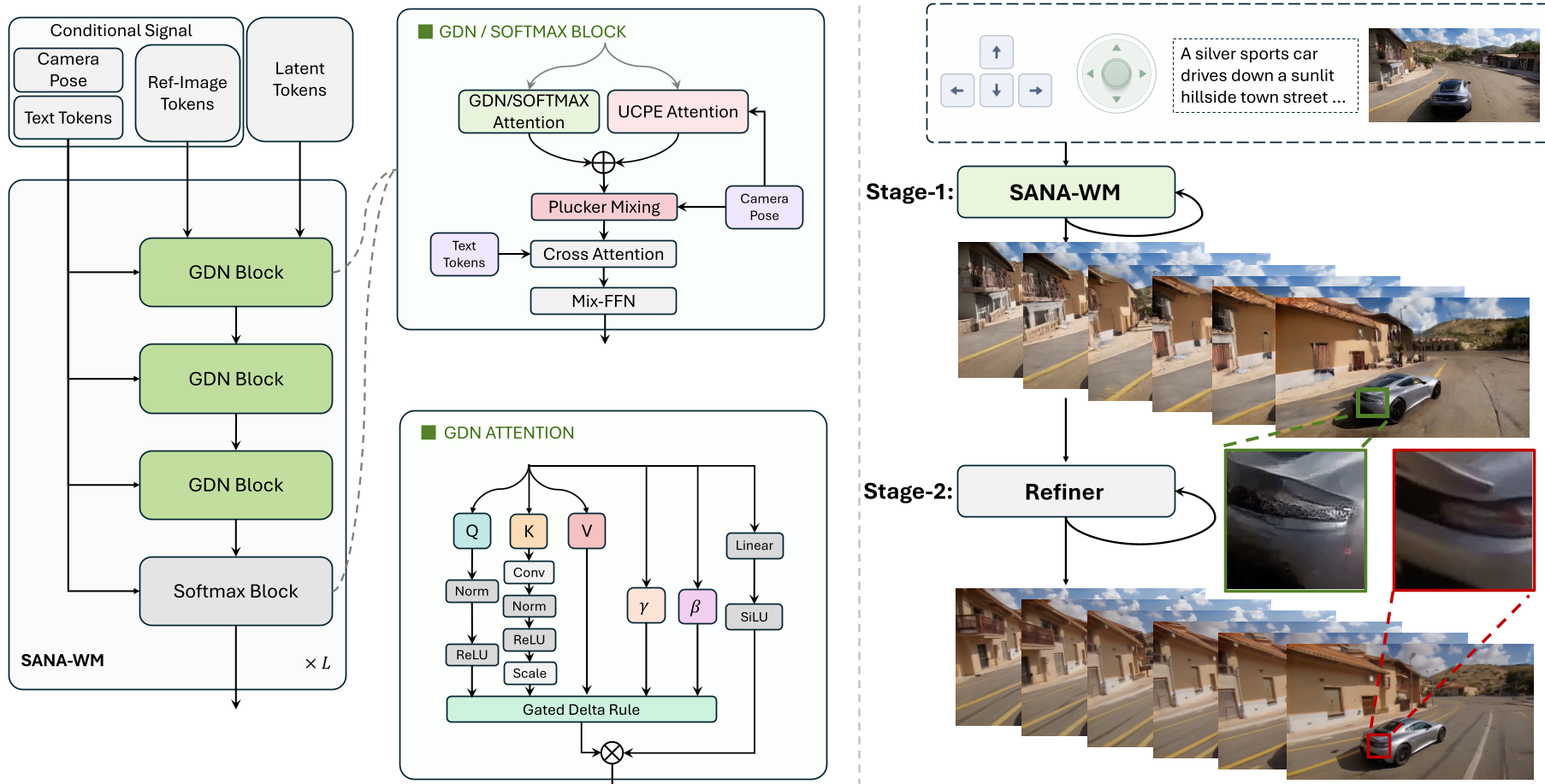
The core innovation is the Hybrid GDN-Softmax architecture. Instead of calculating attention between every single token (which is impossible at this length), SANA-WM uses:
- Gated DeltaNet (GDN): A linear-recurrent mechanism that updates its internal state frame-by-frame. It acts like a memory bank that constant-size regardless of how long the video gets.
- Periodic Softmax Attention: Every 4th block uses standard attention to "anchor" the spatial structure and prevent the recurrent state from drifting too far.
2. Dual-Branch Camera Control
Controlling a world model is hard because VAEs (which compress the video) often lose fine camera details. SANA-WM uses a two-pronged approach:
- Coarse Branch (UCPE): Captures global 6-DoF poses at the latent frame rate.
- Fine Branch (Plücker Mixing): Injects raw-frame motion info into the model to capture high-frequency movement that occurred inside the VAE’s compression window.
Experiments: SOTA Results on a Single GPU
SANA-WM was trained in just 15 days on 64 H100s, utilizing a robust annotation pipeline to extract metric-scale poses from over 213K public video clips.
Performance Benchmarks
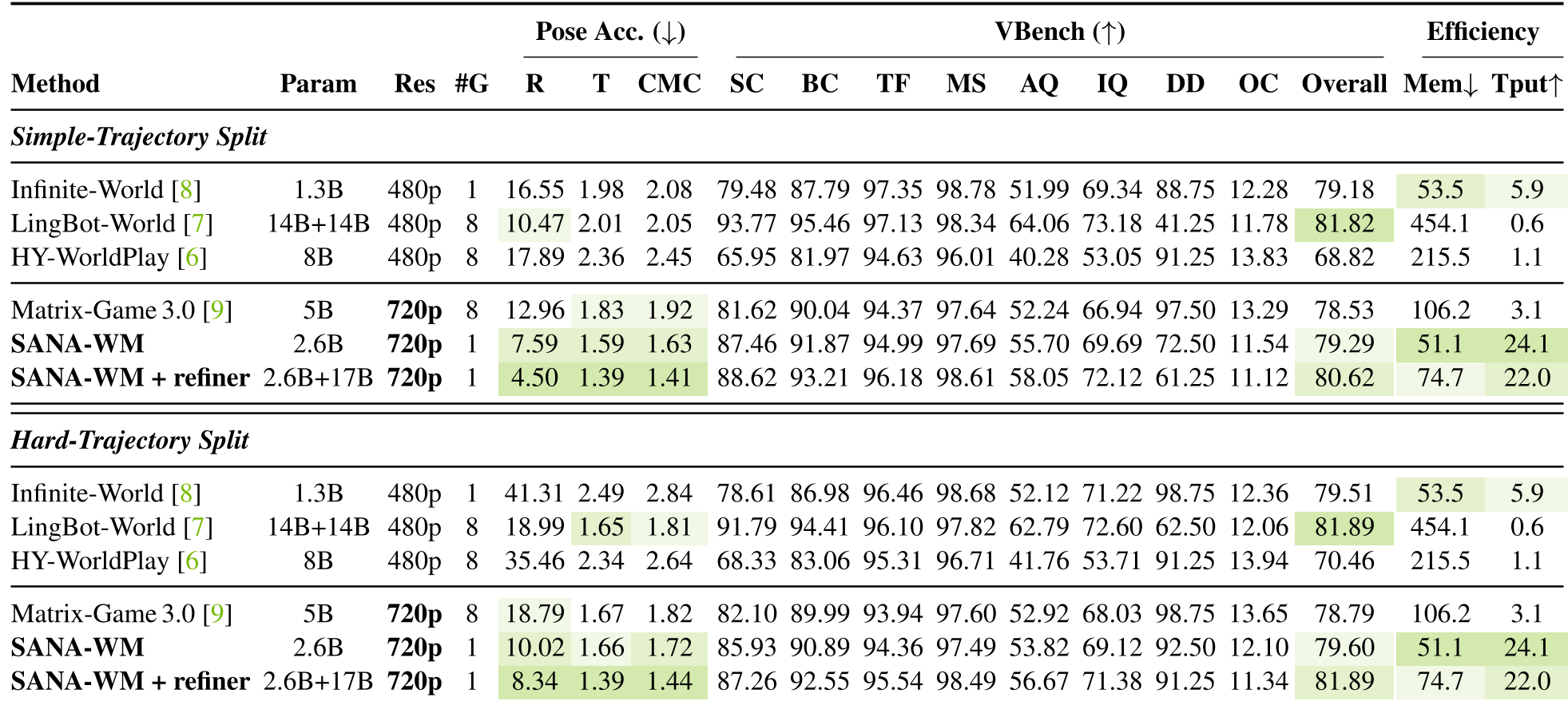
In comparisons with baselines like LingBot-World and HY-WorldPlay, SANA-WM achieved the highest action-following accuracy.
- Accuracy: Significantly lower Rotation and Translation error compared to Matrix-Game 3.0.
- Throughput: 36x faster than the most efficient 480p baselines.
Two-Stage Refinement
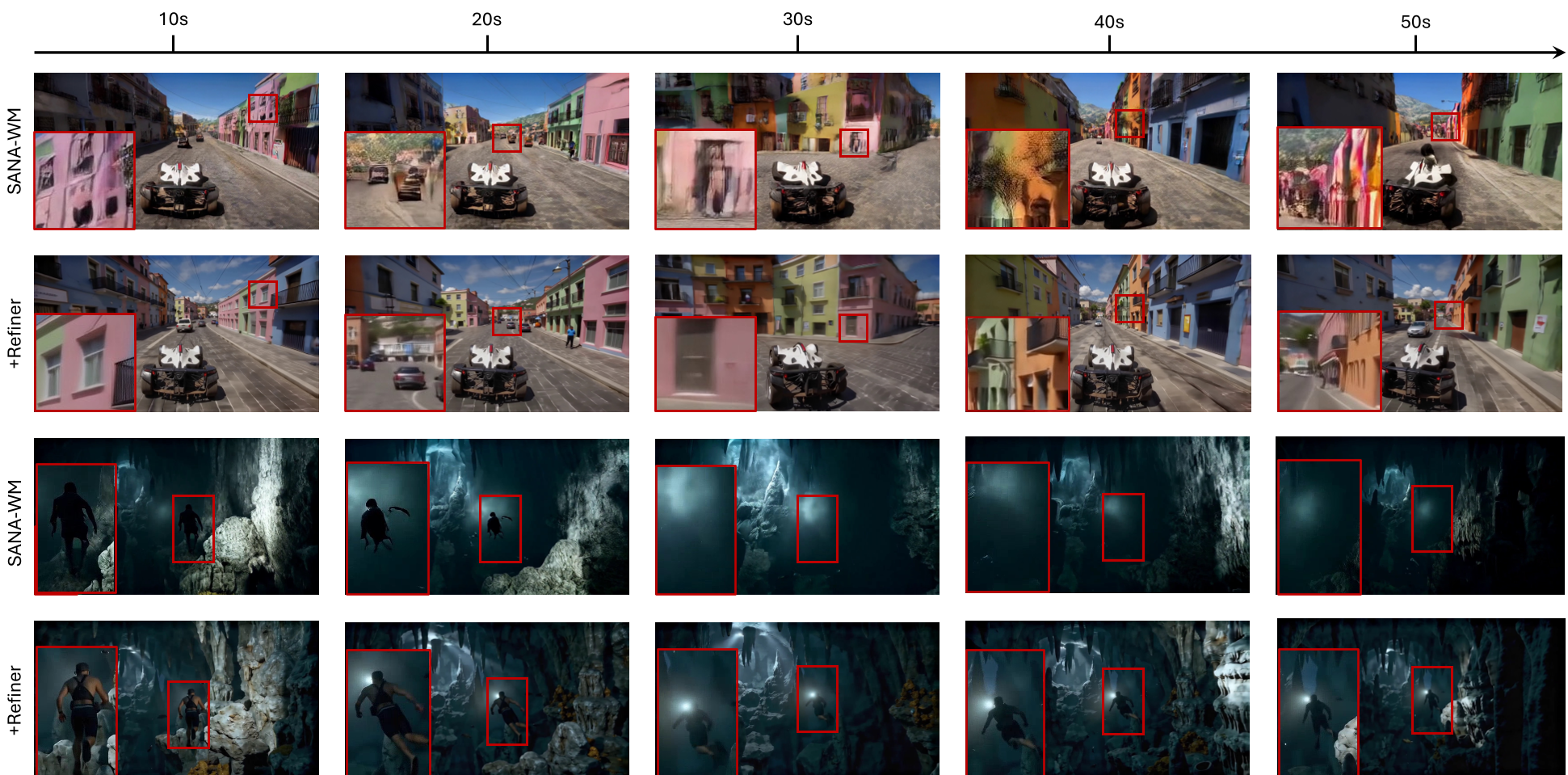
To ensure the video doesn't just look "okay" but looks great, the authors use a Refiner Stage. This stage corrects structural artifacts and sharpens blurred regions that often appear in stage-1 generation.
Critical Insight & Future Outlook
SANA-WM marks a shift from "Scaling Compute" to "Designing Efficiency." By proving that linear recurrences (GDN) can replace heavy Transformers for temporal modeling, NVIDIA has opened the door for Real-Time Interactive World Models on consumer hardware.
Limitations: While impressive, the model still lacks "explicit 3D memory." It understands the scene, but it doesn't build a 3D map. Future iterations incorporating explicit spatial memory could make these simulations virtually infinite without any drift.
Takeaway
For developers and researchers in Embodied AI and Robotics, SANA-WM provides a cost-effective platform to simulate complex environments for a full minute, providing high-fidelity visual feedback for trained agents.