
Scaling Laws for Cross-Encoder Rerankers: Forecasting the Future of Search
Scaling Laws for Cross-Encoder Reranking
This paper presents the first systematic study of scaling laws for Cross-Encoder rerankers, covering models up to 1B parameters. By analyzing pointwise, pairwise, and listwise objectives, the authors demonstrate that ranking metrics like NDCG@10 follow predictable power laws across model size and training exposure, allowing for accurate performance forecasting of large-scale models from smaller experimental runs.
TL;DR
Scaling laws have finally arrived for the final stage of the retrieval pipeline: the Cross-Encoder. This research proves that reranking performance (NDCG) follows predictable power laws relative to model size and training data. By training models only up to 150M parameters, the authors successfully forecasted the performance of 1B-parameter models, providing a blueprint for compute-efficient search engineering.
Background Positioning: This is a foundational study that fills the gap between LLM scaling laws (Kaplan/Chinchilla) and first-stage retrieval scaling, moving into the high-precision "ranking" territory.
Problem & Motivation
In modern search architectures, we typically see a "Bi-Encoder" (fast, low precision) followed by a "Cross-Encoder" (slow, high precision). While we've known how to scale the fast stage, the high-precision stage has been a "black box" regarding resource allocation.
The challenge lies in the nature of reranking:
- Retriever Bias: Rerankers only see what the retriever gives them.
- Metric Discontinuity: Metrics like NDCG@10 are not smooth like cross-entropy loss, making them traditionally harder to forecast.
- Objective Diversity: Does a Pointwise model scale the same way as a Listwise one? (Spoiler: No).
Methodology: The Power of Prediction
The authors leverage a saturating power law for their analysis: Where is model size and is training steps. This formula treats performance as a journey toward a theoretical asymptote (), with and determining how quickly we hit "diminishing returns."
Model Architecture
The study utilizes the Ettin cross-encoder series, spanning from a tiny 17M parameters to a massive 1B. They tested three major paradigms:
- Pointwise: Treating each doc-query pair as a binary classification (BCE).
- Pairwise: Comparing pairs of documents (RankNet).
- Listwise: Optimizing the ordering of the entire list (ListNet).
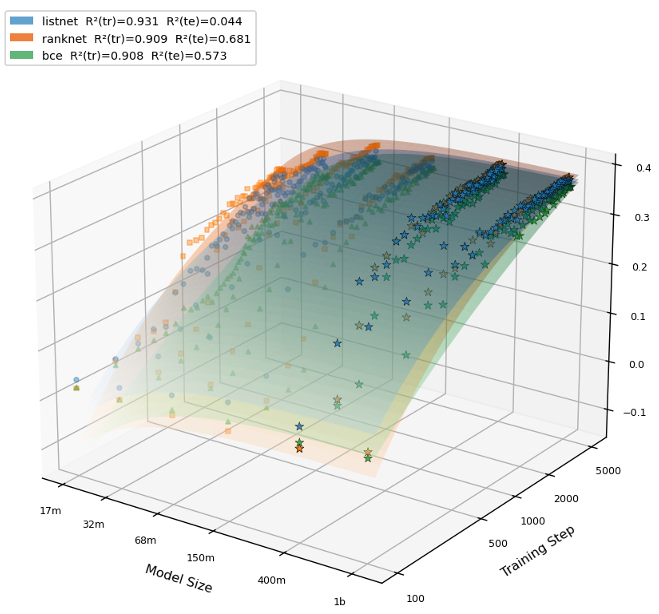 Figure: NDCG@10 showing clear, predictable model-scaling trends across different objectives.
Experiments & SOTA Results
The findings suggest that search performance is surprisingly "well-behaved."
- Ranking vs. Calibration: NDCG is easier to predict than Contrastive Entropy (CE). The model often improves its ranking order even when its internal score calibration (CE) gets "noisier."
- The Winner: The Pairwise objective consistently delivers the highest absolute performance at the 1B scale, reaching an NDCG@10 of 0.378.
- Forecasting Accuracy: Training a 150M model allowed the authors to predict the 1B model's performance with striking accuracy (RMSE ~0.012 for pairwise).
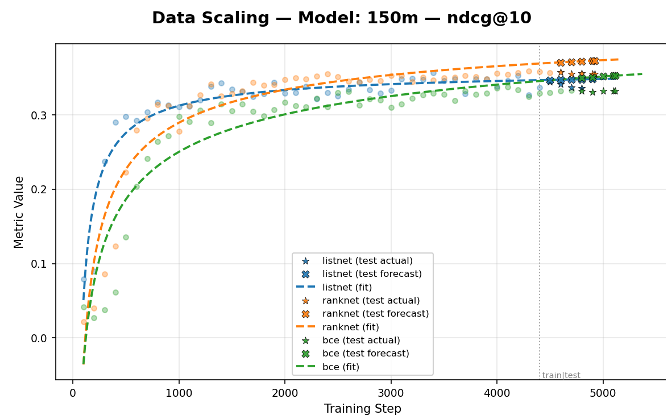 Figure: NDCG@10 improvement over training steps. Note how the gains plateau near the end of the epoch.
Compute-Optimal Allocation
One of the most valuable outputs of this paper is the deriviation of (model scaling coefficient).
- For all ranking metrics, , which traditionally signals a data-heavy regime.
- However, for Pointwise models, the gains are almost entirely model-driven ( as low as 0.12), meaning training them longer provides very little benefit compared to simply making the model larger.
Critical Analysis & Conclusion
Takeaway: If you are building a production reranker, don't blindly scale. If you use Pointwise loss, buy a bigger GPU. If you use Pairwise or Listwise loss, invest in more high-quality training pairs.
Limitations:
- The study is limited to Encoder-only (BERT-style) architectures. Decoder-only (LLM-based) rerankers might exhibit different scaling "breaks."
- The training was limited to a single epoch on MSMARCO. Whether a "Chinchilla-style" multi-epoch regime changes the exponents remains to be seen.
In summary, this work provides the "ruler" with which we can now measure the future efficiency of search systems. It moves reranking from an artisanal trial-and-error process into a predictable engineering discipline.