
SilverSpeak: Breaking AI Text Detectors with Simple Unicode Tricks
SilverSpeak: Evading AI-Generated Text Detectors using Homoglyphs
This paper introduces SilverSpeak, a homoglyph-based adversarial attack designed to evade AI-generated text detectors. By replacing standard Latin characters with visually identical but differently encoded characters (e.g., Cyrillic 'а'), the study successfully bypasses seven state-of-the-art detectors across five diverse datasets, achieving near-total evasion.
TL;DR
Researchers have uncovered a massive blind spot in AI text detectors: Homoglyphs. By swapping standard letters for visually identical Unicode characters (like a Latin 'A' for a Cyrillic 'А'), a new attack called SilverSpeak totally blinds state-of-the-art detectors. The effectiveness was staggering—dropping detection scores from highly reliable to basically random (MCC 0.64 → -0.01).
The Fragility of Modern Detection
As LLM-generated content floods the web, we've relied on tools like Binoculars, DetectGPT, and Watermarking to police the boundaries of human vs. AI writing. However, these tools are built on a house of cards: the assumption that text is encoded consistently. SilverSpeak exploits the difference between what a human sees (visual semantics) and what a computer processes (binary encoding).
Methodology: The Art of the Swap
The attack is deceptively simple. Unlike paraphrasing, which requires another LLM to rewrite text, SilverSpeak uses a simple script to replace a percentage of characters (5% to 20%, or a "greedy" 100% of possible swaps) with homoglyphs.
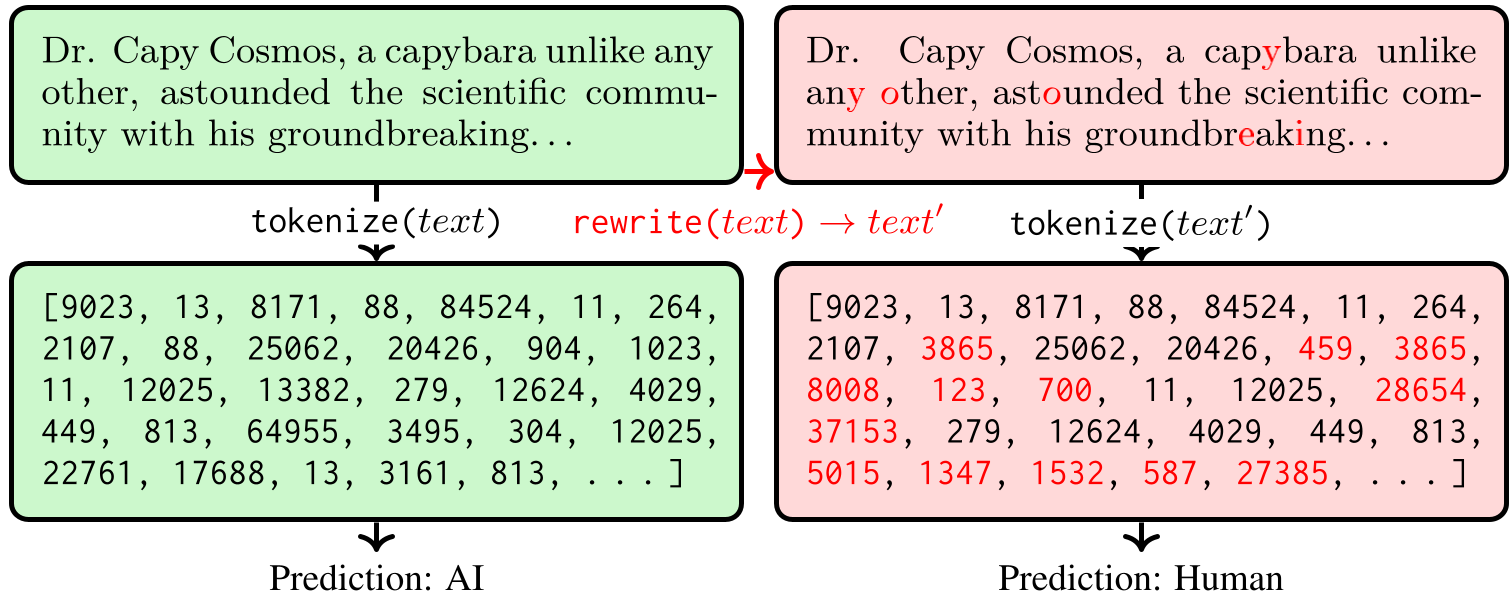 Figure 1: Notice how the text looks identical to the eye, but the tokenization (bottom) changes drastically.
Why It Works: A Triple Threat
The researchers identified three distinct technical reasons why detectors fail:
- Perplexity Explosion: For LLM-based detectors (like Binoculars), homoglyphs are "rare" characters. This forces the tokenizer to break words into tiny, nonsensical sub-tokens, which the model perceives as high-entropy, "human-like" chaos.
- Embedding Displacement: Supervised classifiers (like RoBERTa-based ones) haven't seen these mixed-alphabet strings during training. In a 2D UMAP projection, the "attacked" AI text moves into a completely different subspace, away from the "AI" cluster.
- Watermark De-synchronization: Watermarks depend on the relationship between token and token . Since homoglyphs change how text is tokenized, the "green list" rules of the watermark are broken instantly.
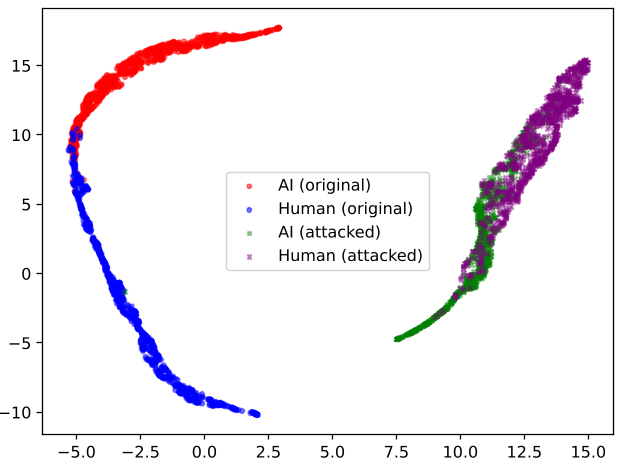 Figure 2: UMAP projection showing how homoglyphs (purple/green) move AI text away from the detectable AI cluster (blue).
Experimental Showdown
The authors tested seven detectors against five datasets (essays, news, academic abstracts). The results were a bloodbath for the detectors.
| Attack Intensity | Avg. MCC (Detection Power) |
|---|---|
| No Attack | 0.64 |
| 5% Replacement | 0.17 |
| 20% Replacement | 0.01 |
| Greedy Attack | -0.01 |
Even at a 5% replacement rate—virtually unnoticeable to a human reader—most detectors lost over 70% of their effectiveness. By the time they reached "Greedy" replacement, the detectors were essentially flipping coins.
Critical Insight & Future Outlook
The core takeaway is clear: Detectors that rely solely on string-level statistics are unfit for purpose in a hostile environment.
Does this mean AI detection is dead? Not necessarily, but it must evolve. The authors suggest:
- Input Constraints: Standardizing all text to a base Unicode form (Normalization NFKC) before detection.
- OCR-based Detection: Analyzing the image of the text rather than the raw bytes.
- Loglikelihood Analysis: Looking at deeper probability patterns that transcend character encoding.
SilverSpeak serves as a wake-up call. In the arms race between AI generation and detection, a simple "A" might be the most effective weapon yet.