
LLM-as-a-Judge: The New Frontier of Scalable and Reliable AI Evaluation
A survey on llm-as-a-judge
This paper presents a comprehensive survey of "LLM-as-a-Judge," a paradigm where Large Language Models are employed as evaluators for complex, open-ended tasks. It establishes a formal definition of the framework and introduces a systematic classification of implementation strategies and reliability-oriented benchmarks.
TL;DR
As AI models tackle increasingly subjective and complex tasks, traditional metrics are failing. This survey codifies "LLM-as-a-Judge"—the use of models like GPT-4 to act as scalable, context-sensitive evaluators. The paper provides a rigorous mathematical framework, identifies critical biases (why LLMs prefer their own answers or longer ones), and outlines the future of "Reasoning-Centric" evaluation where models act as their own critics.
Background & Motivation: The Evaluation Dilemma
In the pre-LLM era, researchers were trapped in a trade-off. You could have scalability (using metrics like BLEU/ROUGE) but lose the semantic depth. Or you could have comprehensiveness through human experts, which is prohibitively expensive and slow.
LLM-as-a-Judge emerges as a "third way." By leveraging the reasoning capabilities of state-of-the-art models, we can simulate human-like judgment at a fraction of the cost. However, the survey warns that we cannot treat LLMs as unbiased "objective" observers. Like humans, they have "hallucinations of authority" and systematic blind spots.
Methodology: How to Build a Judge
The paper formalizes the evaluation process using a generative probability function: Where the judgment () is an auto-regressive generation based on the input () and context prompt ().
Key Implementation Strategies:
- In-Context Learning (ICL): Using Few-shot prompts to define scoring rubrics (1-10 scales), Pairwise Comparisons (Model A vs. Model B), or Multi-choice selections.
- Model Selection: Choosing between general-purpose closed-source APIs (GPT-4) or specialized fine-tuned open-source judges (like PandaLM or Prometheus).
- Post-processing: Techniques like Constrained Decoding (forcing JSON/Table output) and Logit Normalization to extract a reliability score () that is consistent across runs.
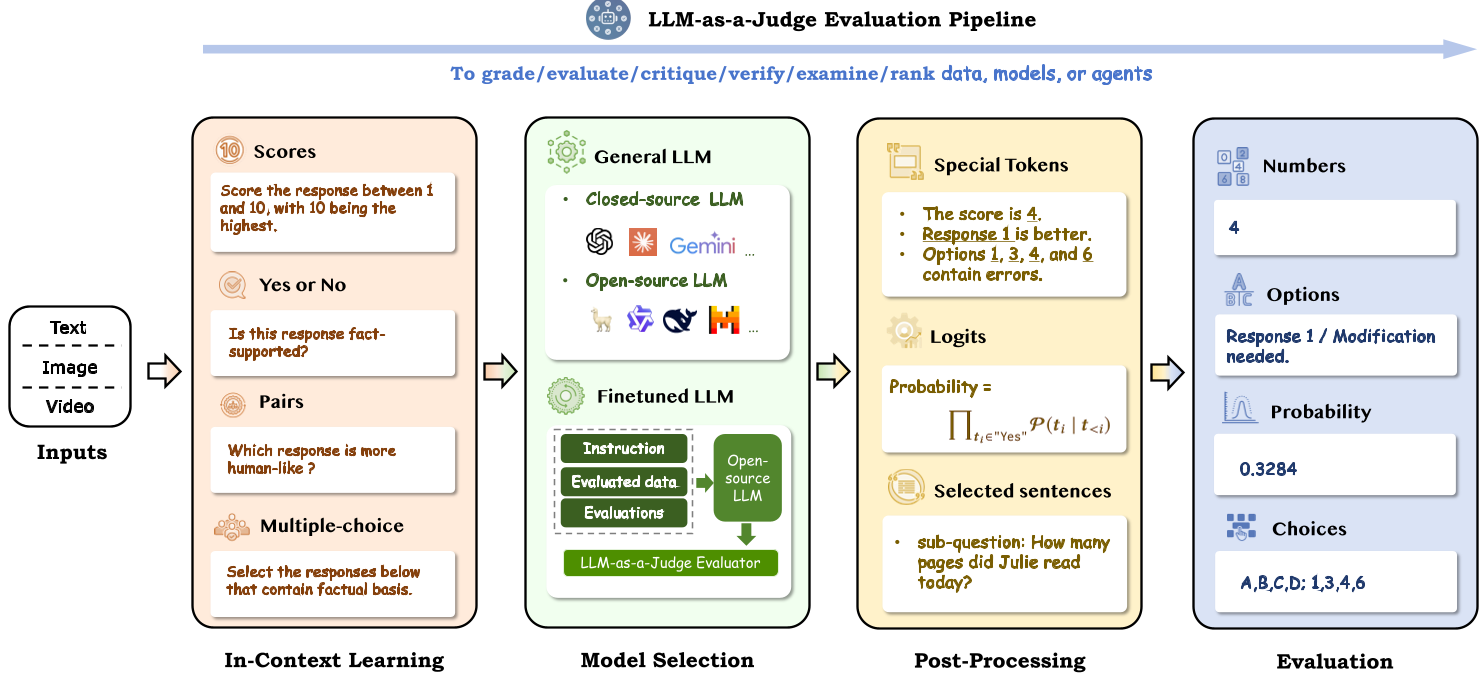 Fig 1. The standard pipeline: transition from prompt design to post-processed judgment.
The "Broken" Judge: Biases and Vulnerabilities
The survey provides a deep dive into why LLM judges might be unreliable. The authors categorize these into:
- Position Bias: Models often favor the first response presented, regardless of quality.
- Length (Verbosity) Bias: A systemic tendency to give higher scores to longer, more "verbose" answers even if they contain no extra information.
- Self-Enhancement Bias: LLMs consistently favor their own generation style over others.
- Concreteness Bias: A preference for responses that use "fake" authoritative markers like specific citations or complex terminology, even if factual correctness is missing.
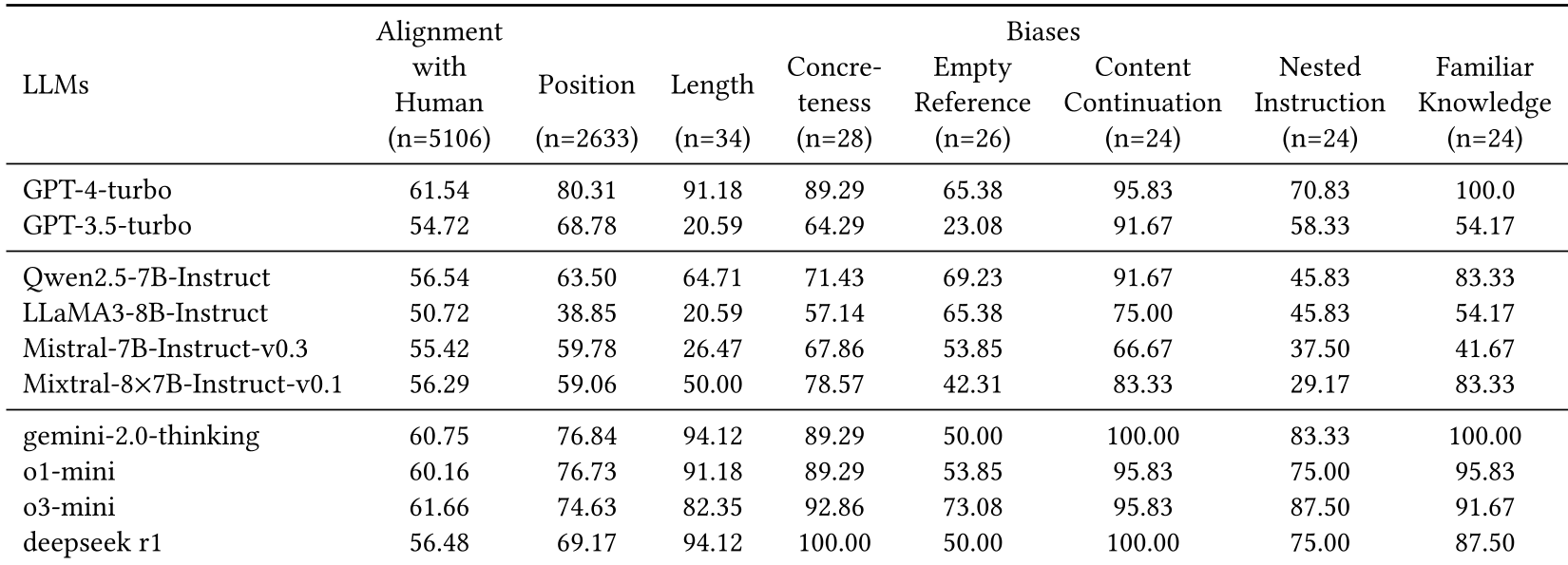 Fig 2. Benchmarking biases across models. Note how position consistency varies significantly between GPT and open-weight models.
Improvement Strategies: Toward Reliable Judgment
How do we fix these biases? The survey highlights several "battle-tested" methods:
- Chain-of-Thought (CoT) Judging: Forcing the model to write down its reasoning before giving a final score.
- Reference-based Evaluation: Providing the "Gold Standard" answer in the prompt to ground the model.
- Position Swapping: Running the evaluation twice with Model A and B positions swapped and averaging the result.
- Consensus (Multi-Judge): Using an ensemble of different LLMs (e.g., GPT-4 + Claude + Qwen) to vote on the winner.
Future Outlook: Reasoning-Centric Evaluation
The most exciting direction is the shift from Outcome-based to Process-based reward modeling. Instead of just judging if the final answer is right, "Judge-as-a-Verifier" roles evaluate every single step in a reasoning chain (as seen in models like OpenAI's o1 or DeepSeek-R1).
The paper concludes that we are moving toward "Self-Evolving Judges"—evaluators that don't just rely on fixed prompts but can iteratively refine their own criteria based on task difficulty and human feedback.
Conclusion
The LLM-as-a-Judge paradigm is no longer a luxury; it is a necessity for scaling the next generation of AI. However, the survey serves as a vital "cautionary tale"—without rigorous meta-evaluation and bias mitigation, our judges may end up being as flawed as the models they are meant to improve.
Takeaway: To build a reliable judge, focus on "Reasoning-Centric" feedback loops rather than simple 1-10 scoring.