
SynCode: Bridging the Gap Between Neural Hallucination and Formal Rigor
SynCode: LLM Generation with Grammar Augmentation
SynCode is a novel framework for grammar-augmented LLM generation that ensures outputs strictly adhere to Context-Free Grammars (CFGs). By utilizing an offline-constructed DFA mask store and incremental LR parsing, it achieves state-of-the-art syntactical precision across JSON, SQL, Python, and Go, eliminating syntax errors in JSON tasks.
TL;DR
SynCode is a high-performance framework that forces LLMs to follow specific syntax rules (CFGs). It solves the "token misalignment" problem using a novel DFA Mask Store, ensuring that every token generated is a valid continuation of a formal language. It effectively eliminates syntax errors in JSON and reduces them by over 96% in Python and Go.
Background: The Structural Fragility of LLMs
While LLMs are phenomenal at natural language, they are notoriously "unreliable narrators" when it comes to formal code. Even the most powerful models can trip over a missing closing brace in JSON or an invalid keyword in SQL. In professional software pipelines—where LLM outputs are piped into compilers or executors—a single syntax error is a fatal failure.
The core challenge is Token Misalignment: LLM tokens (like ret and urn) don't correspond 1-to-1 with language terminals (like the keyword return). Previous attempts to fix this were either too slow (filtering the whole vocabulary on the fly) or imprecise.
Methodology: How SynCode Enforces Rules
SynCode treats the decoding process as a live journey through a Deterministic Finite Automaton (DFA).
1. Incremental Parsing and the "Remainder"
As the model generates text, SynCode's incremental LR(1) parser tracks the current state. Crucially, it identifies a remainder—the trailing string that hasn't formed a complete "word" (lexical token) yet. This allows the system to predict what can come next based on the partial word already written.
2. The DFA Mask Store
This is the "secret sauce." Instead of doing heavy math during inference, SynCode precomputes a DFA Mask Store. This lookup table maps a DFA state and a sequence of allowed terminals to a bitmask of the entire LLM vocabulary.
- Why it works: At each step, the system just does a quick lookup and applies a boolean mask to the model's output probabilities.
- Efficiency: It turns a complex parsing problem into a simple tensor operation, often parallelized on the GPU.
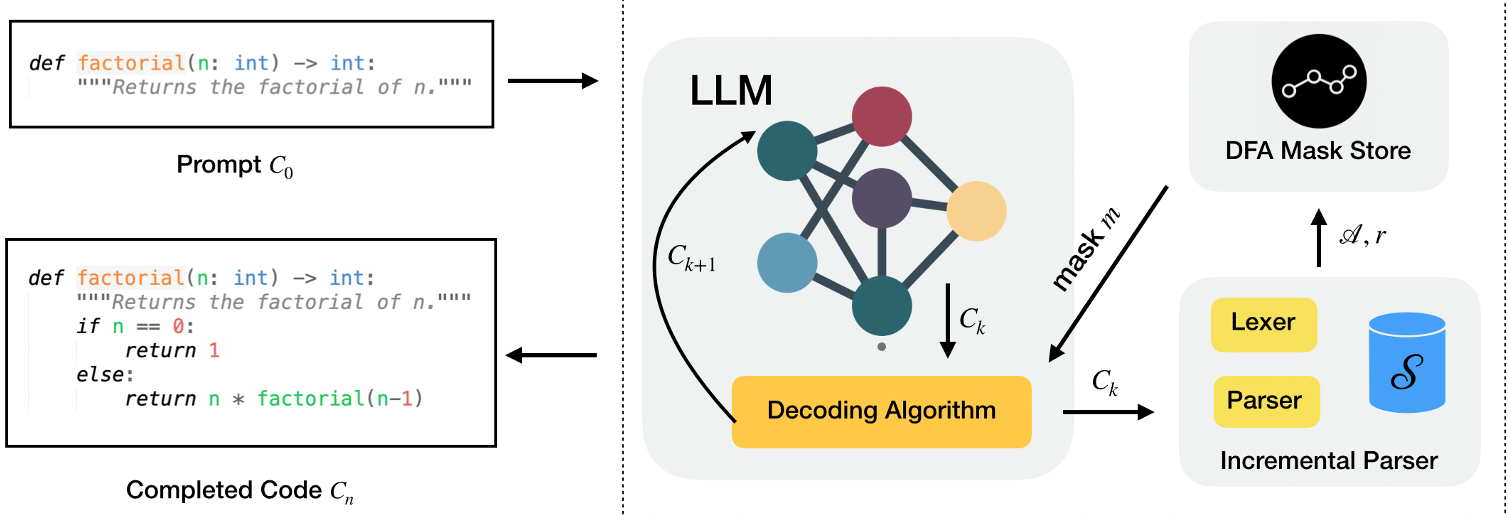 Figure 1: The SynCode workflow integrating LLM generation with DFA-based validation.
Proven Soundness and Precision
The authors provide a formal proof of Soundness: SynCode is guaranteed to retain all syntactically valid tokens. Under conditions where the lookahead is sufficient, it is also Complete (rejecting all invalid tokens).
Experimental Battlegrounds
The framework was tested across two distinct domains:
- Data Serialization (JSON): SynCode achieved 0 syntax errors, even when the model (like Llama-2-7B) struggled to stay in "JSON mode."
- General Programming (Python & Go): On datasets like HumanEval, SynCode destroyed the syntax error rate, reducing it by 98% for Llama-7B.
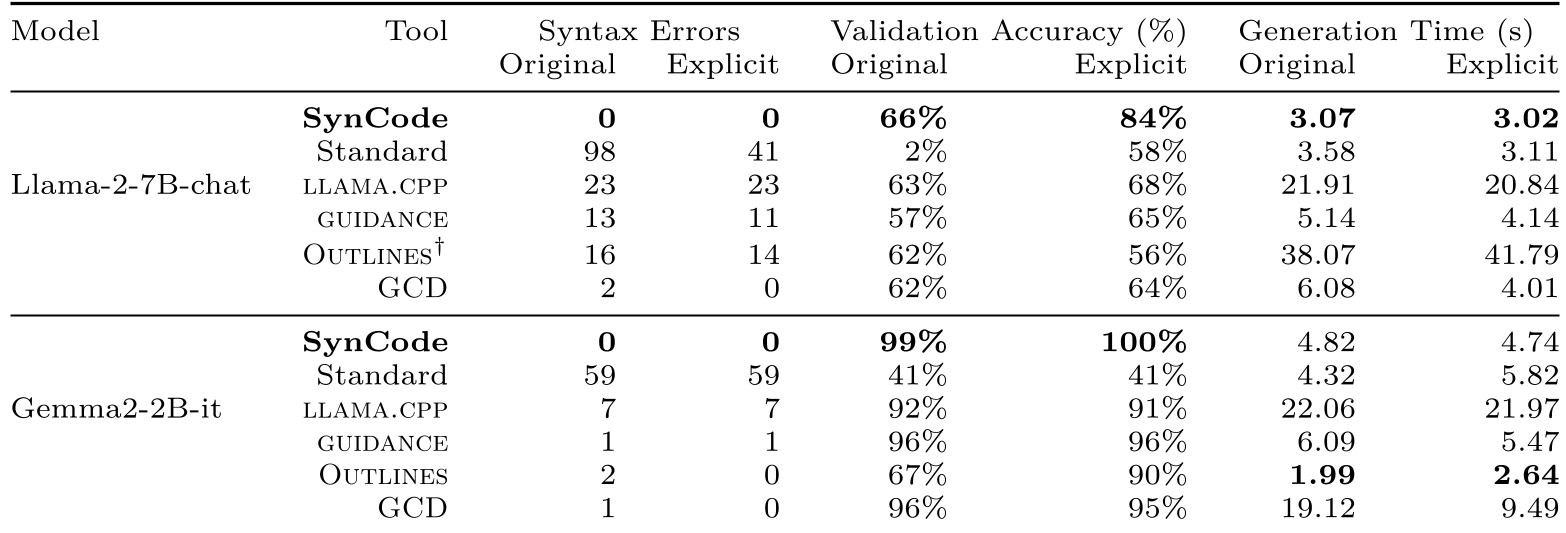 Table 1: Performance comparison showing SynCode eliminating syntax errors in JSON generation.
The SQL Breakthrough
In Text-to-SQL tasks (Spider dataset), SynCode didn't just fix syntax; it improved Execution Accuracy. By narrowing the search space to valid SQL, the model was more likely to find the correct logic, leading to a significant jump in success rates (e.g., Llama-3.2-3B reaching 81.4% execution success).
Critical Insight: Why This Matters
The most impressive part of SynCode is its Generality. Because it works at the logit-masking level, it is "plug-and-play" with any decoding strategy—be it Greedy, Beam Search, or Temperature Sampling. Unlike earlier tools that were hard-coded for specific models, SynCode’s DFA approach scales to massive grammars (like Python’s 500+ rules) with minimal latency.
Limitations and Future Work
While SynCode solves Syntax, it does not yet solve Semantics. It can ensure your Python code is valid, but not that you haven't used an undefined variable or a logic bug. The next frontier in this research will likely be integrating "Semantic Masking" (e.g., tracking variable scope in real-time) using similar high-speed lookup architectures.
Conclusion
SynCode represents a significant step toward "Safe AI." By wrapping the creative potential of LLMs in the iron-clad guards of formal language theory, it makes these models ready for the high-stakes world of automated software engineering and structured data processing.