
TL-Training: Mastering Tool-Use with Minimal Data and Maximum Precision
TL-Training: A Task-Feature-Based Framework for Training Large Language Models in Tool Use
This paper introduces TL-Training, a task-feature-based framework designed to enhance Large Language Model (LLM) tool-use capabilities. It integrates three strategies: Adverse Effects Mitigation (MAE), Key Tokens Prioritization (PKT), and an Itemized Reward Mechanism (IRM) optimized via PPO, achieving SFT performance on CodeLLaMA-2-7B that rivals GPT-4 models.
TL;DR
The efficiency of training LLMs for tool-use isn't just about the size of your dataset—it's about the quality of your feedback loop. TL-Training proves that with just 1,217 data points, a 7B model can outperform GPT-4-turbo in tool selection and execution. By filtering bad data trajectories, weighting critical tokens, and using error-aware rewards, this framework turns CodeLLaMA-2 into a SOTA tool-using agent.
The Motivation: Why Big Data is Often Bad Data
Current SFT paradigms for tool-use (like ToolLLM) assume that more data equals better reasoning. However, the authors discovered that even datasets generated by GPT-4 are "noisy." Approximately 17.5% of interaction trajectories in common training sets contain errors (Tool Hallucinations or Bad Requests).
Furthermore, when an LLM fails to call a tool, it’s usually because it tripped over a specific token—often the first token of a long tool name or a prefix shared by multiple similar tools. Treating a common word like "the" with the same importance as "get_crypto_currency_price" during training is an inefficient use of the gradient.
Methodology: The Three Pillars of TL-Training
TL-Training addresses these issues through a clever combination of supervised filtering and reinforcement learning.
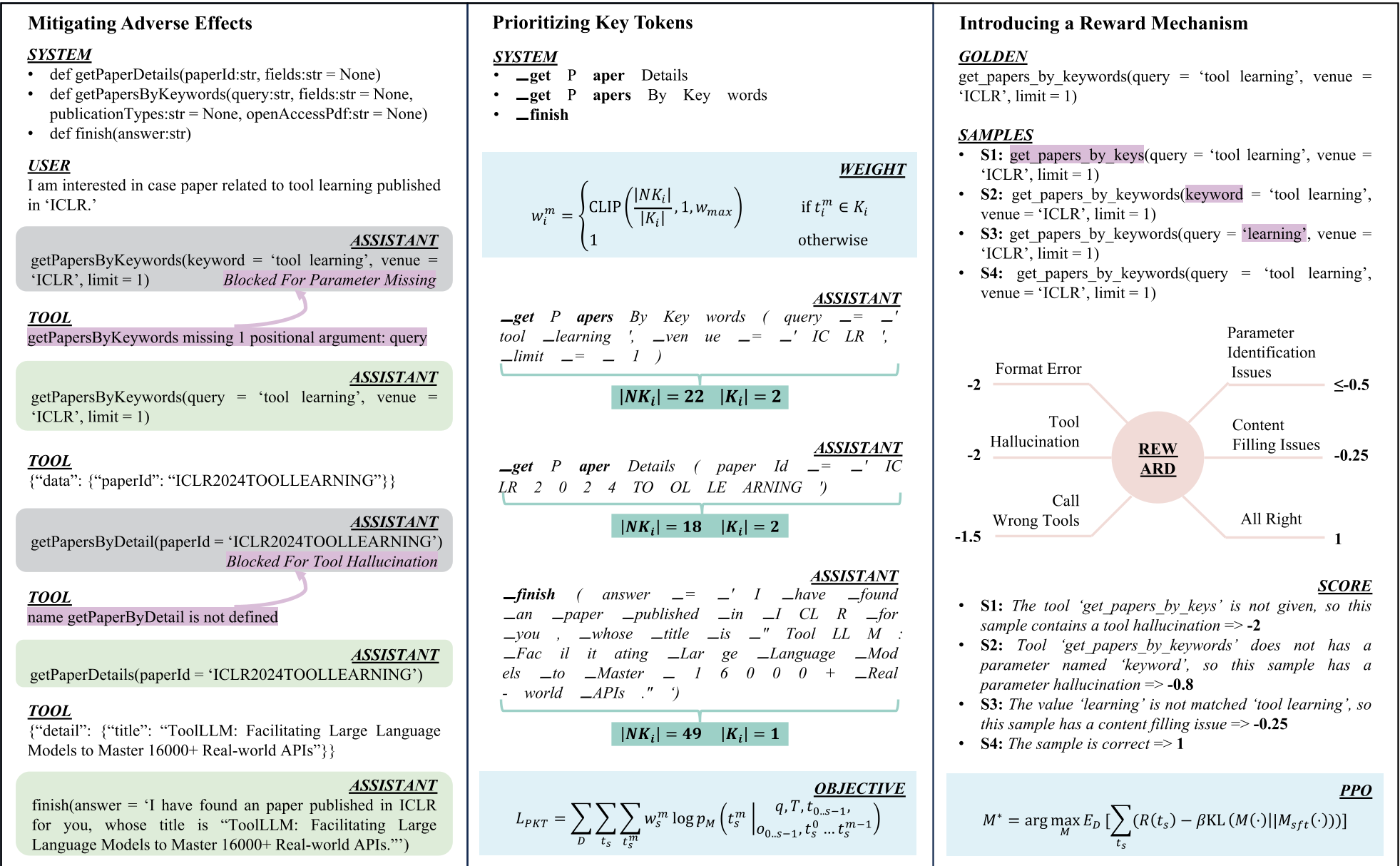
1. Adverse Effects Mitigation (MAE)
Instead of manually cleaning data, TL-Training uses automated tool feedback. If a trajectory results in a "400 Client Error" or "Unexpected Argument," those specific steps are masked during SFT. This prevents the model from internalizing "failure patterns" as valid behaviors.
2. Key Tokens Prioritization (PKT)
The authors observed that tool-selection errors often happen at the start of a sequence. They introduced a weight multiplier (set to 9 in experiments) for "Key Tokens"—specifically prefixes that distinguish one tool from another.
- The Intuition: Force the model to "pay more attention" to the tokens that actually determine the logic of the tool call.
3. Itemized Reward Mechanism (IRM)
Moving beyond binary "Success/Fail" rewards, the IRM assigns granular penalties based on the type of error:
- Major Penalties (-2.0): Tool Hallucinations (making up tools).
- Moderate Penalties (-1.5): Wrong tool selection.
- Minor Penalties (-0.25 to -0.8): Content filling issues or redundant parameters.
- Positive Reward (+1.0): Successful correct execution.
These rewards guide the Proximal Policy Optimization (PPO) stage, aligning the model with precise execution requirements.
Experimental Results: Small Model, Big Impact
The results are striking. Despite being the smallest model in many tests, TL-CodeLLaMA-2 consistently outpunches its weight class.
| Metric | TL-CodeLLaMA-2 (7B) | GPT-4-turbo | Qwen-2.5-7B-Instruct |
|---|---|---|---|
| ToolAlpaca (CF) | 57.89% | 42.11% | 44.74% |
| BFCL-v3 (CF) | 88.33% | 76.25% | 87.92% |
| ToolEyes (VA) | 77.75% | 90.31% | 74.08% |
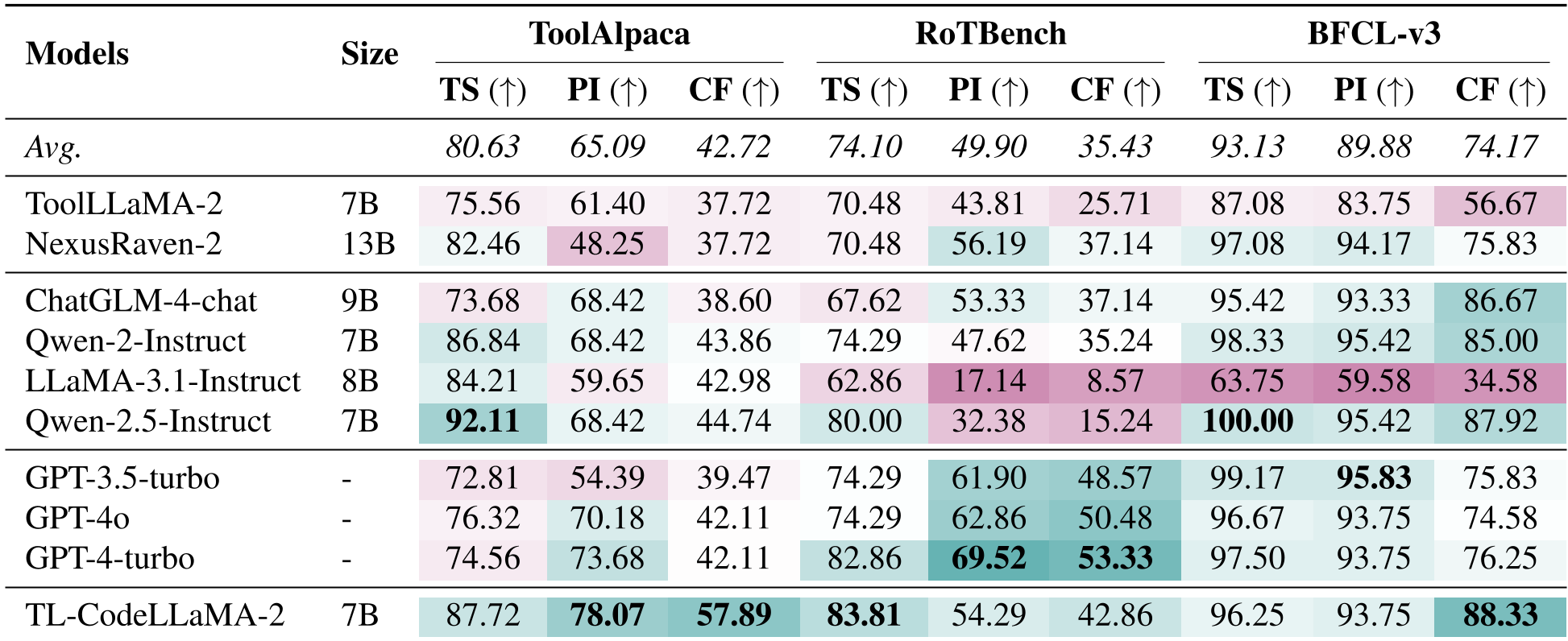
Robustness & Generalization
One common fear is that "over-tuning" on tools ruins the model's general intelligence. TL-Training actually improved math (GSM8K) and coding (HumanEval) performance. The authors suggest that learning to use tools effectively enhances the model's underlying reasoning logic without overriding its pre-trained knowledge base.
Critical Analysis & Conclusion
The core takeaway from TL-Training is efficiency through awareness. By acknowledging that not all training tokens are equal and that not all "gold" data is actually good, we can train incredibly capable agents with a fraction of the hardware and data.
Limitations:
- The reward mechanism relies on structured feedback. If a tool provides vague error messages, the IRM might struggle to categorize the failure correctly.
- Currently, it utilizes a hard-coded reward function rather than a learned reward model.
Future Outlook: Scaling this to a learned reward model that can understand "implicit" tool failures would be the next logical step for creating generalized AI agents that can handle any API documentation on the fly.
For more details, check out the code at GitHub/Junjie-Ye/TL-Training.