
Tstars-Tryon 1.0: Redefining Commercial Virtual Try-On for the Multi-Item Era
Tstars-Tryon 1.0: Robust and Realistic Virtual Try-On for Diverse Fashion Items
Tstars-Tryon 1.0 is a commercial-grade virtual try-on system based on a unified MMDiT architecture that supports robust, multi-item garment composition across eight categories. Developed by Alibaba's Pailitao Team, it achieves state-of-the-art results on the new Tstars-VTON Benchmark and is deployed at scale on the Taobao App.
Executive Summary
Virtual Try-On (VTON) has long been the "holy grail" of e-commerce AI, yet most existing solutions crumble when faced with the chaos of real-world user photos. Tstars-Tryon 1.0, developed by Alibaba’s Pailitao Team, represents a leap from academic prototypes to industrial-scale reality. By treating try-on as a specialized MMDiT-based image editing task rather than a narrow inpainting problem, this system handles everything from single shirts to complex 6-item "OOTD" compositions with unmatched robustness.
Problem & Motivation: The Gap Between Lab and Life
Traditional VTON research has been "trapped" by its own benchmarks (like VITON-HD or DressCode). These datasets typically feature models in static, "zombie-like" poses against plain white backgrounds. When a user uploads a photo—perhaps crouching in a neon-lit street or sitting in a library—academic models fail:
- Feature Omission: In multi-item setups, accessories like hats or bags are often ignored.
- Identity Erosion: The AI accidentally changes the person's face or body type to match the training distribution.
- Structural Breakdown: Clothes "clip" through limbs or defy the laws of gravity and layering.
Alibaba’s team argues that the industry needs a Foundation Model approach to VTON—one that understands physical world logic as much as fashion.
Methodology: The MMDiT Engine
Tstars-Tryon 1.0 moves away from the "warping then blending" logic of the past. Instead, it utilizes a Unified MMDiT Architecture (Multi-Modal Diffusion Transformer).
1. Unified Structure
The model processes the person's image and multiple garment references in a shared latent space. This allows the transformer blocks to attend to correlations between different items (e.g., how a coat should naturally occlude a sweater).
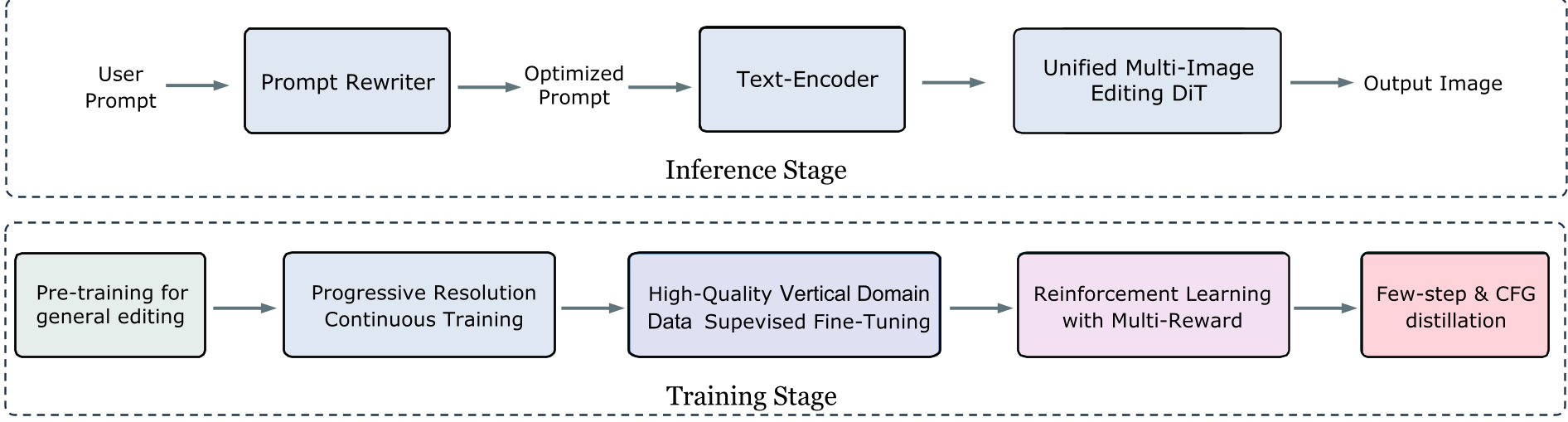 Figure 4: The Tstars-Tryon 1.0 workflow, showing the data engine, prompt rewriter, and the 5B MMDiT core.
2. Multi-Stage Training Strategy
- Pre-training: General image editing knowledge.
- SFT (Supervised Fine-Tuning): Domain-specific garment alignment.
- RL (Reinforcement Learning): Using DiffusionNFT to optimize the "policy" of the diffusion process, favoring trajectories that result in stable, physically logical garment drapes.
3. Inference Optimization
To achieve the speed necessary for the Taobao App (serving millions), the team utilized Step Distillation. This reduced the parameters to a lean 5B, allowing a full outfit generation in under 7 seconds—a massive improvement over the hundreds of seconds required by non-optimized models.
Experiments & Results: Setting a New Standard
To prove their success, the team released the Tstars-VTON Benchmark, which includes 1,780 paired samples covering 8 categories and 465 sub-styles.
Performance vs. Competition
The results show that Tstars-Tryon 1.0 dominates both open-source models (like Flux.2) and proprietary black-box APIs.
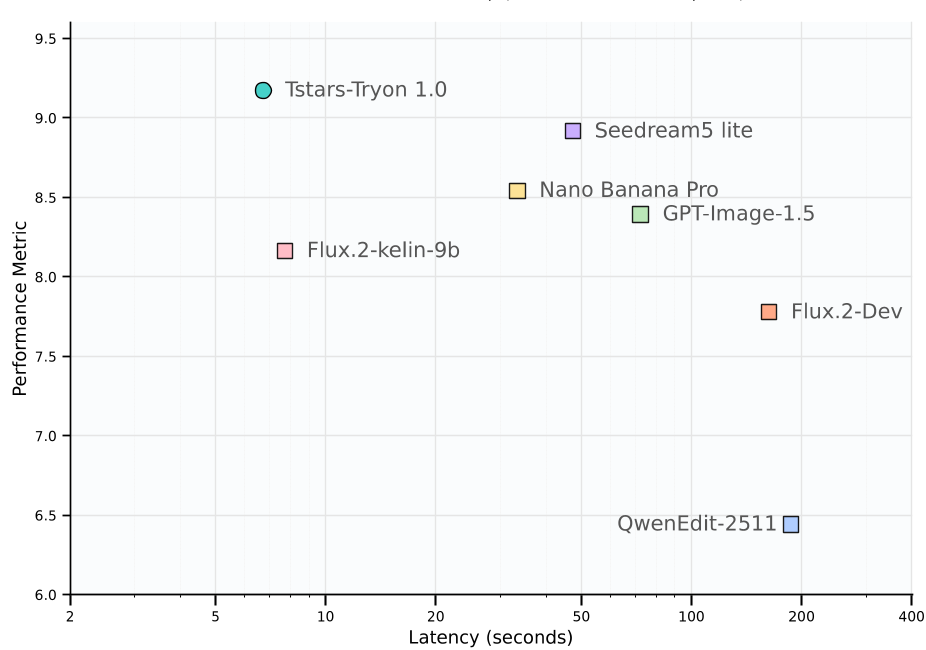 Figure 5: Performance/Latency trade-off. Tstars-Tryon 1.0 (red stars) achieves the highest scores with the lowest latency.
Visual Robustness
The model's ability to preserve identity while handling complex orientations is striking. Whether the subject is a real human, an anime character, or even a statue, the system correctly "interprets" how the garment should fit.
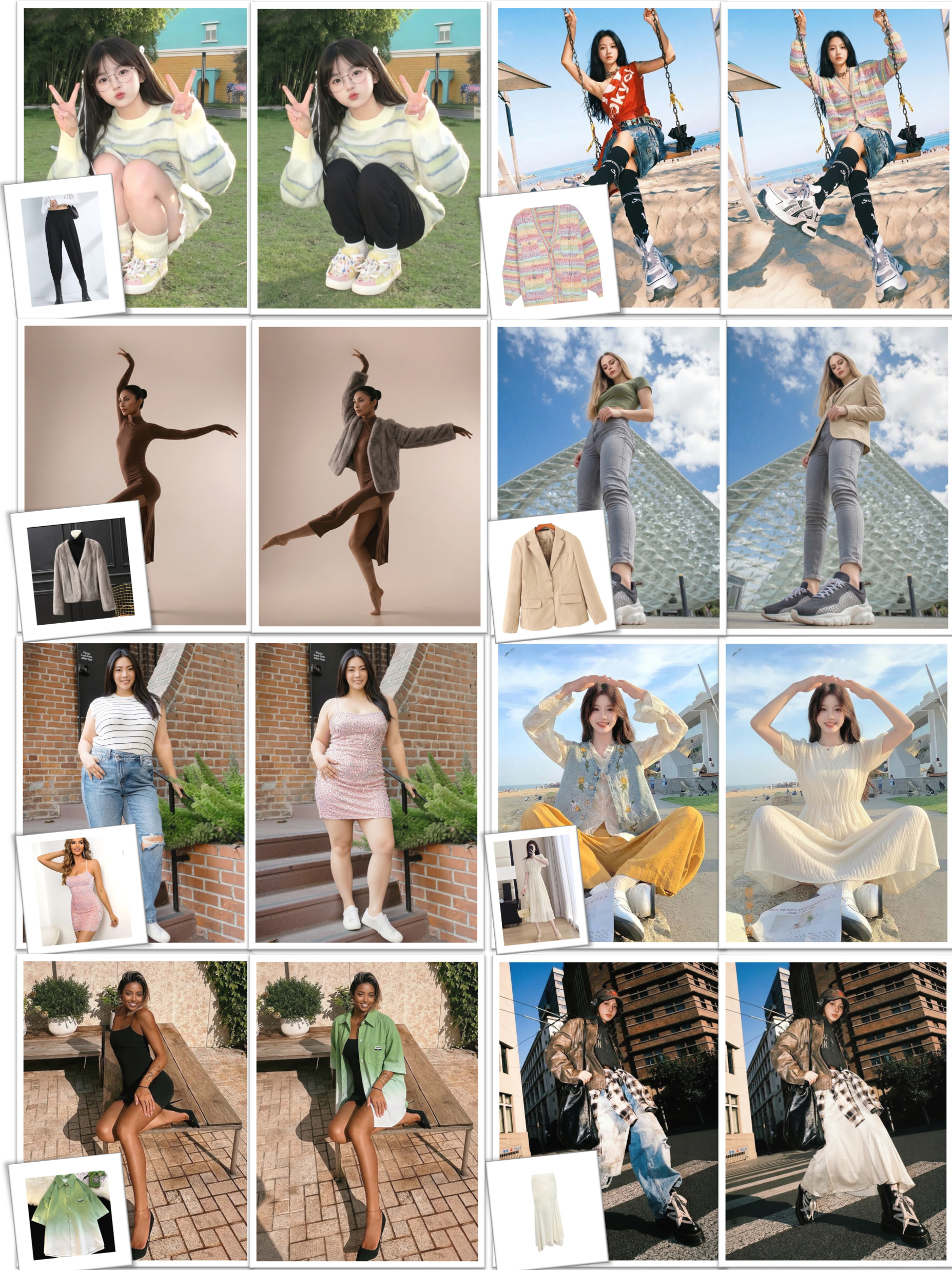 Figure 14: Single-garment results across extreme poses, plus-size body types, and complex backgrounds.
Critical Analysis & Conclusion
Tstars-Tryon 1.0 is a masterclass in Vertical AI Engineering. Its success doesn't come from a single "magic" formula, but from the holistic optimization of:
- Data Quality: A proprietary data engine to generate high-quality captions and filtrations.
- Architecture: Adopting MMDiT for better cross-item reasoning.
- Deployment: Aggressive distillation to make real-time interaction possible.
Takeaway: The future of virtual try-on is no longer limited to "putting a shirt on a model." It is about holistic outfit synthesis—where shoes, hats, and bags interact naturally with a user's unique identity in any environment. As this technology scales on Taobao, it signals the end of the "reconstruction" era and the beginning of the "generative styling" era.