
Mobile Spin Qubits: High-Fidelity Logic and Teleportation in Silicon
Two-qubit logic and teleportation with mobile spin qubits in silicon
This paper demonstrates high-fidelity two-qubit logic and conditional quantum state teleportation using mobile electron spin qubits in a silicon-based 28Si/SiGe quantum dot array. By employing "conveyor-mode" shuttling to transport spins into overlapping potential wells, the authors achieve a gate-based interaction that realizes a CZ gate with 98.86% fidelity.
TL;DR
Researchers at QuTech have successfully demonstrated that electron spin qubits in silicon don't need to stay put to perform logic. By "shuttling" two electrons toward each other in traveling potential wells, they executed a CZ gate with ~99% fidelity and performed quantum state teleportation across a five-dot array. This marks a shift from static, nearest-neighbor architectures toward reconfigurable, high-connectivity quantum processors.
Background: The Connectivity Bottleneck
Scaling up quantum computers is not just about adding qubits; it's about how they talk to each other. In solid-state systems like silicon quantum dots, interactions are typically limited to immediate neighbors. This "grid-lock" makes implementing complex error-correction codes expensive. While trapped ions and neutral atoms have used "mobile" qubits for years to achieve flexible connectivity, doing the same with electron spins in a solid-state lattice is notoriously difficult due to charge noise and dephasing during transport.
Methodology: The Conveyor-Mode Interaction
The core innovation lies in the use of conveyor-mode shuttling. Instead of "hopping" an electron from dot to dot (which is discrete and prone to errors), the team uses synchronized AC signals on gate electrodes to create a smooth, traveling wave.
1. Controlled Exchange through Shuttling
By moving two electrons from different parts of the array toward a shared interaction zone, the researchers can "dial in" the exchange interaction (). As the wavefunctions overlap, increases exponentially. Crucially, they found that by using elongated potential minima, the interaction strength actually saturates—a phenomenon likely linked to Wigner molecularization, where electron-electron repulsion creates a stable, correlated state that is less sensitive to local noise.
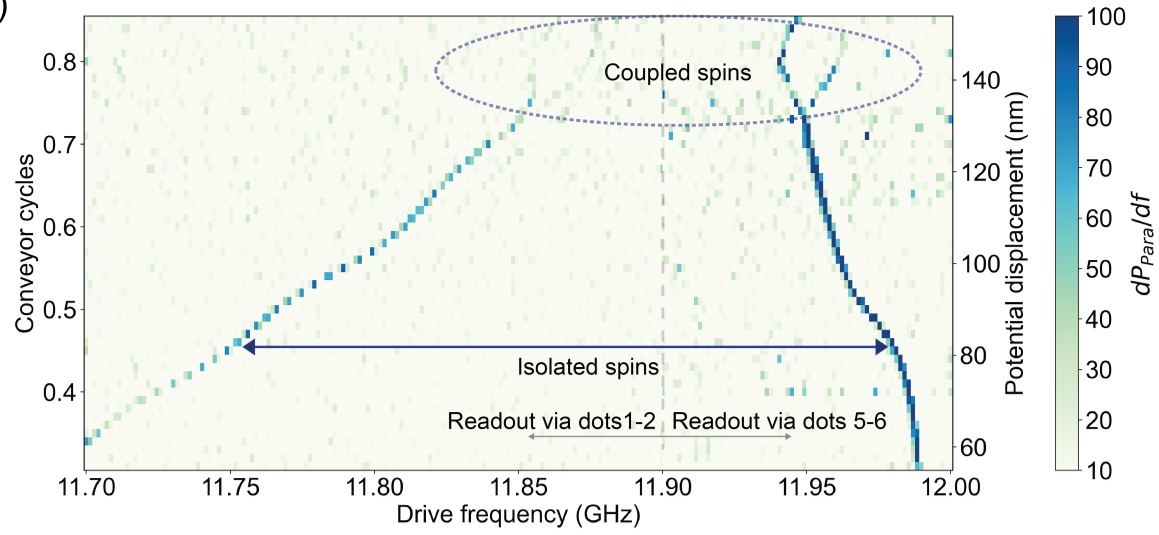 Figure 1: (a) Proposed scalable architecture. (c) SEM image of the 6-dot device. (e) EDSR spectroscopy showing the interaction split as qubits approach.
2. High-Fidelity CZ Gates
The team implemented a Conditional-Z (CZ) gate by bringing qubits Q2 and Q5 together for 58 ns. By maintaining a specific Zeeman energy difference between the spins, they suppressed unwanted "flip-flop" errors, leaving a clean interaction.
Experimental Results: Breaking the Classical Limit
The performance of these mobile operations was validated using Interleaved Randomized Benchmarking (IRB).
- CZ Gate Fidelity: 98.86 ± 0.29%. This is comparable to static SOTA gates in silicon.
- Teleportation: They used a mobile-gate-generated Bell pair to teleport a quantum state from Q6 to Q2. After correcting for SPAM errors, the process fidelity reached 86.7%, comfortably surpassing the 66.7% (2/3) benchmark that defines the boundary between classical and quantum performance.
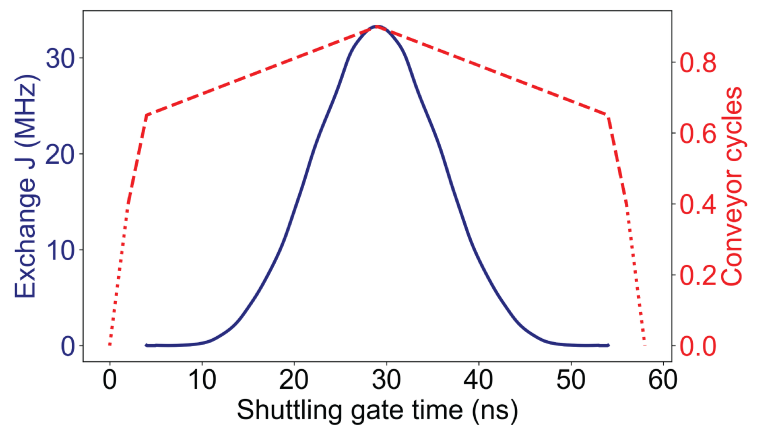 Figure 2: (b) Time evolution of during the 58ns gate. (d) Randomized benchmarking results showing the decay curves for reference vs. interleaved gates.
Deep Insight: Motional Averaging
Why does the coherence survive the journey? The authors note that (dephasing time) during shuttling is often better than in static dots. This is due to motional averaging: as the qubit moves rapidly through the silicon lattice, it "samples" different local magnetic environments so quickly that the fluctuations average out, effectively smoothing the noise landscape.
Critical Analysis & Future Outlook
While the results are impressive, there are hurdles to full-scale implementation:
- Readout Speed: The current teleportation is conditional (post-selected) because the readout takes 40 s—longer than the qubits' coherence time. Real-time "feed-forward" will require faster, non-demolition measurements.
- Saturation Regime: The discovery of the interaction saturation in elongated dots (Figure 2f) is a "golden nugget" for future work. If this regime can be stabilized without sacrificing , it could provide a "noise-insensitive" zone for quantum logic.
Conclusion
This work demonstrates that semiconductor chips can move quantum information as effectively as they store it. The ability to perform high-fidelity gates on the move transforms the silicon quantum processor from a rigid grid into a dynamic, reconfigurable network—a prerequisite for the fault-tolerant era.