
[Entropy 2022] VBGRU: Solving the Redundancy and Noise Dilemma in Massive Time-Series Forecasting
A Variational Bayesian Deep Network with Data Self-Screening Layer for Massive Time-Series Data Forecasting
This paper introduces a novel deep learning framework for PM2.5 forecasting, integrating a Data Self-Screening Layer (DSSL) with a Variational Bayesian Gated Recurrent Unit (VBGRU). The model achieves state-of-the-art accuracy by combining Maximal Information Distance Coefficient (MIDC) for feature selection and variational inference for noise-robust sequence modeling.
TL;DR
More data isn't always better. In the realm of massive time-series forecasting, noise and redundancy often lead to the "curse of dimensionality." This paper proposes a dual-pronged solution: a Data Self-Screening Layer (DSSL) to filter out redundant features and a Variational Bayesian GRU (VBGRU) to handle sensor noise. Tested on Beijing’s PM2.5 data, the model outperforms traditional LSTM, GRU, and TCN architectures in both accuracy and robustness.
Context: The Paradox of Big Data
In modern environmental monitoring, we are flooded with data—temperature, humidity, CO, SO2, and multiple spatial sensors. The prevailing academic intuition suggests that "more features equal better performance." However, the authors argue that redundancy and noise are the silent killers of deep learning models. Redundant data increases computational cost without adding entropy, while sensor noise leads to overfitting.
Methodology: Intelligence Before Architecture
The paper’s contribution is bifurcated into data engineering (DSSL) and architectural robustness (VBGRU).
1. Data Self-Screening Layer (DSSL)
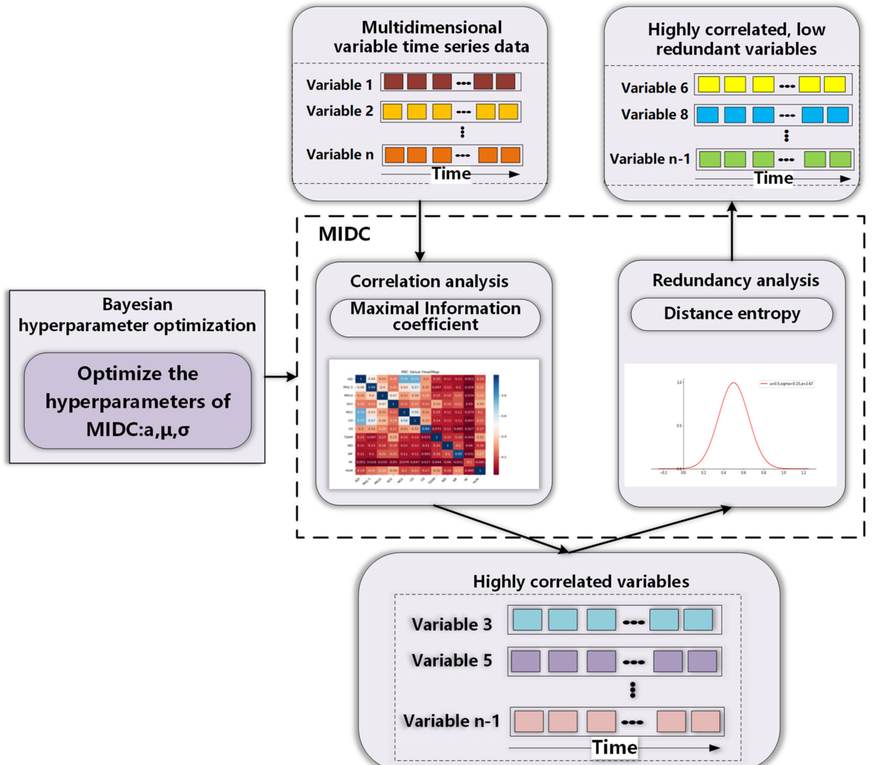
Most researchers use the Maximal Information Coefficient (MIC) to find correlations. But MIC has a flaw: it identifies correlation but ignores redundancy. Two sensors right next to each other might both have high MIC relative to the target, but they provide the same information. The authors propose MIDC (Maximal Information Distance Coefficient), which combines MIC with Distance Entropy (DE).
- The Logic: Select variables that are highly relevant to the target but "distant" (non-redundant) from each other.
- Optimization: They use Bayesian Hyperparameter Optimization to adaptively tune the screening process.
2. Variational Bayesian GRU (VBGRU)
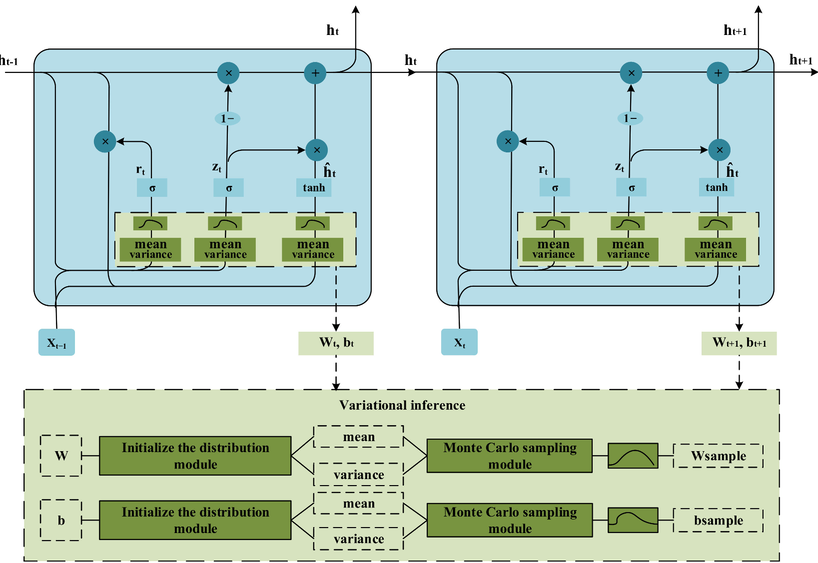
In a standard GRU, weights are fixed (deterministic) after training. If the input is noisy, the output is skewed. VBGRU changes the weights from single values to Gaussian distributions ().
- The Intuition: By sampling from a distribution (Monte Carlo sampling) during the forward pass, the model learns the uncertainty of the data. This acts as a natural regularizer, significantly enhancing the model's anti-noise capability.
Experiments: Proving the MIDC Advantage
The authors validated their approach using air quality data from Beijing (2017–2021). A critical finding in Section 4.3 shows that while AQI and PM2.5 have a high MIC (0.76), adding AQI doesn't improve the model as much as adding CO (MIDC of 0.91), because AQI is largely redundant.
Performance Comparison
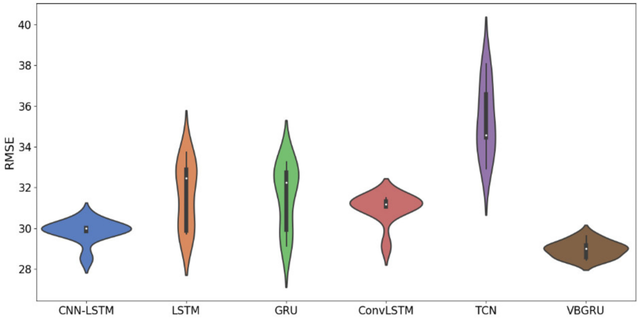
When compared against SOTA models like ConvLSTM and TCN, the VBGRU showed a tighter error distribution.
- RMSE Improvement: 5.1% better than standard GRU and 18.4% better than TCN.
- Consistency: The 10-fold cross-validation (visualized in violin plots) confirms that VBGRU has the most stable performance across different temporal windows.
Deep Insight & Conclusion
This paper is a masterclass in "Data-Centric AI." Instead of just building a deeper or more complex transformer, the authors looked at the quality of the information entering the network.
Key Takeaways for Practitioners:
- Stop blindly feeding all available features: Use information-theoretic metrics like MIDC to prune your input space.
- Probabilistic is the new Deterministic: If your data comes from physical sensors (IoT, HVAC, Environmental), using Variational Bayesian layers can prevent the model from "hallucinating" patterns in the noise.
Limitations: While the training time is better than complex CNN-LSTMs, it is still slightly slower than a vanilla GRU due to the sampling overhead. However, for 24-hour forecasting, the trade-off for accuracy is clearly worthwhile.