
VGGT-Ω: Scaling Feed-Forward Reconstruction to the 10B Frontier
VGGT- Ω
VGGT-Ω is a high-performance feed-forward 3D/4D reconstruction model that scales to 10B parameters and 4M training sequences. It introduces "register attention" to efficiently aggregate global scene information and achieves SOTA results in both static and dynamic scene reconstruction, outperforming previous methods like Depth Anything 3 and MegaSaM.
TL;DR
VGGT-Ω represents a significant leap in 3D computer vision, proving that feed-forward reconstruction scales predictably with model size (up to 10B parameters) and data (4M+ sequences). By introducing Register Attention and a massive data annotation pipeline, it moves beyond static scenes to handle complex dynamic environments, while providing "scene tokens" that are highly effective for downstream robotics and language alignment.
The Motivation: Why Foundations Are Lacking in 3D
While 2D vision and NLP have well-understood scaling laws, 3D vision has remained fragmented. Traditional Structure-from-Motion (SfM) is robust but slow, while early feed-forward models were often limited by the "quadratic bottleneck" of global attention and a lack of high-quality dynamic data. The authors' insight is twofold:
- Efficiency is the gatekeeper of scale: To train on millions of videos, you must slash memory usage.
- Registers are the bridge: A small set of tokens can represent an entire scene's geometry and semantics.
Methodology: Register Attention & Memory Efficiency
1. Register Attention (Scene Tokens)
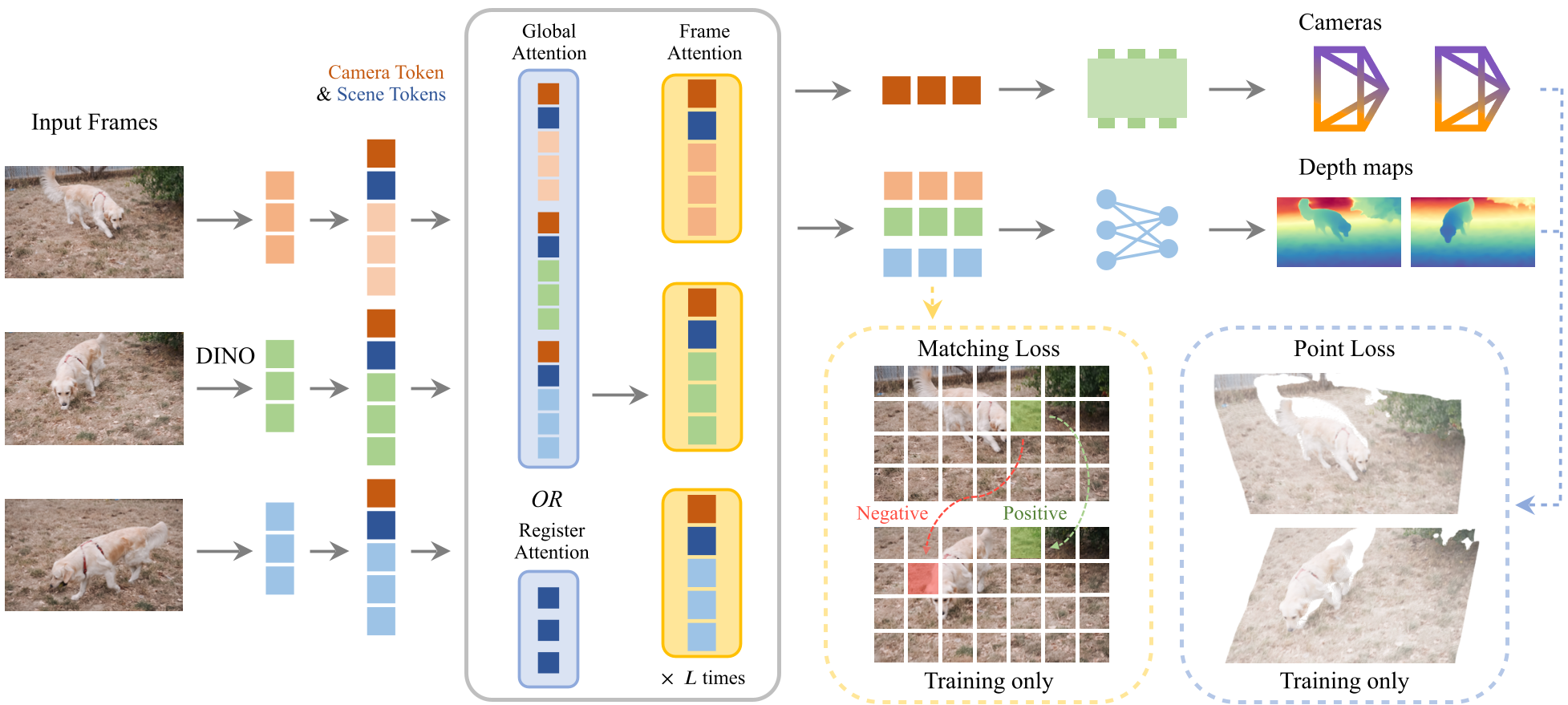
In standard Transformers, every patch in every frame attends to every other patch across all frames. This is . VGGT-Ω introduces Register Attention:
- Each frame has 16 learnable registers (scene tokens).
- In 25% of layers, global attention is restricted only to these registers.
- Registers act as a bottleneck that aggregates multi-view information and redistributes it back to local frames.
2. Radical Architectural Simplification
To enable the 10B parameter variant, the authors removed the memory-heavy high-resolution convolutional layers in the DPT heads. They replaced them with a single MLP and a pixel-shuffle operator, reducing training memory by 70% without losing precision.
3. The Data Pipeline
The real "secret sauce" is the annotation of 40 million internet videos. The authors used a VLM-based filter to reject "bad" videos (cuts, motion blur) and an ensemble of SfM tools (COLMAP, VGGSfM) to create pseudo-labels.
Experimental Results: Dominating the Benchmarks
VGGT-Ω sets a new standard across the board. On the Sintel dataset (a rigorous dynamic benchmark), it achieves a staggering 77% improvement in strict camera pose estimation (AUC@3°).
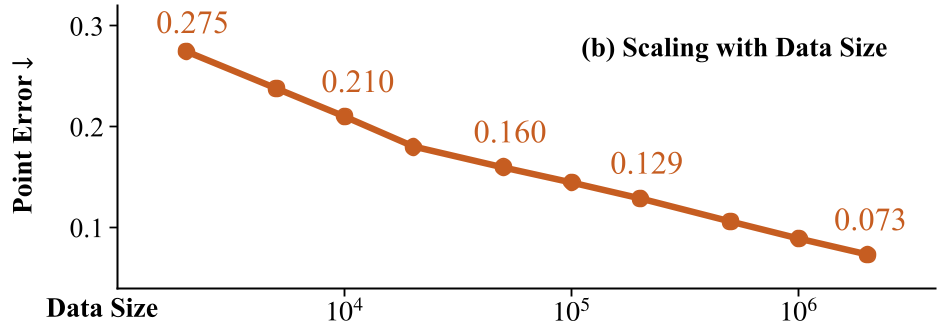
The figure above demonstrates the clear power-law relationship between model parameters, data scale, and reconstruction error.
Qualitative Prowess
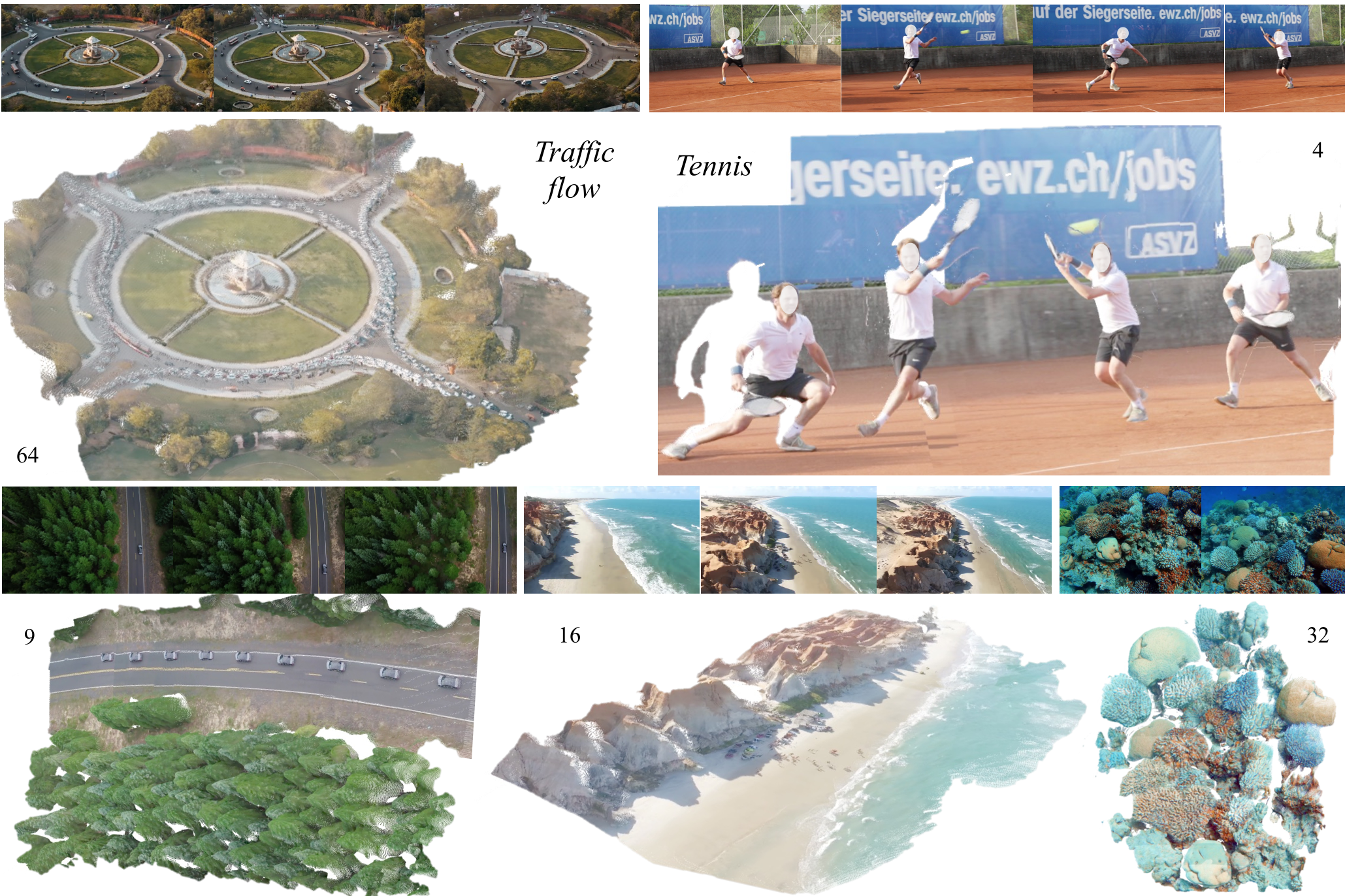
The model handles everything from underwater coral reefs to fast-moving tennis players. Unlike previous methods, it doesn't just "guess" depth; it understands global consistency, avoiding the "ghosting" effects seen in competitors like Depth Anything 3.
Beyond Geometry: Semantic Registers
The authors discovered that the registers aren't just for 3D points. When frozen and plugged into Vision-Language-Action (VLA) models for robotics (like OpenVLA), they consistently improve task success rates. This suggests the model has learned a "Platonic" representation of space that aligns naturally with language and action.
Critical Analysis & Conclusion
VGGT-Ω proves that reconstruction is a foundational proxy task. By solving for geometric consistency, the model inherently learns semantics and motion awareness.
Limitations:
- High-frequency motion blur still causes degradation.
- While memory-efficient, the 10B model still requires significant H100 resources for inference at high frame counts.
The Takeaway: The future of 3D vision is feed-forward. As we move toward "Omni-models," the architectural patterns established here—especially the use of registers to bottleneck massive multi-view data—will likely become the blueprint for spatial reasoning in AI.