
Bypassing the Wall: A Deep Dive into Wall-Layer Models for Large-Eddy Simulation
Wall-layer models for large-eddy simulations
This paper reviews methodologies for Wall-Layer Models (WLM) in Large-Eddy Simulations (LES), focusing on bypassing the computationally expensive viscous sublayer at high Reynolds numbers. It categorizes approaches into equilibrium laws, zonal/two-layer models, and Detached-Eddy Simulation (DES), highlighting how these techniques enable SOTA-level engineering simulations of complex flows like airfoils and backward-facing steps at a fraction of the cost of resolved LES.
TL;DR
The computational "wall" is real: resolving the near-wall turbulence in Large-Eddy Simulation (LES) for high-Reynolds number () flows is economically impossible. This paper by Piomelli and Balaras provides a seminal review of Wall-Layer Models (WLM)—techniques that model rather than resolve the viscous sublayer. By using "approximate boundary conditions," researchers can simulate complex engineering flows (like airfoils and ducts) with a grid requirement scaling at instead of .
The Reynolds Number Bottleneck
In turbulent flows, the size of energy-carrying eddies in the inner layer scales with the viscous length . As increases, these eddies become infinitesimally small. If we attempt a "Resolved LES," we must pack the grid near the wall, leading to a point requirement that grows near-quadratically with . For an aircraft wing, this translates to trillions of grid points—far beyond modern supercomputing reach.
The insight of wall modeling is that we don't need to resolve every quasi-streamwise vortex. Instead, we can use the "outer" resolved flow to figure out the wall stress () and apply it as a boundary condition.
Methodology: From Log-Laws to Zonal Grids
The authors categorize the evolution of these "shortcuts" into three distinct philosophies:
1. Equilibrium Laws (The Log-Law)
The simplest approach assumes the flow follows the classic "Law of the Wall" locally and instantaneously. While effective for simple channel flows, this "equilibrium" assumption breaks down in separation zones or adverse pressure gradients where the flow doesn't behave "normally."
2. Two-Layer Models (TLM)
This is a more sophisticated "Zonal" approach. A secondary, highly refined 1D or 2D grid is embedded between the wall and the first LES grid point. Here, we solve simplified Boundary Layer Equations (BLE).
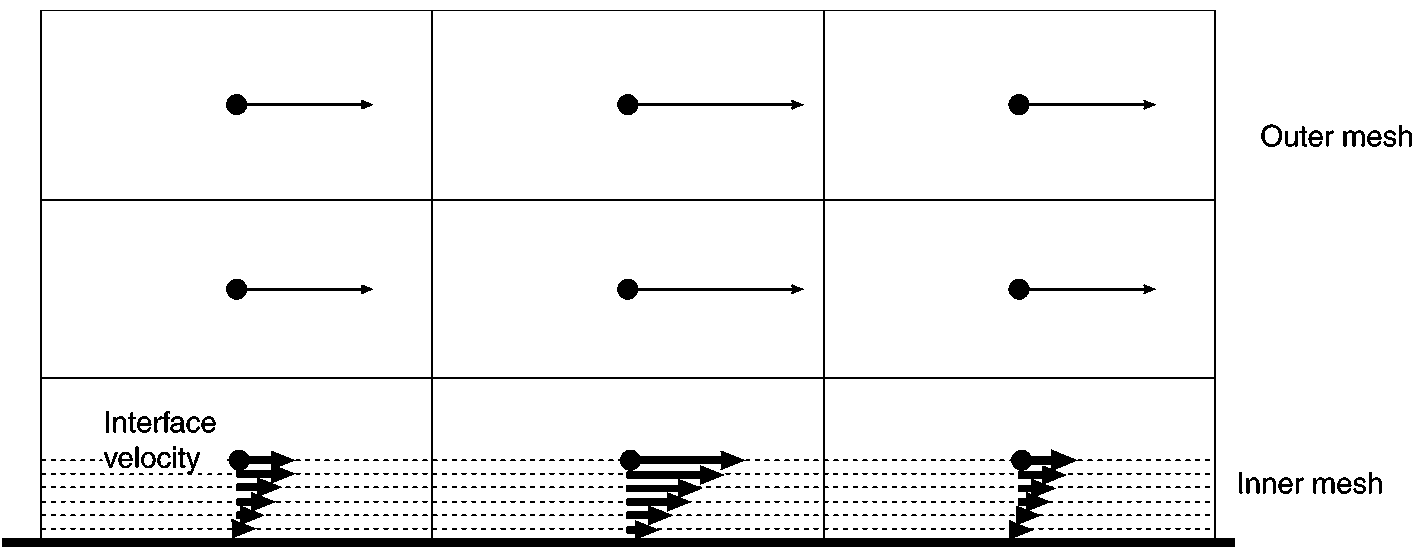 Figure: The TLM approach uses a refined nested grid to resolve the viscous effects numerically while passing stress data back to the coarse LES grid.
3. Detached-Eddy Simulation (DES)
DES is a hybrid. It uses RANS (Reynolds-Averaged Navier-Stokes) near the wall and switches to LES in regions of massive separation. It’s a "best of both worlds" strategy, though it often suffers from a "buffer layer" error where the RANS-to-LES transition isn't quite seamless.
Experimental Validation: The Backward-Facing Step
One of the most rigorous tests for these models is the backward-facing step. It involves separation, recirculation, and reattachment—a nightmare for simple equilibrium models.
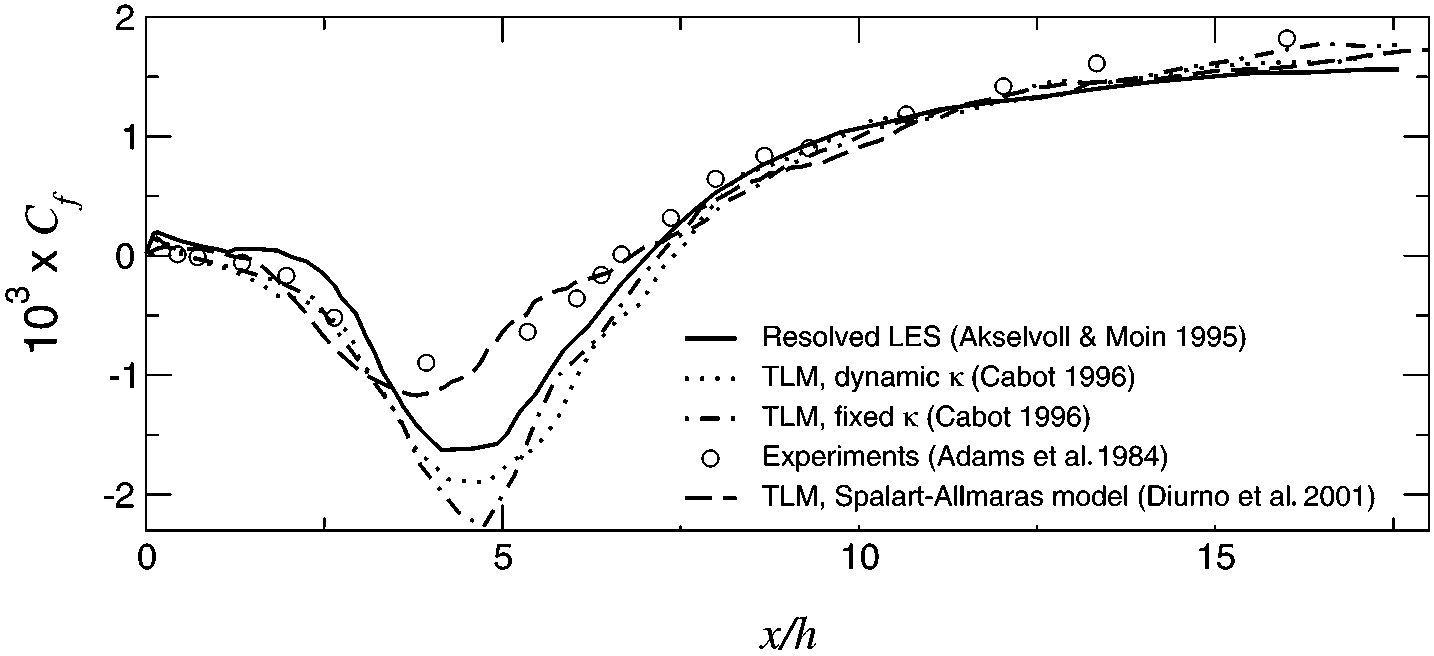 Figure: Comparison of skin friction results. Wall models successfully captured the separation bubble dynamics at a much lower cost than DNS.
The study shows that while simple log-laws fail to capture the recovery region, the Two-Layer Model responds well to outer-flow perturbations, providing a mean skin-friction coefficient within 5% of resolved data.
Critical Insight: The Transition Layer Problem
Despite the success, a "transition layer" often appears—a few grid cells where the velocity profile unphysically "kinks" as it moves from the modeled wall region to the resolved LES region. This is often due to a decorrelation between the velocity fluctuations in the RANS-like wall zone and the resolved eddies in the LES zone.
Conclusions & Future Outlook
Piomelli and Balaras conclude that while WLMs have enabled the jump to high- engineering, they are not yet universal "plug-and-play" tools.
- Successes: TLM performs excellently in rotating channels and separated flows.
- Failures: Three-dimensional, highly non-equilibrium shear flows still pose challenges.
- The Path Forward: To reach truly predictive accuracy, we must improve the interaction between the Subgrid-Scale (SGS) models and the wall-layer numerical schemes.
For the industry, this paper serves as a reminder: the "wall" is the frontier of CFD. Only by mastering these approximate boundary conditions can we hope to simulate the next generation of efficient aircraft and ships.