
World Action Models: Defining the Next Frontier in Embodied AI
World Action Models: The Next Frontier in Embodied AI
This survey formally defines and explores World Action Models (WAMs), an emerging paradigm in Embodied AI that integrates world dynamics prediction with action generation. It introduces a structured taxonomy of Cascaded and Joint WAMs, demonstrating how unified state-action modeling achieves superior generalization across diverse robotic platforms and unstructured environments.
TL;DR
The dominant paradigm for robot learning is shifting from simple "reactive" Vision-Language-Action (VLA) models to World Action Models (WAMs). While traditional VLAs map "See → Act," WAMs internalize the laws of physics to "See → Imagine → Act." This survey provides the first systematic roadmap of this field, detailing how robots can now predict their future states and use that "foresight" to navigate the complexity of the real world.
The "Reactive" Bottleneck
Despite the success of models like RT-2 and OpenVLA, robots still struggle with unexpected physical interactions. Why? Because they lack a mental model of the world. If a robot doesn't know how a glass will slide when pushed, it can only react to the visual frame it currently sees.
The authors argue that the missing ingredient is Forward Predictive Modeling. By the time a robot sees a failure, it's often too late. WAMs solve this by modeling the joint distribution of future observations and actions: .
Anatomy of a World Action Model
The survey breaks down the WAM landscape into two primary architectural families:
1. Cascaded WAMs: The "Plan then Execute" Strategy
In this setup, a generative "World Model" first synthesizes a video or latent plan of the task. A secondary "Action Model" (Inverse Dynamics) then looks at this plan and asks: "What motor commands do I need to make this video a reality?"
- Pros: Highly interpretable; can utilize massive, action-free internet videos.
- Cons: Prone to "semantic drift" or hallucinations in the video component.
2. Joint WAMs: Unified Physical Reasoning
Joint WAMs are the cutting edge. They use a single backbone—often a Diffusion Transformer (DiT)—to simultaneously denoise both the future image and the robot's actions. This forces the model to learn the intrinsic coupling between its movements and the environment's reaction.
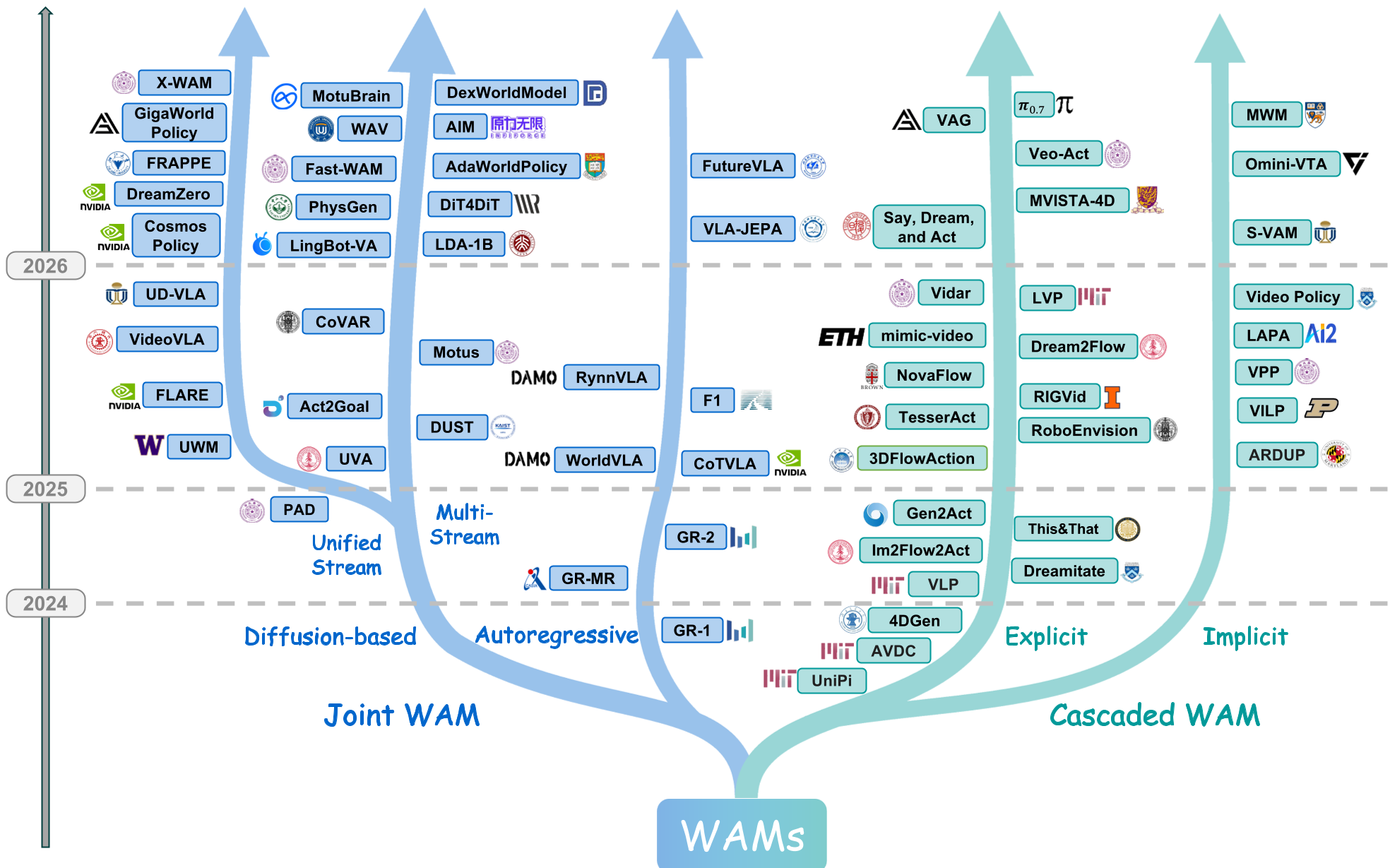 Figure 1: The evolutionary path from traditional VLAs to Cascaded and Joint World Action Models.
Data: The Fuel for Physical Foresight
A WAM is only as good as the physics it has seen. The paper identifies four critical data streams:
- Robot Teleoperation: Perfect but expensive.
- Simulation: Infinite scale but suffers from the "sim-to-real" gap.
- Portable Human Demos (UMI): The "Goldilocks" data—diverse, real-world, and relatively cheap to collect.
- Internet Video: The secret weapon for teaching robots "passive physics" (e.g., gravity and fluid dynamics).
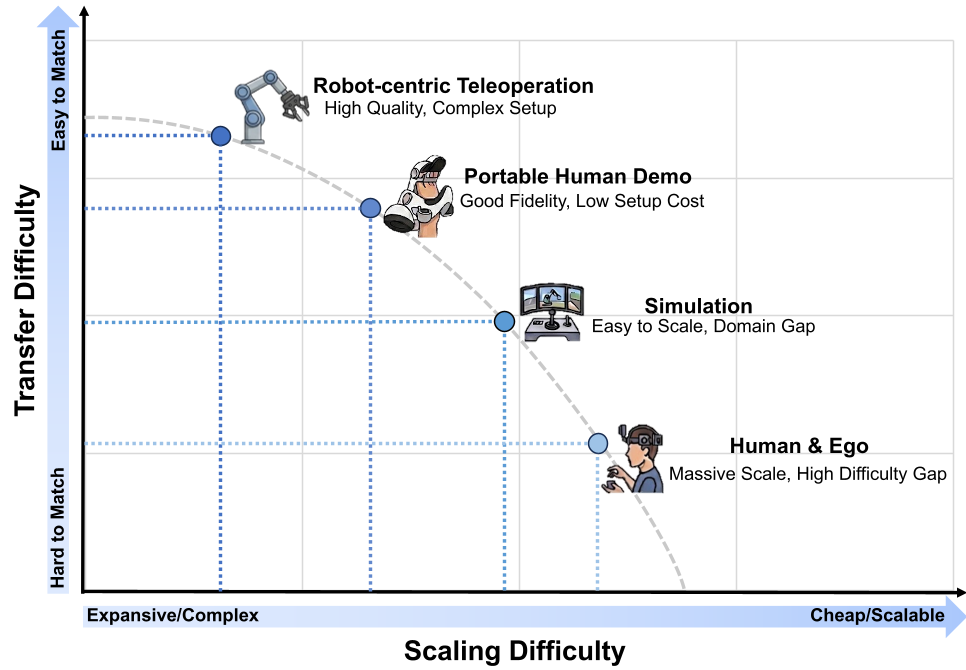 Figure 2: Scaling vs. Transfer Difficulty across different Embodied AI data sources.
Critical Analysis: Is Video Necessary?
One of the paper's most salient insights is the "Action Plausibility" challenge. A world model can generate a visually stunning 4K video of a robot picking up a cup, but if that video ignores the subtle contact wrenches or frictional forces required, it is useless for control.
The survey points toward Latent-space WAMs (using JEPA-style architectures) as a potential solution. These models predict abstract representations of the future rather than raw pixels, potentially focusing more on "actionable dynamics" and less on irrelevant background textures.
Future Outlook and Challenges
- The Latency Tax: Diffusion-based foresight currently runs at ~7Hz. For high-speed manipulation, we need to push this toward 50Hz+.
- Hidden Physics: Visual WAMs are often "blind" to tactile and force signals. The next generation must be truly multimodal.
- Long-Horizon Drift: Imagining 1 second into the future is easy; imagining 1 minute of complex assembly without the "mental image" breaking down remains a massive hurdle.
Conclusion
World Action Models represent the transition from robots that mimic to robots that understand. By unifying predictive physics with motor control, WAMs provide the cognitive foundation necessary for truly general-purpose robotic agents.
For a deeper dive into specific model performance, see the OpenMOSS Awesome-WAM Repo.